
When Your Toddler Will Not Sit Still for a Book
A toddler who walks away after two pages, stands to look, returns to one picture, or does not answer questions is not necessarily “bad at reading.” At this age, shared reading can be one short moment of joint attention: the child notices something, the adult responds, and the activity ends when interest is gone.
| Suggested age | One reading moment | Must finish the book? | Must sit still? |
|---|---|---|---|
| About 18 months–3 years | 1–8 minutes | No | No |
Begin with One Page
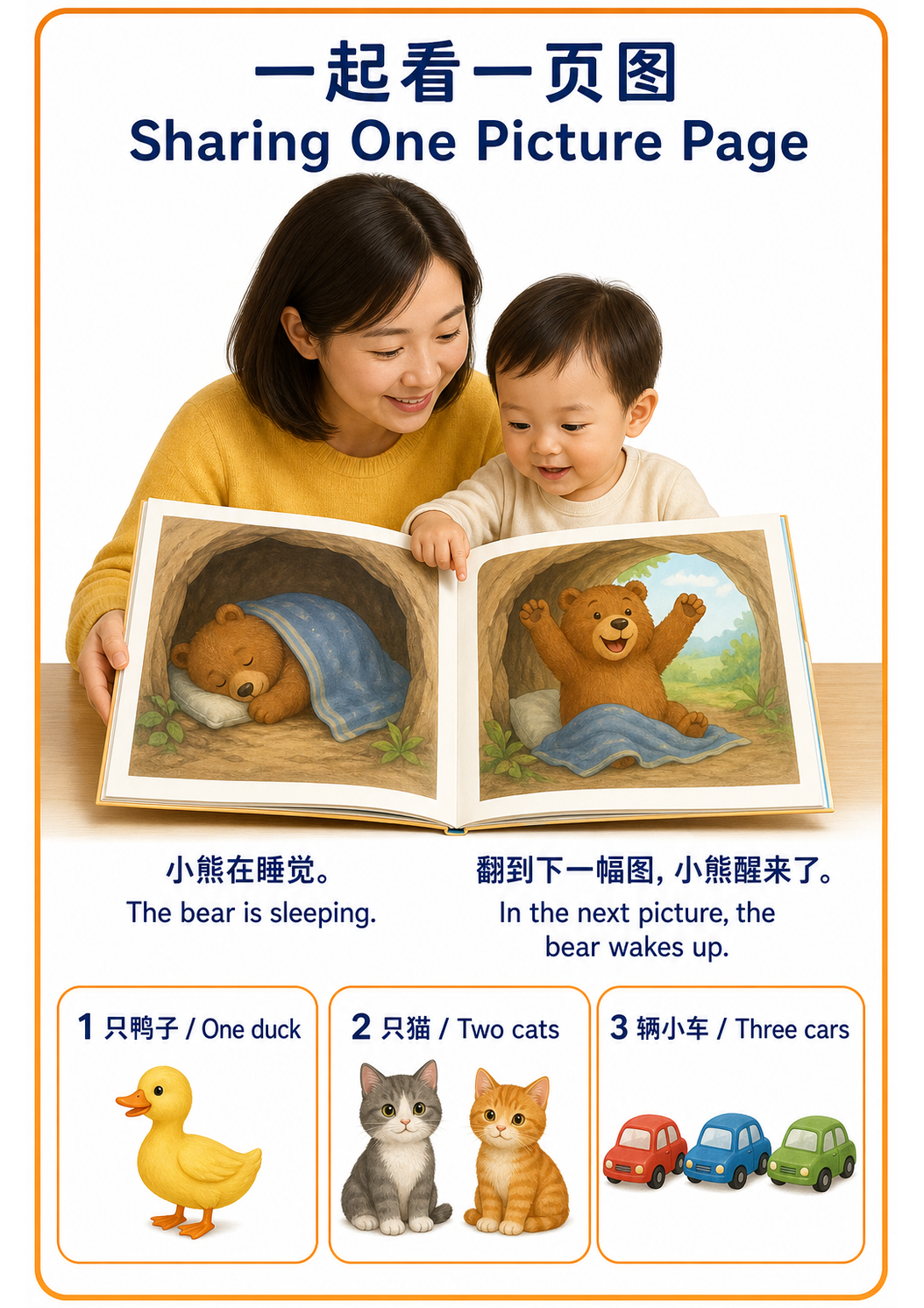
Open the A4 shared-reading picture
This picture resembles an open book: the bear sleeps on the left and wakes on the right. The adult needs only two sentences:
- “The bear is sleeping.”
- “Now the bear is awake.”
Then pause and notice where the child's attention goes next.
Four Ways That Still Count as Shared Reading
Looking while standing or moving
A child may stand beside the table, lean in for one look, leave, and return. When the environment is safe, there is no need to repeatedly pull the child back into a “reading posture.”
Staying with one page or detail
If the child notices only the bear's eyes, describe the eyes. If the child points only to a car at the bottom, respond to the car. Following present interest makes back-and-forth interaction more likely than insisting on the planned text.
Hearing one sentence without answering
Quiet, looking, touching the page, vocalising, and turning away are all useful signals. Wait a few seconds before adding another question.
Returning several times in one day
Ten seconds in the morning, another quick look later, and one sentence at bedtime can become the day's reading experience. One continuous sitting is not the only measure of quality.
Replace “What Is This?” with Description
Repeated questions can make book sharing feel like an assessment. Try these swaps:
| Use less often | Try instead |
|---|---|
| “What is this?” | “I see a bear who is sleeping.” |
| “What happened to the bear?” | “The bear's eyes are closed.” |
| “Do you remember?” | “We saw this picture before.” |
| “Say it.” | “I will say it slowly once.” |
Answer the child's own questions, of course. The aim is simply to reduce adult-led rapid-fire testing.
Signs of Participation
- Looking at one place on the page.
- Giving the book to an adult or pushing it away.
- Responding with a point, movement, expression, or sound.
- Saying one word, related or apparently unrelated.
- Leaving and coming back.
These signals help the adult decide whether to describe, turn a page, or finish.
This guide is adapted from our Sharing One Picture Page family record.
Record only one thing today
Write down the picture where the child paused and one sentence the adult used in response. Avoid scoring reading time, correct answers, or sitting posture.
Safety and Development Boundary
Important note
This page offers a family activity idea, not a developmental test or individual professional advice. The adult should assess the child, materials, and environment, and finish when the child signals stop. Discuss persistent concerns with a qualified professional.
How This Guide Was Made
This page uses the linked original family diary and picture as its experience base, with factual checks against public sources. AI assisted with structure and bilingual editing. It is not medical, psychological, or therapeutic advice. Read the editorial and fact-checking policy.
Further Reading
- Center on the Developing Child at Harvard University: Serve and return interaction
- CDC: Language and communication milestones at age 2
To place shared reading inside a light family rhythm, see A 10-Minute Daily Learning Routine.