
I Can Choose
I Can Choose
Today we introduce yes, no, and choose, then practise looking, pointing, and waiting while an adult respects either answer.
Today's Approach
Amara is about 2 years and 3 months old. Keep each guided activity to 3–8 minutes. Looking, pointing, nodding, turning away, opening a hand, or saying one word all count as meaningful responses. No is a valid response in optional play and is accepted calmly. Do not test reading, demand an explanation, or move her hand to an answer.
A4 Teaching Picture
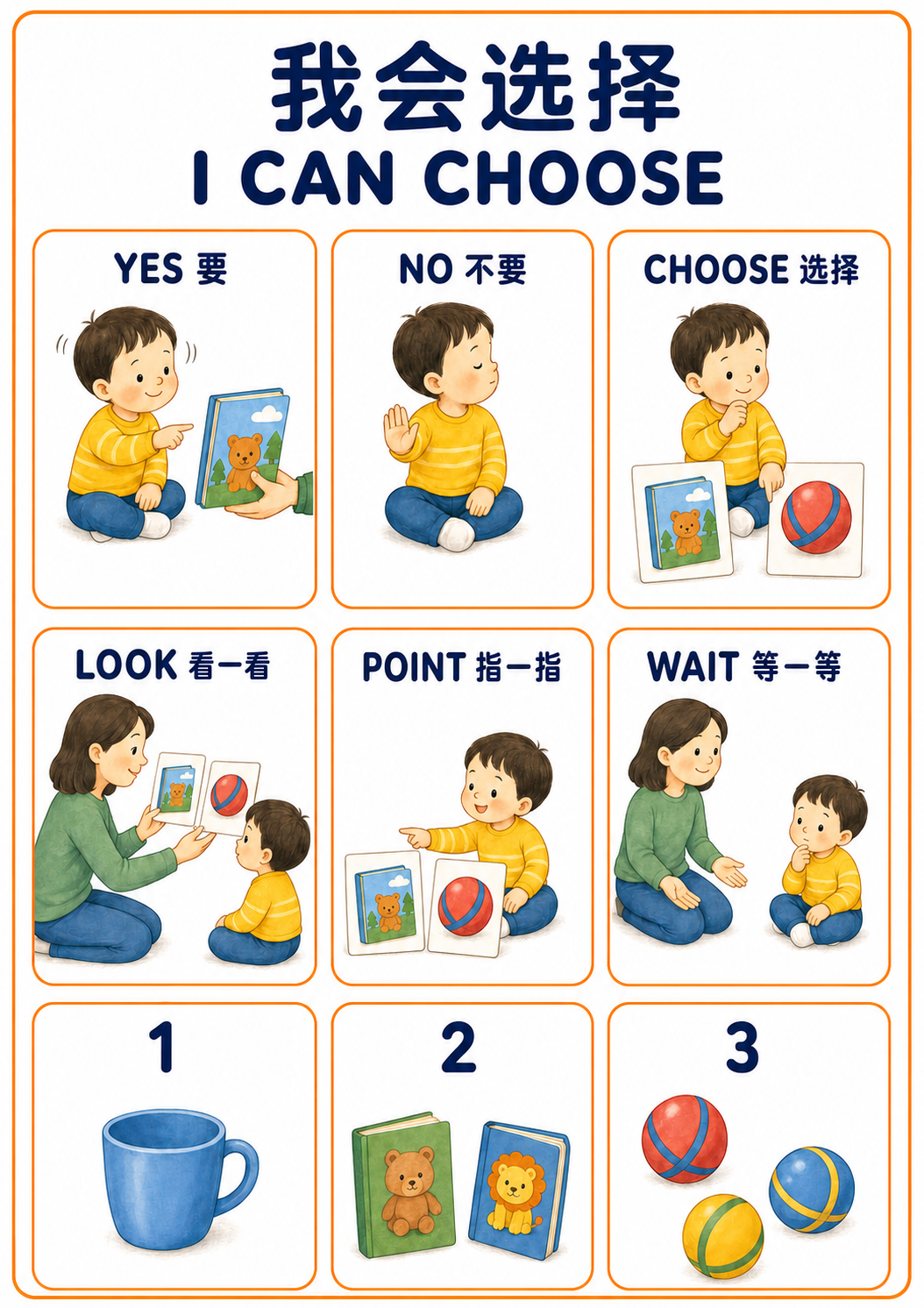
Open the original image to download or print
How to use it
Use only this A4 picture, printed or displayed full-screen. First notice yes, no, and choose. Then follow the calm actions look, point, and wait. Finish by counting only the bottom row: one cup, two books, and three balls. Amara does not need to read the labels or select every time.
Goals
- Chinese: understand 要, 不要, 选择 and 看一看, 指一指, 等一等.
- English: meet
yes,no,choose,look,point, andwait. - Social-emotional learning: experience yes and no as equally acceptable responses in optional activities.
- Early math: count one cup, two books, and three balls.
- Movement: use a small nod, open palm, point, or resting gesture to communicate.
- Life skills: make one bounded choice between two safe adult-approved options.
Materials
- Only the A4 teaching picture above, printed or displayed full-screen.
- A calm place where the adult can wait without rushing.
No choice cards, toys, food, rewards, or other teaching objects are needed.
1. Chinese Picture Talk
Time: 5–8 minutes.
Describe one card at a time:
- “小朋友想要这本书,可以表示‘要’。”
- “小朋友不想继续,可以表示‘不要’。”
- “两张图片都可以,孩子选一张。”
- “先看一看,再指一指;大人等一等。”
Choose only one or two prompts:
- “哪张图表示不要?”
- “你想先看书,还是球?”
- “你想继续,还是结束?”
If Amara turns away, closes her hand, or does not answer, name and respect it: “你现在不想选,也可以。” Silence is not treated as yes.
2. English Time
Time: 3–5 minutes.
| English | Meaning | Picture or response |
|---|---|---|
yes | 要、可以 | Point to the calm yes card |
no | 不要 | Point to the calm no card |
choose | 选择 | Look between two picture options |
look | 看一看 | Look at one or both cards |
point | 指一指 | Point if she wants to |
wait | 等一等 | Adult relaxes and gives time |
Model:
Yes, please.No, thank you.You can choose.Look and point.I can wait.
Say one line, then pause. A glance, gesture, movement away, or partial word is enough; do not require repetition.
3. Early Math: One Cup, Two Books, Three Balls
Time: 3–5 minutes.
Use only the bottom row:
- Under 1, touch the one cup once:
one cup. - Under 2, touch the two books one at a time:
one, two. - Under 3, touch the three balls one at a time:
one, two, three.
Count each whole picture once. Do not count cup handles, cover pictures, ball stripes, or printed numerals.
4. Movement: Yes, No, or Rest
Time: 3–5 minutes.
Move away from the screen:
- A small nod or open hand may mean
yes. - A still open palm, head turn, or step back may mean
no. - A point may show a choice.
- Resting without choosing is also allowed.
Do not insist on a standard gesture. The adult observes the whole response and stops if Amara disengages.
Choice and Consent
Offer choices only when both options are genuinely safe and acceptable. Never force a hand, repeat a question until the preferred answer appears, or use a reward for saying yes. Optional play stops on refusal. Health, car-seat use, road safety, and other essential care remain adult responsibilities and are not presented as false choices.
5. Everyday Connection
During a routine that already allows a choice, offer only two options:
- “先看书,还是先听歌?”
This book or that book?You can say no.
Wait quietly for a look, point, word, or no response. The adult accepts the answer and does not add more options.
Bedtime Recall
- “今天怎样表示要或不要?”
- “大人等一等时,孩子可以做什么?”
Yes, no, or choose?- “不想继续时可以怎样表示?”
Model a calm no without asking Amara to perform it.