First & Then
First & Then
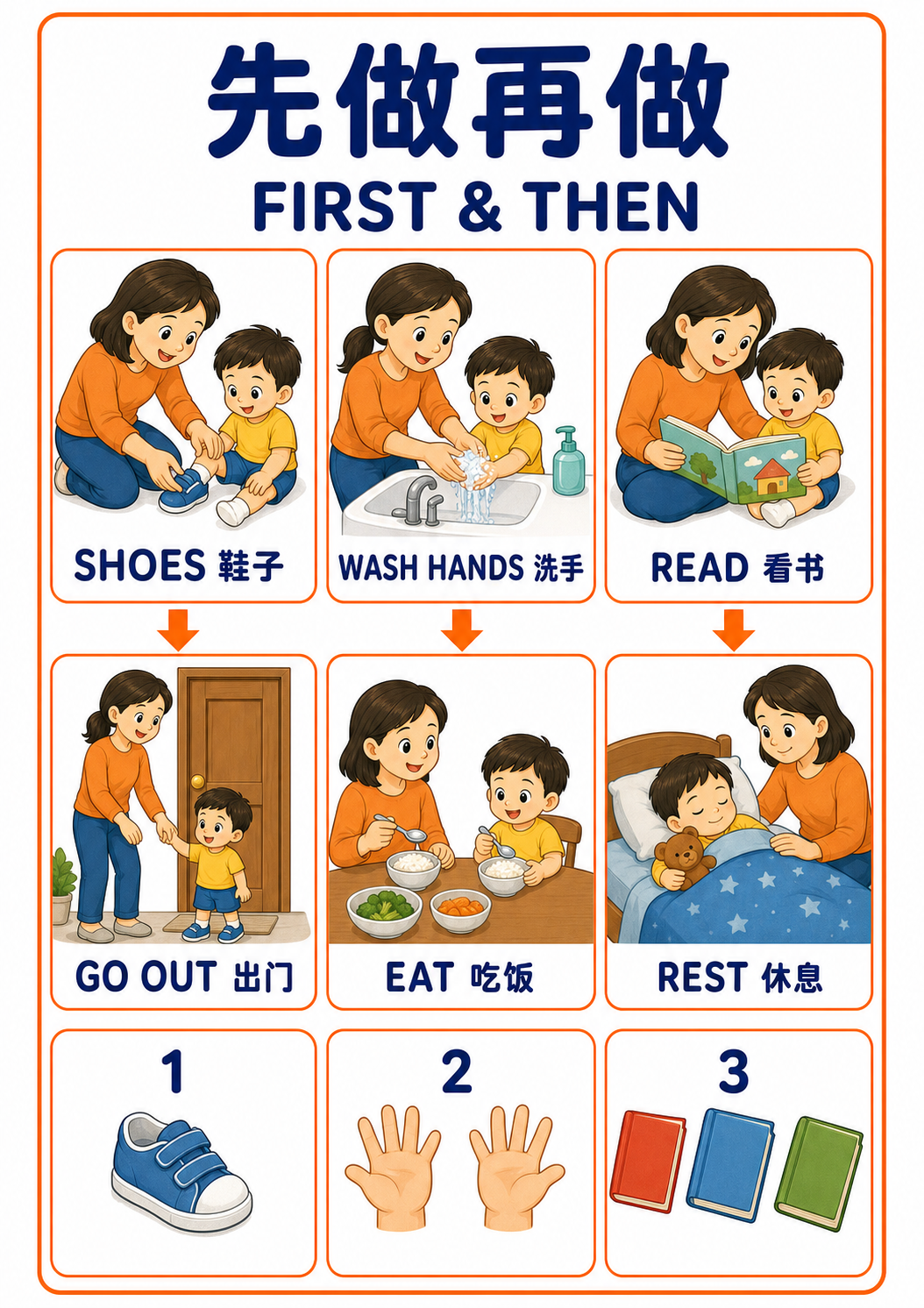
Today we look at three familiar two-step examples: shoes then go out, wash hands then eat, and read then rest. The adult chooses one pair and supplies the order words.
Today's Approach
Amara is about 2 years and 3–4 months old. Keep each guided activity to 3–8 minutes. Looking, pointing to one picture, following an arrow, copying an action, making a sound, or saying one word all count as meaningful responses. This introduces two-step language; it is not a memory or sequencing test.
A4 Teaching Picture
Open the original image to download or print
How to use it
Print in colour on portrait A4 paper with “Fit to page” selected, or show it full-screen. Choose only one column. Name the top picture with first, trace the arrow, and name the bottom picture with then. Count only the bottom numbered row. Amara does not need to read, remember the pair, arrange cards, or complete all three sequences.
Goals
- Chinese: hear 先 and 再 in three clear, familiar two-step examples.
- English: meet
first,then,shoes,wash hands,read,go out,eat, andrest. - Cognition: visually follow one arrow from a first picture to a then picture.
- Early math: touch exactly one shoe, two open hands, and three closed books in the bottom row.
- Movement: copy one first action and one then action.
- Life skills: hear a calm two-step cue during an adult-led routine.
Materials
- Only the A4 teaching picture above, printed or displayed full-screen.
- No sequence cards, shoes, book, food, sink, or other object is required.
1. Chinese Picture Talk
Time: 5–8 minutes.
Choose one column and describe it:
- “先穿鞋,再和大人出门。”
- “先洗手,再坐好吃饭。”
- “先看一会儿书,再休息。”
- “箭头从先做的图片走到再做的图片。”
Choose one prompt:
- “你想看哪一组?”
- “这条箭头走到哪里?”
- “先洗手,再做什么?”
If Amara points only to the second picture, name it without correcting: “你找到‘再吃饭’了。”
2. English Time
Time: 3–5 minutes, focused on listening, pointing, and one arrow.
| English | Meaning | Picture or response |
|---|---|---|
first | 先 | Point to one top card |
then | 再 | Follow its arrow down |
shoes / go out | 鞋子 / 出门 | Use the first column |
wash hands / eat | 洗手 / 吃饭 | Use the second column |
read / rest | 看书 / 休息 | Use the third column |
Use one short pair:
First shoes, then go out.First wash hands, then eat.First read, then rest.First this, then that.
Say only one pair at a time. Accept a look, point, partial arrow trace, action, sound, or one word. Do not ask Amara to repeat the order from memory.
3. Early Math: Shoe, Hands, Books
Time: 3–5 minutes.
Use only the bottom cards:
- Under 1, touch the one shoe once and say
one shoe. - Under 2, touch the two open hands one at a time and say
one, two. - Under 3, touch the three separate closed books one at a time and say
one, two, three.
Do not count fingers, pages, people, bowls, or pictures in the sequence cards. The aim is one touch for one whole pictured item, not numeral recognition.
4. Movement: First One, Then One
Time: 3–5 minutes.
Choose one simple pair:
First shoes— tap one foot.Then go out— offer a hand to the adult and take two indoor steps.
Or:
First wash hands— rub empty hands gently.Then eat— pretend to bring an empty spoon towards the table, not the mouth.
One pair is enough. The adult models; Amara does not need to perform it in order.
5. Life Skill: Adult Gives a Two-Step Cue
Time: 3–5 minutes during a routine that is already happening.
The adult may use one calm, immediate pair:
- “先坐下,再穿袜子。”
First wait, then we go together.
The adult remains responsible for the whole routine and offers help after each step. If Amara does the second step first or stops after one, describe what happened and continue without correction pressure.
Sequence and Routine Safety
The picture pairs do not grant independence. Going out, washing at a sink, eating, and resting remain adult-supervised. Keep real directions immediate, safe, and limited to two small steps. Never use access to food, comfort, toileting, or affection as a reward for compliance.
Bedtime Recall
- “今天看了哪一组先和再?”
- “先洗手,再吃饭,这句话听起来熟悉吗?”
First or then?Read or rest?
Keep it conversational. Do not ask Amara to reproduce a sequence from memory.