Where Clothes Go
Where Clothes Go
Today we follow three simple picture paths: hat to head, shirt to body, and socks to feet. The aim is familiar language and participation, not remembering a quiz answer.
Today's Approach
Amara is about 2 years and 3–4 months old. Keep each guided activity to 3–8 minutes. Looking, pointing, tracing part of a path, touching a body area over clothing, making a sound, or saying one word all count as meaningful responses. Model one pair and stop while it is enjoyable.
A4 Teaching Picture
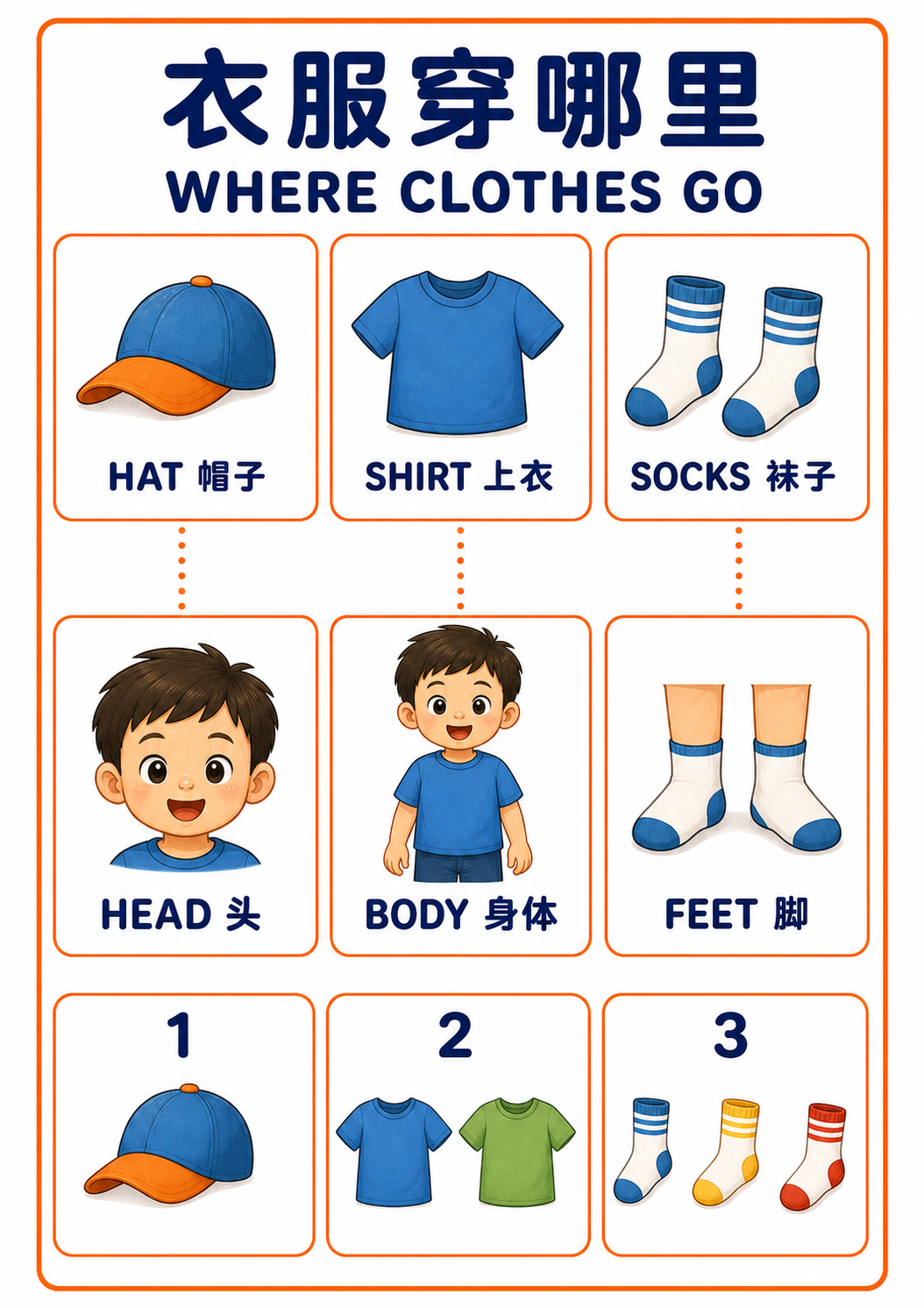
Open the original image to download or print
How to use it
Print in colour on portrait A4 paper with “Fit to page” selected, or show it full-screen. Name a hat, shirt, or socks, then trace its dotted path to head, body, or feet. Try another only if Amara remains interested. Count only the bottom row. She does not need to read, remember all three pairs, dress herself, or answer every prompt.
Goals
- Chinese: understand 帽子, 上衣, 袜子, 头, 身体, and 脚 through pictures and gestures.
- English: meet
hat,shirt,socks,head,body, andfeet. - Cognition: visually follow one dotted path between clothing and a body area.
- Early math: touch exactly one hat, two shirts, and three individual socks in the bottom row.
- Movement: copy gentle pretend putting-on actions.
- Life skills: join one adult-supported dressing step.
Materials
- Only the A4 teaching picture above, printed or displayed full-screen.
- No clothing, doll, dressing card, or other object is required.
1. Chinese Picture Talk
Time: 5–8 minutes.
Describe one pair at a time:
- “帽子戴在头上。”
- “上衣穿在身体上。”
- “袜子穿在脚上。”
- “跟着虚线,从衣服走到身体部位。”
Choose one or two prompts:
- “帽子在哪里?”
- “袜子的虚线走到哪里?”
- “你想先找头,还是脚?”
If Amara traces only part of a path, name the discovery: “你的手指走向脚了。”
2. English Time
Time: 3–5 minutes, focused on listening, pointing, and body gestures.
| English | Meaning | Response |
|---|---|---|
hat | 帽子 | Point to hat |
shirt | 上衣 | Point to shirt |
socks | 袜子 | Point to socks |
head | 头 | Gently touch own head |
body | 身体 | Place hands on own shirt |
feet | 脚 | Tap feet on the floor |
Use short chunks:
Hat on your head.Shirt on your body.Socks on your feet.Follow the dots.Where does it go?
Accept a look, point, partial trace, gesture, sound, or one word. Do not require translation or a full sentence.
3. Early Math: Hat, Shirts, Socks
Time: 3–5 minutes.
Use only the bottom cards:
- Under 1, touch the one hat once and say
one hat. - Under 2, touch the two separate shirts one at a time and say
one, two. - Under 3, touch the three separate individual socks one at a time and say
one, two, three.
The bottom shows three single socks, not three pairs. Do not count stripes, sleeves, people, or clothing in the upper cards. Do not test numeral recognition.
4. Cognition and Movement: Follow and Pretend
Time: 3–5 minutes.
- Trace hat to head, then pretend to place a hat gently on the head.
- Trace shirt to body, then touch the front of one's own shirt.
- Trace socks to feet, then tap both feet.
- Stop after one pair if Amara is satisfied.
Use empty hands and comfortable movements. Approximate actions count.
5. Life Skill: Join One Dressing Step
Time: 3–5 minutes during a routine that is already happening.
The adult may say:
Hat on.- “上衣穿在身体上。”
Socks on your feet.
The adult chooses weather-appropriate clothing and helps with balance, openings, fasteners, and fit. Amara may offer a foot, raise an arm, or simply watch.
Dressing Safety
Have the toddler sit or stay supported while dressing feet and legs. Adults check fit, temperature needs, tight elastics, cords, loose buttons, broken fasteners, and other choking or entanglement hazards. Never force a body movement or leave a child unsupervised on a raised surface.
Bedtime Recall
- “今天哪件衣服穿在头上?”
- “袜子穿在哪里?”
Hat, shirt, or socks?Head, body, or feet?
Keep it conversational. Amara may answer with a point, path trace, body gesture, sound, or one word.