
Go & Stop
Go & Stop
Today we use shoes, feet, and an adult to introduce go, stop, and slow through calm, adult-led walking in a clear indoor space.
Today's Approach
Amara is about 2 years and 3 months old. Keep each guided activity to 3–8 minutes. Looking, pointing, taking one small step, becoming still, or saying one word all count as meaningful responses. This is not a race or obedience test. The adult controls the space and pace, and no running is used.
A4 Teaching Picture
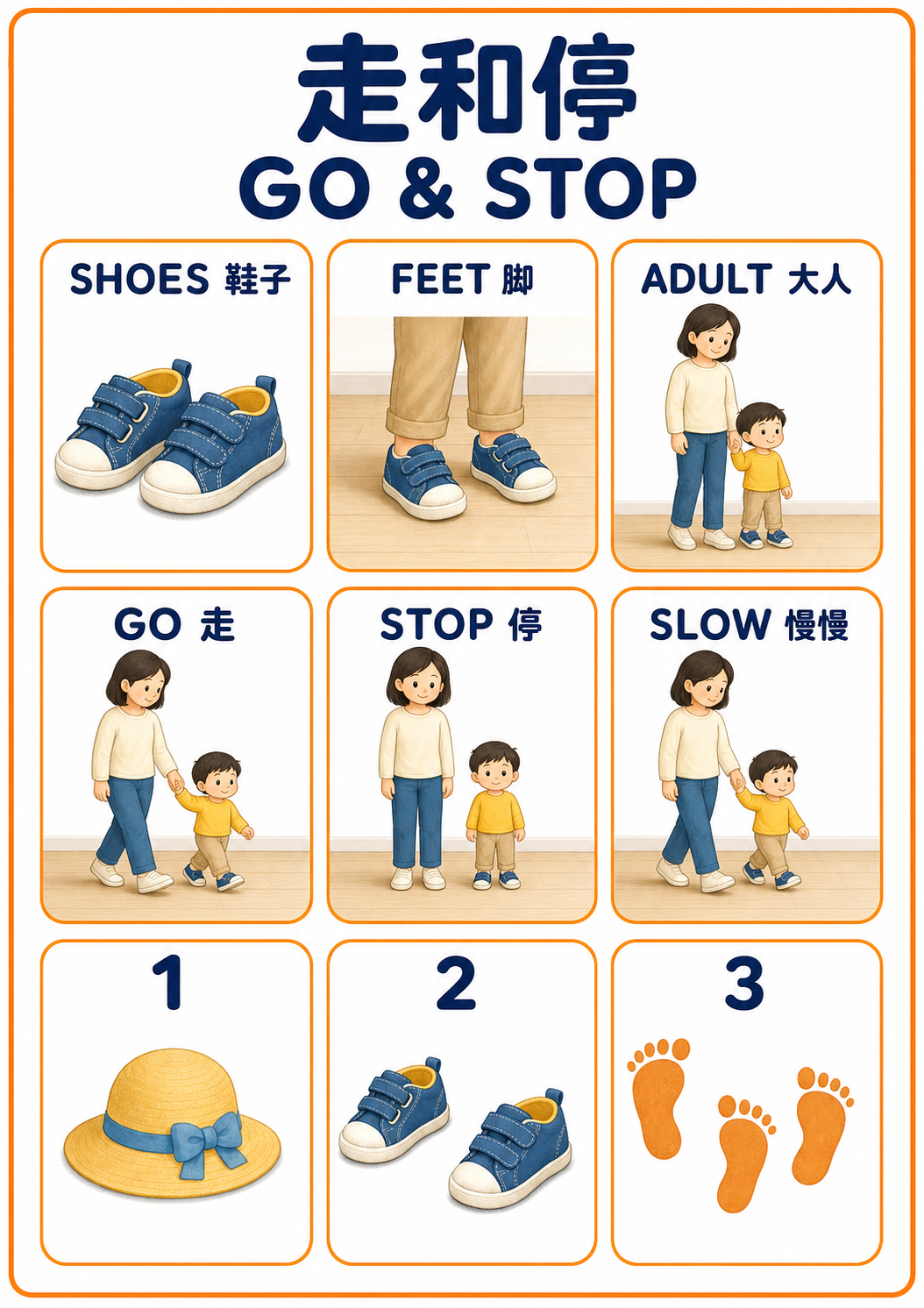
Open the original image to download or print
How to use it
Use only this A4 picture, printed or displayed full-screen. First find the shoes, steady feet, and adult. Then point to the adult and child going slowly, stopping, and walking together. Count only the bottom row: one hat, two individual shoes, and three individual footprints. Reading the labels is not required.
Goals
- Chinese: understand 鞋子, 脚, 大人 and 走, 停, 慢慢.
- English: meet
shoes,feet,adult,go,stop, andslow. - Cognition: connect a calm cue with beginning or pausing one movement.
- Early math: count one hat, two individual shoes, and three individual footprints.
- Movement: take one or two slow steps and become steady with adult support.
- Life skills: stay beside an adult during a transition.
Materials
- Only the A4 teaching picture above, printed or displayed full-screen.
- A dry, non-slip indoor space cleared of furniture and clutter.
No cones, tape lines, traffic signs, vehicles, or obstacle-course materials are needed.
1. Chinese Picture Talk
Time: 5–8 minutes.
Describe one card at a time:
- “这是鞋子,脚稳稳地站在地面上。”
- “大人在小朋友身边。”
- “听到‘走’,和大人慢慢走一步。”
- “听到‘停’,两只脚停稳。”
- “他们一直慢慢走,不冲跑。”
Choose only one or two prompts:
- “鞋子在哪里?”
- “哪一张图停下来了?”
- “你想指走,还是停?”
If Amara becomes still, name it: “你停稳了。” Do not repeat the cue until she performs.
2. English Time
Time: 3–5 minutes.
| English | Meaning | Picture or movement response |
|---|---|---|
shoes | 鞋子 | Point to the shoes |
feet | 脚 | Point to the steady feet |
adult | 大人 | Point to the adult beside the child |
go | 走 | Take one small step with the adult |
stop | 停 | Become still |
slow | 慢慢 | Move one hand slowly |
Model:
Shoes on.Feet steady.Go with me.Stop here.Walk slowly.
Say one short chunk and wait. Looking, pointing, pausing, or making part of a movement is enough.
3. Early Math: One Hat, Two Shoes, Three Footprints
Time: 3–5 minutes.
Use only the bottom row:
- Under 1, touch the one hat once:
one hat. - Under 2, touch the two shoes one at a time:
one, two. - Under 3, touch the three footprints one at a time:
one, two, three.
The bottom shows two individual shoes and three individual footprints, not pairs. Do not count straps, toes, people, or printed numerals.
4. Movement: Two Slow Steps
Time: 3–5 minutes.
Move away from the screen:
- The adult stands within reach in a clear indoor space.
- Say
Goand take one or two small, slow steps together. - Say
Stoponce and become still together. - Finish after one round, or repeat only if Amara asks.
Holding hands is optional in pretend play; close adult supervision is not optional.
Walking Safety
Use only a dry, non-slip, uncluttered indoor floor. No running, chasing, racing, sudden turns, jumping, stairs, open doors, roads, driveways, or car parks are part of this activity. The adult stays close, chooses the direction, and stops before Amara becomes excited or unsteady.
5. Everyday Connection
During a transition that is already happening:
Wait with me.Go slowly.Stop here.
At doors, lifts, stairs, and outdoors, the adult remains fully responsible and uses the safest physical connection. The picture game never means Amara may walk ahead.
Bedtime Recall
- “今天哪张图在慢慢走?”
- “听到停时,两只脚可以怎样?”
Go or stop?- “走路时谁在身边?”
Model the answer rather than asking repeatedly.