Sky Friends
Sky Friends
Today we look at the sun, clouds, and moon, then talk about clear examples of daytime, cloudy weather, and nighttime.
Today's Approach
Amara is about 2 years and 3–4 months old. Keep each guided activity to 3–8 minutes. Looking, pointing, tracing a floating motion, making a sound, or saying one word all count as meaningful responses. The pictures are conversation starters, not fixed one-to-one pairs or a memory test.
A4 Teaching Picture
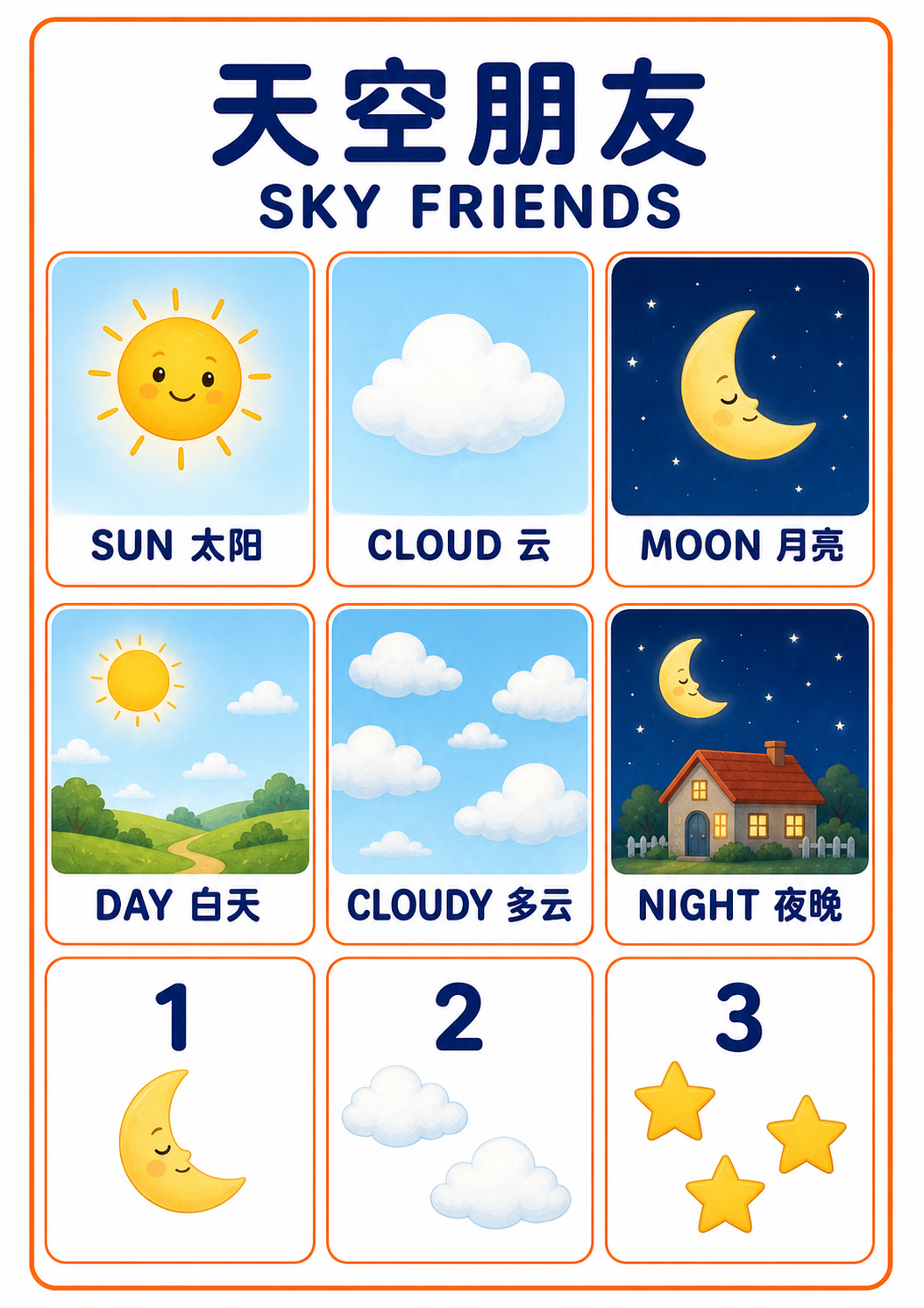
Open the original image to download or print
How to use it
Print in colour on portrait A4 paper with “Fit to page” selected, or show it full-screen. Point to the sun, cloud, and moon, then look at the daytime, cloudy, and nighttime examples. Count only the bottom row. Amara does not need to read, memorise a pairing, look at the real sun, or answer every prompt.
Goals
- Chinese: understand 太阳, 云, 月亮, 白天, 多云, and 夜晚 through clear sky pictures.
- English: meet
sun,cloud,moon,day,cloudy, andnight. - Cognition: notice that the sky can look different across time and weather.
- Early math: touch exactly one moon, two clouds, and three stars in the bottom row.
- Movement: copy gentle rising, floating, and resting gestures.
- Safety: observe the sky without looking directly at the sun.
Materials
- Only the A4 teaching picture above, printed or displayed full-screen.
- No outdoor observation, binoculars, telescope, or other object is required.
1. Chinese Picture Talk
Time: 5–8 minutes.
Describe one card at a time:
- “太阳让白天很明亮,但眼睛不能直接看太阳。”
- “云会在天空中慢慢移动。”
- “夜晚常常能看到月亮和星星。”
- “月亮有时白天也能看到,云在白天或夜晚都可能出现。”
Choose one or two prompts:
- “云在哪里?”
- “哪张图是夜晚?”
- “你想先看太阳,还是月亮?”
The poster gives clear examples only. Do not treat DAY, CLOUDY, and NIGHT as fixed matches Amara must remember.
2. English Time
Time: 3–5 minutes, focused on listening, pointing, and gestures.
| English | Meaning | Response |
|---|---|---|
sun | 太阳 | Point to the poster |
cloud | 云 | Trace a slow floating motion |
moon | 月亮 | Make a crescent with one hand |
day | 白天 | Open both hands gently |
cloudy | 多云 | Move hands slowly across |
night | 夜晚 | Rest cheek on joined hands |
Use short chunks:
The sun is up.Clouds float.The moon is out.It is daytime.It is nighttime.
Accept a look, point, gesture, sound, or one word. Do not ask for translation or a complete sentence.
3. Early Math: Moon, Clouds, Stars
Time: 3–5 minutes.
Use only the bottom cards:
- Under 1, touch the one crescent moon once and say
one moon. - Under 2, touch the two separate clouds one at a time and say
one, two. - Under 3, touch the three separate stars one at a time and say
one, two, three.
Do not count rays, tiny stars, clouds, or windows in the upper pictures. The aim is one touch for one bottom-row item, not numeral recognition.
4. Movement: Rise, Float, Rest
Time: 3–5 minutes.
Move away from the screen:
Sun— slowly raise both hands to shoulder height.Cloud— float both hands gently from side to side.Moon— curve one arm like a crescent.Night— become still and rest.
Keep movements small and calm. One gesture is enough.
5. Everyday Connection: Safe Sky Talk
Time: 3–5 minutes if a natural view is available.
From indoors or a shaded safe place, the adult may describe a cloud, brightness, or the moon without asking Amara to search for the sun. The poster alone is also enough.
Sun and Viewing Safety
Never stare at the sun, even through clouds, sunglasses, a camera, binoculars, or a telescope. Do not direct optical equipment towards the sun. The adult chooses a safe viewing position and points to the poster rather than asking the toddler to find the sun in the real sky.
Bedtime Recall
- “今天看到了哪些天空朋友?”
- “云可以什么时候出现?”
Sun, cloud, or moon?Day or night?
Keep it conversational. Amara may answer with a point, movement, sound, or one word.