Full & Empty
Full & Empty
Today we look at cups, baskets, and bowls, then compare a container that has large blocks inside with one that has nothing inside.
Today's Approach
Amara is about 2 years and 3 months old. Keep each guided activity to 3–8 minutes. Looking, pointing, opening the hands, touching a picture, or saying one word all count as meaningful responses. “Full” and “empty” are introduced through clear pictures, not pouring or filling practice. Do not test reading or demand a verbal comparison.
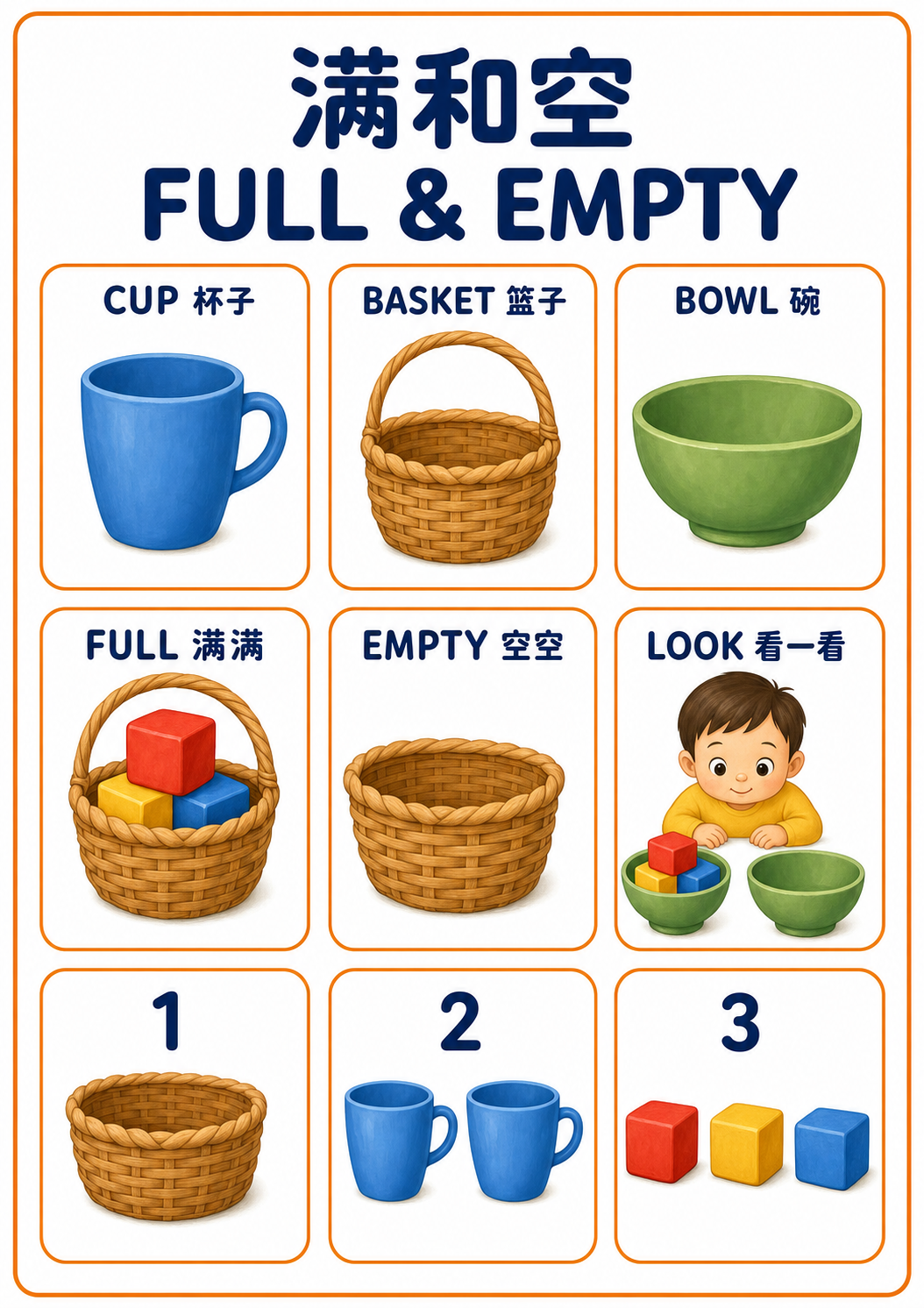
A4 Teaching Picture
Open the original image to download or print
How to use it
Use only this A4 picture, printed or displayed full-screen. First find the cup, basket, and bowl. Then notice the full basket, empty basket, and the child looking at one full and one empty bowl. Count only the bottom row: one basket, two cups, and three large blocks. Reading the labels is not required.
Goals
- Chinese: understand 杯子, 篮子, 碗 and 满满, 空空, 看一看.
- English: meet
cup,basket,bowl,full,empty, andlook. - Cognition: notice whether a pictured container has objects inside.
- Early math: count one basket, two cups, and three large blocks.
- Movement: show full and empty with small open-hand gestures.
- Life skills: hear full/empty language during one ordinary adult-led routine.
Materials
- Only the A4 teaching picture above, printed or displayed full-screen.
- A clear place to sit or stand for hand gestures.
No container, liquid, food, block, or pouring activity is needed.
1. Chinese Picture Talk
Time: 5–8 minutes.
Describe one card at a time:
- “这是一个杯子。”
- “这是一个篮子。”
- “这是一个碗。”
- “篮子里有大积木,是满满的。”
- “这个篮子里面没有东西,是空空的。”
Choose only one or two prompts:
- “空篮子在哪里?”
- “哪个里面有积木?”
- “你想看满满的,还是空空的?”
If Amara only looks, expand it: “你在看空空的篮子。” A point, glance, or gesture already counts.
2. English Time
Time: 3–5 minutes.
| English | Meaning | Picture response |
|---|---|---|
cup | 杯子 | Point to the blue cup |
basket | 篮子 | Point to the open basket |
bowl | 碗 | Point to the green bowl |
full | 满满 | Point to the basket with blocks |
empty | 空空 | Point to the basket with nothing inside |
look | 看一看 | Look between the two bowls |
Model:
A cup.A basket.A bowl.It is full.It is empty.Look inside.
Say one short line, then wait. Looking, pointing, moving the hands, or saying part of a word is enough.
3. Early Math: One Basket, Two Cups, Three Blocks
Time: 3–5 minutes.
Use only the bottom row:
- Under 1, touch the one basket once:
one basket. - Under 2, touch the two cups one at a time:
one, two. - Under 3, touch the three blocks one at a time:
one, two, three.
Count each whole object once. Do not count cup handles, basket weaving, block faces, or objects in the upper rows, and do not test numeral recognition.
4. Movement: Full Hands, Empty Hands
Time: 3–5 minutes.
Move away from the screen:
- Cup both empty hands together as if they were a bowl.
- Bring the hands gently towards the body for
full. - Open the empty palms for
empty. - Rest both hands on
stop.
This is pretend play with empty hands. Exact gestures and words are not required.
Container and Object Safety
Do not use hot liquid, glass, food, water, or small loose objects for this lesson. Do not ask Amara to fill, empty, carry, or pour from a real container. If full/empty language appears in daily life, an adult controls the object and keeps it stable and out of the walking path.
5. Everyday Connection
Notice one safe example that already occurs:
- An adult shows an empty laundry basket before using it.
- An adult says a closed storage basket is full and handles it.
- At the end of picture time, say,
All done. The table is empty.
Describe rather than quiz. Do not create a spill or empty objects out for practice.
Bedtime Recall
- “今天哪个篮子是空空的?”
- “哪个里面有积木?”
Full or empty?Cup, basket, or bowl?
Point to the answer together if Amara does not respond.