
Shape Learning for 2-Year-Olds with One Printable A4 Picture
A two-year-old does not need to begin shape learning by memorising sides and corners. A more natural starting point is noticing a round clock, a square-like window, and a pointed roof while an adult adds the shape word to what the child is already seeing.
| Suggested age | Activity time | Materials | Main experience |
|---|---|---|---|
| About 2–3 years | 5–10 minutes | One A4 picture | Look, point, trace, and find |
Free A4 Shape Picture
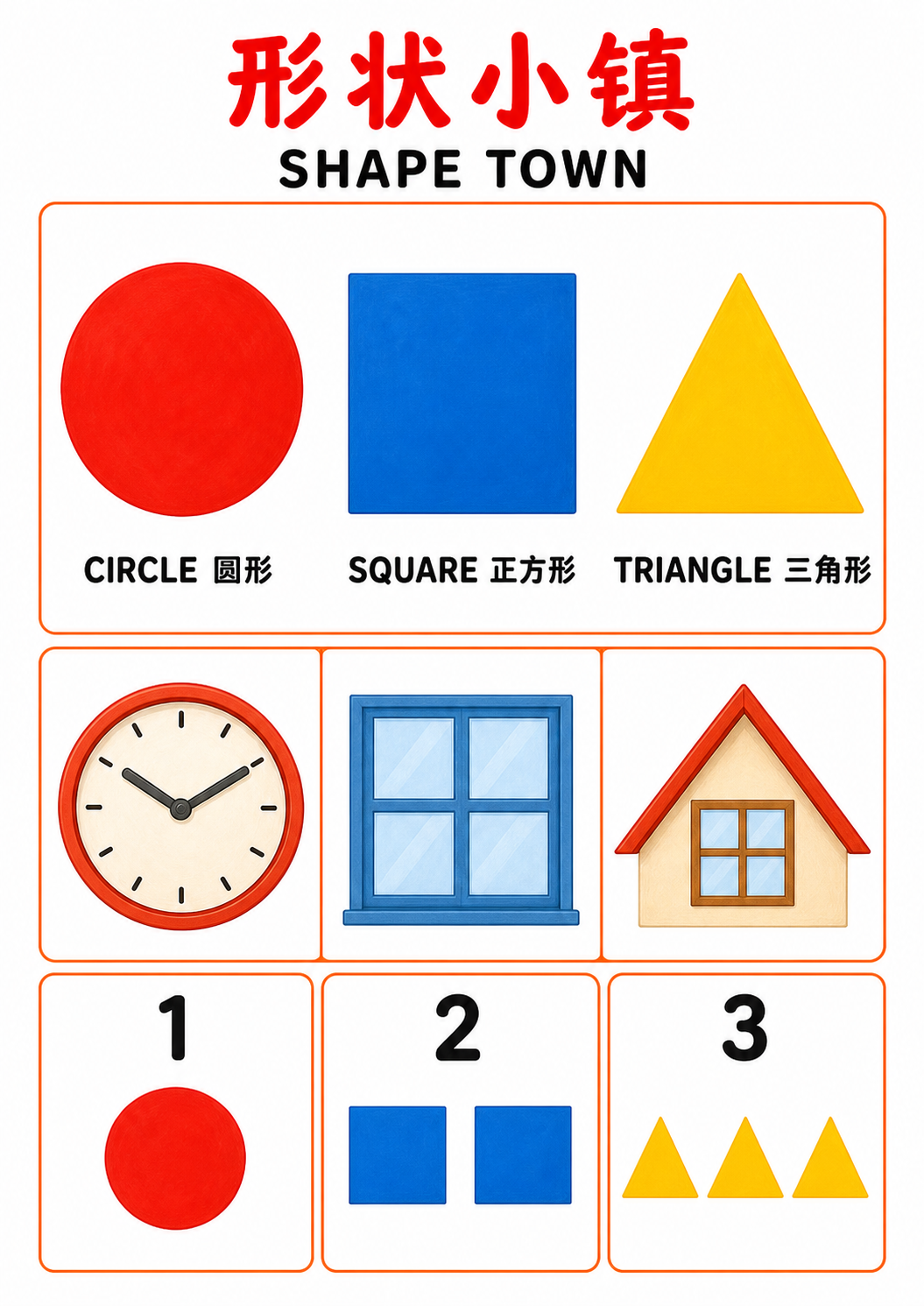
Open the high-resolution picture to download or print
Print it in colour on portrait A4 paper with “Fit to page” selected. If a printer is not available, look at the picture briefly on a screen, then move the device to a safe place before trying the movement ideas.
Why Begin with Three Shapes
Circles, squares, and triangles look noticeably different and are easy to connect with familiar objects. The aim is not to test whether a child can say each name. It is to build three kinds of experience:
- Hearing a shape word beside a meaningful object.
- Noticing a curve, a straight edge, or a pointed top with eyes and fingers.
- Finding everyday objects that “look round” or “have a triangle-like point.”
A Simple Three-Step Activity
1. Describe what the child notices
Begin without a question. When the child looks at the clock, say, “A round clock.” At the window, say, “A square window.” At the roof, say, “The roof has a triangle point.”
Use one sentence and wait. Looking again, pointing, vocalising, or leaving are all information about what to do next.
2. Let one finger travel around the outline
- Circle: travel around one continuous curve.
- Square: move along a straight edge and pause at a turn.
- Triangle: travel from the bottom to the pointed top and back down.
Model first. An incomplete trace, the opposite direction, or one quick touch can all be enough for today.
3. Find one “shape-like” object nearby
There is no need for a separate test. During a walk or tidy-up, say, “That wheel looks round,” or, “The roof has a pointed part.”
Everyday objects are rarely perfect geometric examples. Language such as “looks like a circle” is often more accurate than forcing every object into a category.
Ready-to-Use Parent Phrases
- “I see a round clock.”
- “Your finger reached a corner.”
- “This roof has a pointed top.”
- “You found something that looks round.”
- “We can finish here today.”
Record an Observation, Not a Score
After the activity, write down one concrete detail: where the child looked first, whether tracing was interesting, or which sentence held attention a little longer. Avoid turning that moment into a final judgment about what the child “can” or “cannot” do.
This guide is adapted from our fuller Shape Town family activity record. The diary keeps the original plan; this version keeps the parts that another family can use quickly.
Safety and development note
This activity is not a developmental test. Use a clear, non-slip area for whole-body movement, and finish when the child leaves or signals no.
How This Guide Was Made
This page uses the linked original family diary and picture as its experience base, with factual checks against public sources. AI assisted with structure and bilingual editing. It is not medical, psychological, or therapeutic advice. Read the editorial and fact-checking policy.
Further Reading
- CDC: Milestones and family activities for 2-year-olds
- NAEYC: Supporting early maths through everyday maths talk
Next, try Toddler Maths Without Special Toys, or browse the Free Printable A4 Activity Pack.