
Toddler Maths Without Special Toys: Begin with 1, 2, and 3
Early maths does not have to look like schoolwork. Phrases such as “one cup,” “two shoes,” and “one more” already help a two-year-old notice quantity, matching, size, position, and sequence.
This activity begins with 1, 2, and 3 using one picture—no number cards, special toys, or worksheets.
| Suggested age | Time | Materials | Adult's job |
|---|---|---|---|
| About 2–3 years | 3–8 minutes | One A4 picture | Point one-to-one and describe naturally |
Free 1, 2, 3 Picture
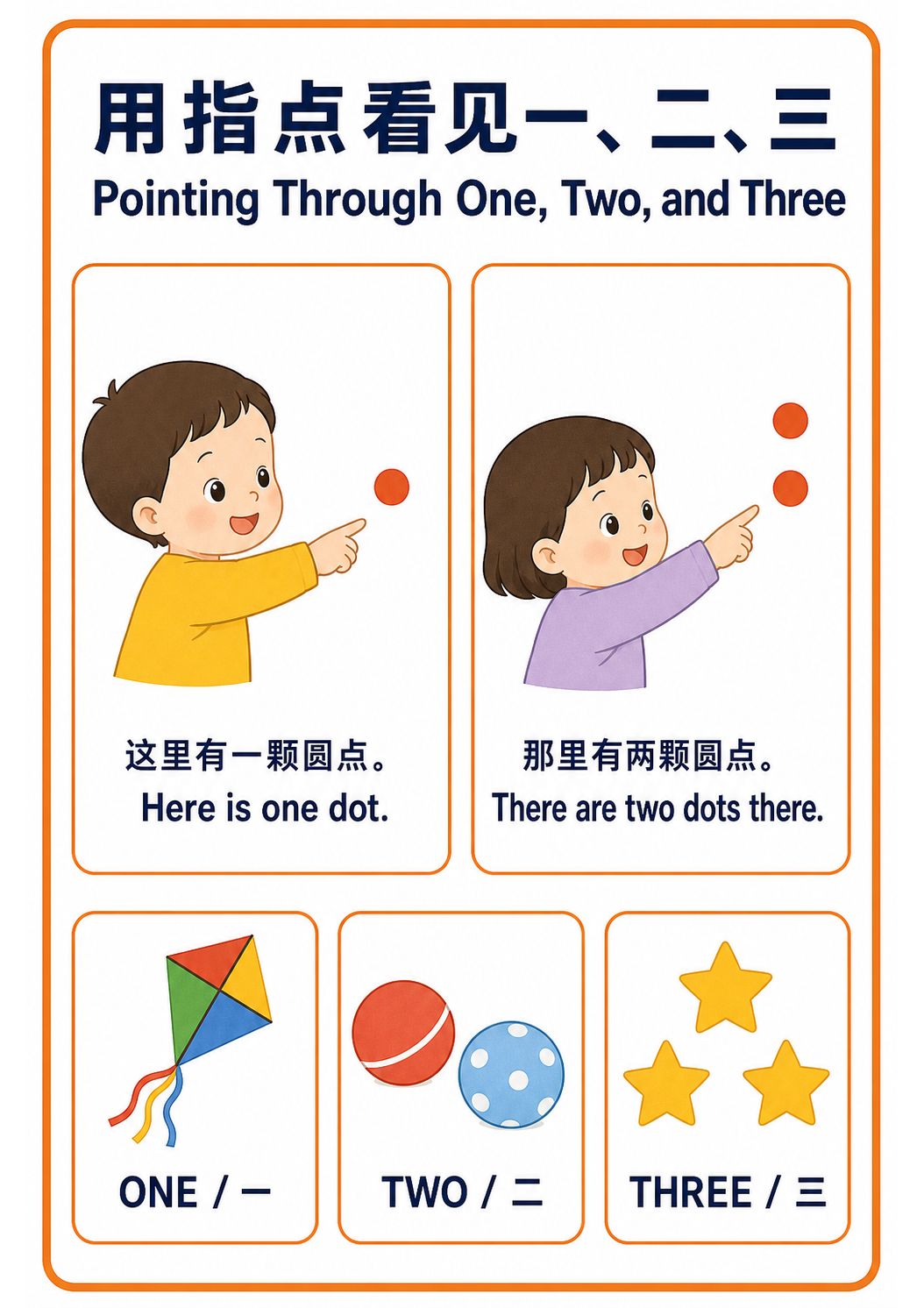
Open the high-resolution picture to download or print
First: Match One Touch to One Object
Use the three separate cells along the bottom:
- Touch the one kite once and say “one.”
- Touch each of the two balls once while saying “one, two.”
- Touch each of the three stars once while saying “one, two, three.”
Avoid jumping the finger back and forth between objects. The child does not have to count aloud. Coordinating one object, one touch, and one number word is the useful experience here.
Next: Put Maths into Ordinary Life
Choose one or two natural moments during the day:
- Getting dressed: “One shoe. Here is the other shoe.”
- Snack time: “There are two pieces on the plate.”
- Stairs: “This step, then the next step.”
- Tidying: “The cup is inside the box. The spoon is beside it.”
Maths language includes more than number words: big and small, above and below, inside and outside, same and different, first and next.
Describe More, Quiz Less
A chain of “How many?” and “What number is this?” can quickly turn the interaction into a test. Replace most questions with descriptions:
- “There are two balls here.”
- “This group has one more.”
- “The two stars are far apart, but there are still two.”
- “You put the cup beside the plate.”
When you do ask an open question, leave enough time and allow no answer.
Common Mix-Ups
Treating the counting sequence as quantity understanding
A child who can recite numbers may not yet match each number word with one object. Both skills can grow gradually; one does not prove the other.
Counting the main picture, words, and decorations together
Begin with one small group whose boundaries are clear. Decorative objects do not join the count, reducing confusion about what the adult means to count.
Correcting immediately
If the child says “three” while pointing to two objects, calmly model: “There are two here. I will touch them—one, two.” There is no need to emphasise that the answer was wrong.
This guide is adapted from our Pointing Through One, Two, and Three family record.
Note
This is a family activity, not a developmental assessment. Children notice numbers and join conversations at different times. If you have an ongoing concern about overall development, record specific observations and discuss them with an appropriate health or early-childhood professional.
Safety and Development Boundary
Important note
This page offers a family activity idea, not a developmental test or individual professional advice. The adult should assess the child, materials, and environment, and finish when the child signals stop. Discuss persistent concerns with a qualified professional.
How This Guide Was Made
This page uses the linked original family diary and picture as its experience base, with factual checks against public sources. AI assisted with structure and bilingual editing. It is not medical, psychological, or therapeutic advice. Read the editorial and fact-checking policy.
Further Reading
- NAEYC: Supporting maths readiness through everyday maths talk
- CDC: Milestones and family activities for 2-year-olds
You can also try Shape Learning for 2-Year-Olds.