
Where Animals Live
Where Animals Live
Build an early habitat relation using familiar animals and places without overgeneralising.
Today's Approach
Amara is about 2 years to 2 years 1 month old. Keep every segment to 3–8 minutes. Looking, pointing, moving, making a sound, saying one word, staying quiet, pausing, or declining all count. Use only the poster and audio; do not request repetition, performance, touch, or eye contact.
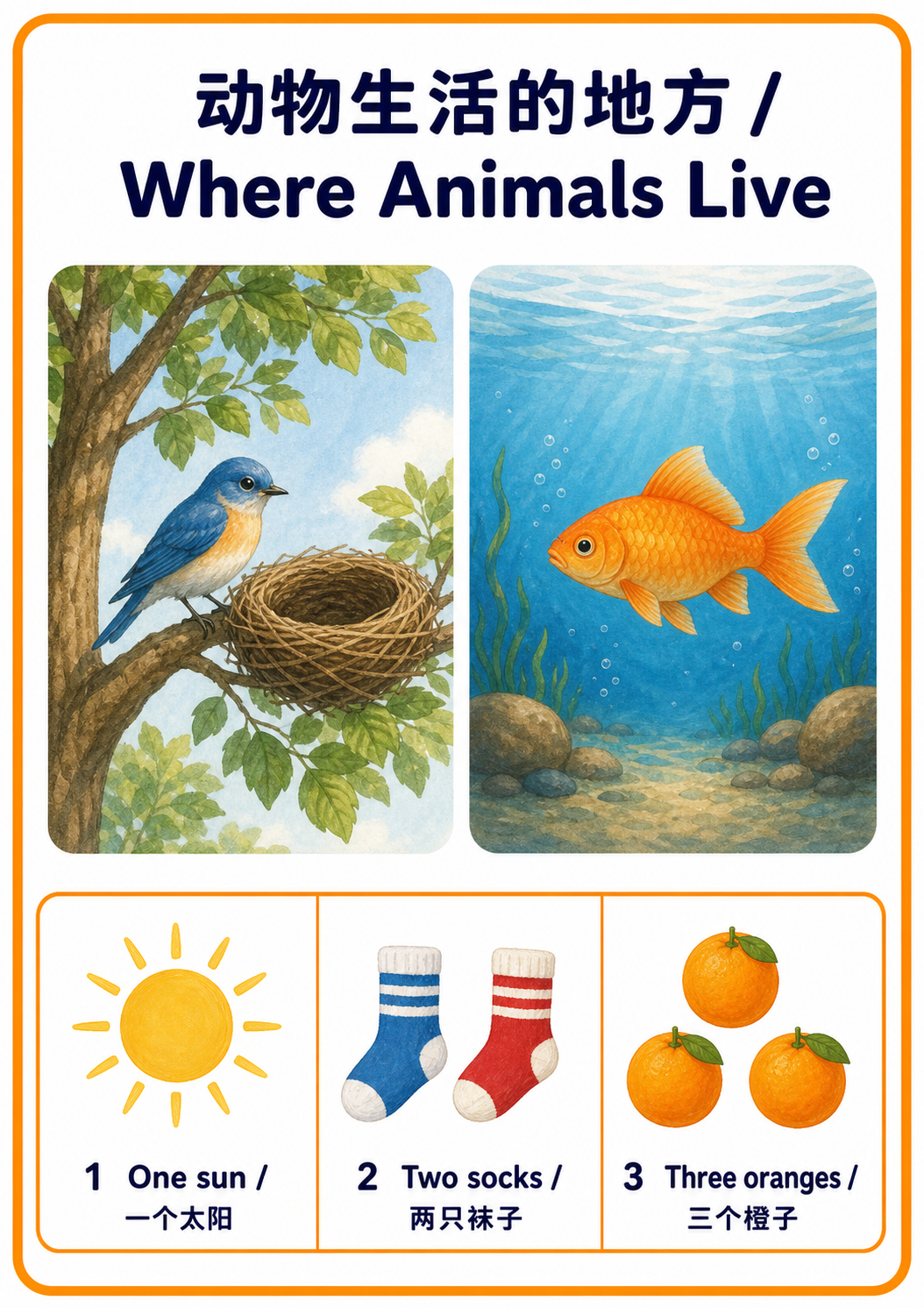
A4 Teaching Picture
Open the teaching poster to download or print
Goals
- Chinese: understand “小鸟可以住在鸟巢里。” and “鱼生活在水里。” in complete short sentences.
- English: hear
A bird can live in a nest.andA fish lives in water.with picture support. - Early maths: count only one sun, two socks, and three oranges in the separate bottom strip.
- Relationship: the adult follows Amara's attention and boundaries without requiring an answer.
Materials
- The one A4 poster above, printed or displayed full-screen.
- The English audio below.
- No cards, toys, food, containers, or other physical objects are needed.
1. Chinese Picture Talk
Time: 5–8 minutes.
Say slowly, “小鸟可以住在鸟巢里。”“鱼生活在水里。” Say each sentence once, then add one short natural expansion. Do not ask “What is this?” or “Say it,” and do not correct pronunciation.
Amara may look anywhere, point, move, make a sound, say one word, stay quiet, pause, or decline. Treat all of these as communication and leave waiting time.
2. English Time
Time: 3–5 minutes.
Download today's English audio
Transcript: English time. Listen, look, or point. A bird can live in a nest. A fish lives in water. One sun. Two socks. Three oranges. All done.
Play it once. The adult may point gently to the matching part of the poster. Repeating, answering, and performing are not tasks.
| English | Chinese | Possible response |
|---|---|---|
A bird can live in a nest. | 小鸟可以住在鸟巢里。 | Look, point, make a sound, say one word, or stay quiet |
A fish lives in water. | 鱼生活在水里。 | Move, pause, or decline |
One. Two. Three. | 一、二、三。 | Follow the adult's point or make no response |
3. Early Maths: 1, 2, 3
Time: 3–5 minutes.
Count only the complete target objects in the three separate bottom cells: exactly one sun in the first cell, two socks in the second, and three oranges in the third. Point one-to-one and say “one, two, three” once. Do not count text, frames, or objects in the main picture, and do not require a number answer.
4. Co-Regulation and Boundaries
Time: 3–5 minutes.
The adult can say, “You are looking. I will look with you,” and “You want to stop. We will stop.” If Amara turns away, pushes the screen away, stays silent, or says no, lower the voice, pause, or finish. Do not use scores, rewards, comparisons, or repeated drills.
Development and Safety Note
Build an early habitat relation using familiar animals and places without overgeneralising. The adult remains responsible for real-world safety decisions, necessary care, and risk management; a poster never replaces supervision. Explain necessary care first, move gently, and offer feasible choices whenever possible.
Gentle Bedtime Recall
Time: 3–5 minutes.
Say “小鸟可以住在鸟巢里。 鱼生活在水里。” once, then say A bird can live in a nest. once. Amara may look, point, make a sound, say one word, stay quiet, or finish immediately.