One Picture Can Have Many True Words
One Picture Can Have Many True Words
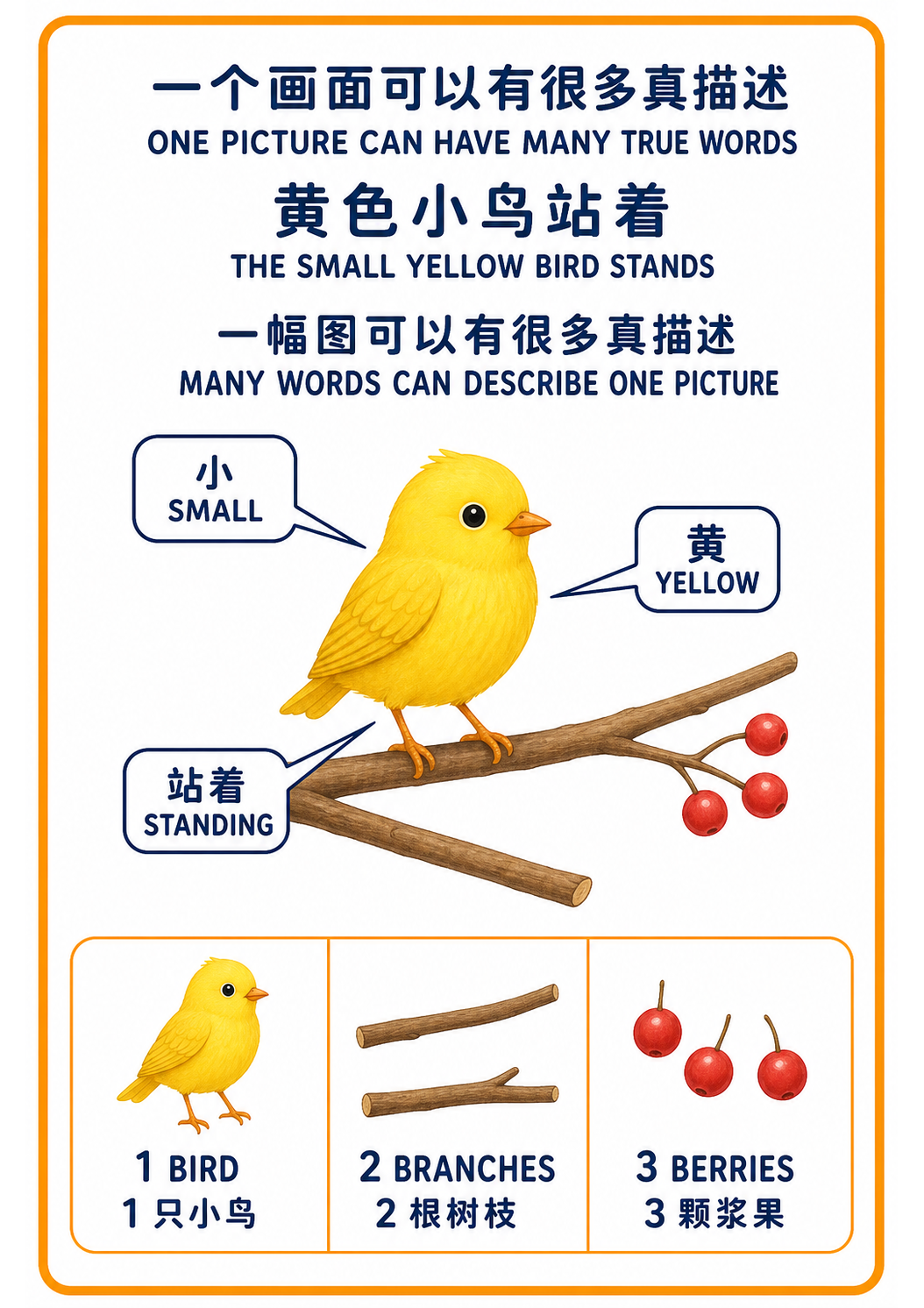
One bird can be yellow, small, and standing; expand vocabulary without testing.
Today's Approach
Amara is about 2 years and 1–2 months old. Keep each activity to 3–8 minutes. Looking, pointing, making a movement or sound, saying one word, staying quiet, pausing, or declining all count. Use only the poster and audio; do not require repetition, performance, touch, or eye contact.
A4 Teaching Picture
Open the teaching poster to download or print
Goals
- Chinese: hear “这只小鸟小小的、黄黄的” and “小鸟站在树枝上” during shared picture talk.
- English: understand
The bird is small and yellow.andThe bird stands on a branch.with picture support. - Early maths: point one-to-one to one bird, two branches, and three berries in the bottom strip.
- Relationship: the adult follows Amara's attention without turning shared observation into a test.
Materials
- Only the A4 teaching picture above, printed or displayed full-screen.
- The English audio below.
- No cards, toys, food, containers, or other real objects are needed.
1. Chinese Picture Talk
Time: 5–8 minutes.
Say, “这只小鸟小小的、黄黄的。”“小鸟站在树枝上。” Model each sentence naturally once, then leave quiet looking time. Amara may look anywhere, point, make a related movement, vocalise, or say one word. Quiet, pausing, and declining are equally valid.
Do not ask a chain of questions, correct pronunciation, request a whole-sentence repetition, or direct where she must look.
2. English Time
Time: 3–5 minutes.
Download today's English audio
Transcript: English time. Listen, look, or point. The bird is small and yellow. The bird stands on a branch. One bird. Two branches. Three berries. All done.
Play it once. The adult may point gently with the audio. Repeating, memorising words, and memory checks are not tasks.
| English | Chinese | Possible response |
|---|---|---|
The bird is small and yellow. | 这只小鸟小小的、黄黄的。 | Look, point, move, vocalise, or say one word |
The bird stands on a branch. | 小鸟站在树枝上。 | Listen quietly, pause, or decline |
3. Early Maths: 1, 2, 3
Time: 3–5 minutes.
Use only the separate bottom counting strip: one bird, two branches, and three berries. Move one fingertip once while saying, “One, two, three.” Do not count the main picture, text, or decoration, and do not require number words or numeral recognition.
4. Shared Attention and Language Expansion
Time: 3–5 minutes.
If Amara offers one word, receive it and naturally add one or two words. For example, when she names something in the picture, say, “I heard you,” then model the related short sentence. Expansion is not correction, and she does not need to repeat it.
5. Choice and Safety Boundaries
Time: 3–5 minutes.
If Amara turns away, pushes the screen aside, stays quiet, or says no, respond, “You want to stop. We will stop.” Do not use scores, rewards, comparison, or repeated drills. When the picture involves weather, plants, animals, roads, water, hot items, or body care, use it only for talk; an adult remains responsible for real-world safety decisions and necessary care.
Development Note
Two-year-olds learn mainly through shared attention, movement, sounds, and a small number of words. The adult offers stable, short, meaningful language without bringing forward print drills, KET preparation, memorisation, or question practice.
Gentle Bedtime Recall
Time: 3–5 minutes.
- Say once, “这只小鸟小小的、黄黄的。”
- Then say once,
The bird is small and yellow. - Accept looking, pointing, moving, one word, quiet, pausing, or finishing.