
Help a Toddler Learn Page Order Without Correcting Every Turn
Quick answer: Books usually carry a story in an order, but toddler exploration is rarely linear. Adults can model turning one page at a time without making every skipped or backward page a mistake.
| Suggested age | Activity time | What you need | Participation can include |
|---|---|---|---|
| About 2–3 years | 3–10 minutes | One picture or one real routine | Looking, listening, pointing, moving, communicating, or stopping |
Begin with a Real Family Activity Picture
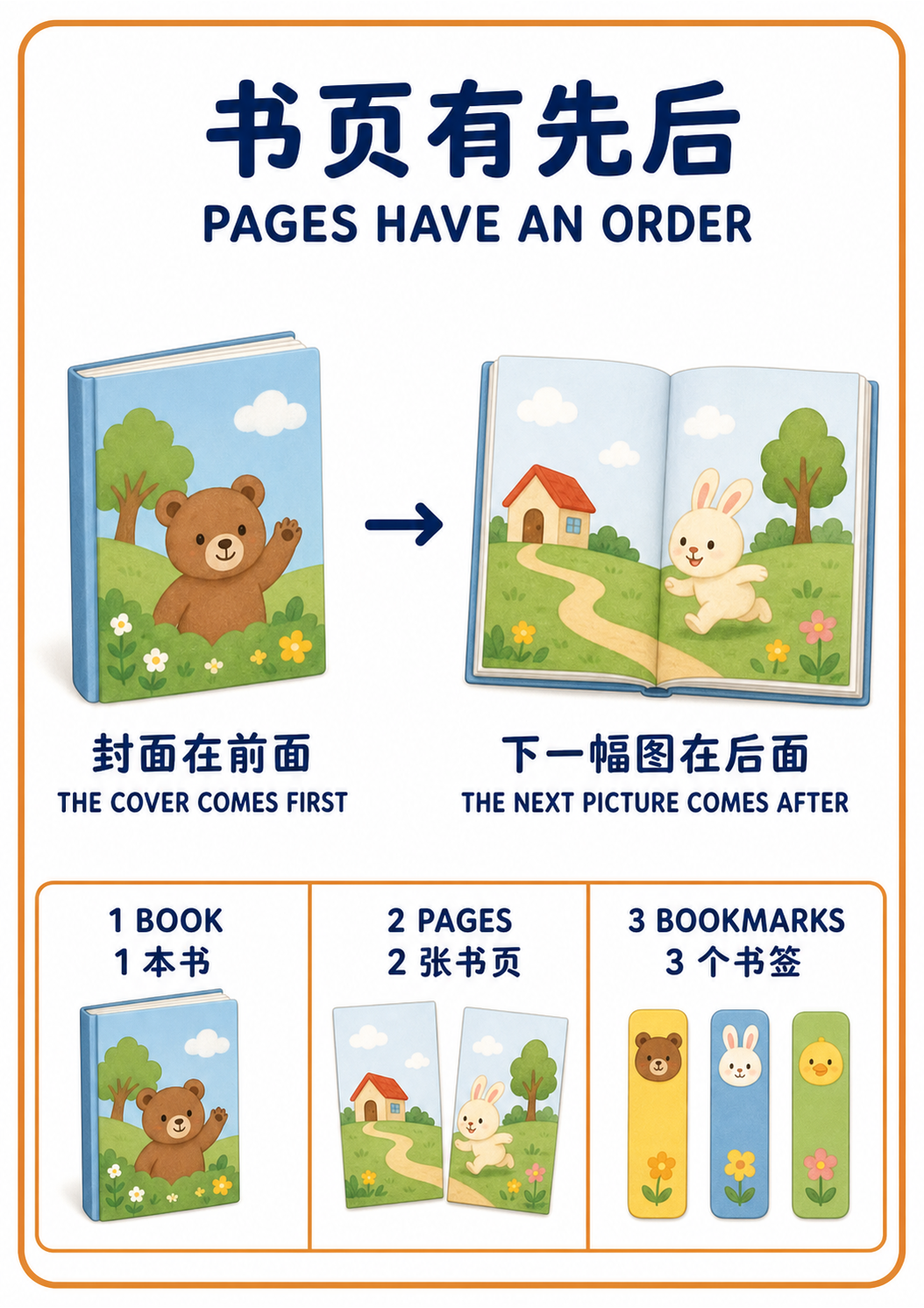
Open the high-resolution picture to download or print
This guide is adapted from our original family record, Pages Have an Order. The diary keeps the full plan and context from that day; this page is reorganised around one parent question and keeps the parts another family can use quickly.
What This Activity Actually Supports
Shared reading can include looking, pointing, page turning, movement, quiet listening, and stopping. The book is a place for joint attention, not a test that requires a spoken answer on every page.
This is not a developmental test. A quick look, a point, one movement, a sound, a word, quiet observation, or a stop signal can all be valid participation.
Try It Today
1. Show where this reading begins
Open to the first chosen page and say ‘We can start here’. It does not always have to be the formal first page.
2. Turn one page slowly
Slide a finger under the edge and turn. Name the change: ‘This page is finished; here is the next picture’.
3. Allow useful returns
If the child goes back to a favourite picture, join them. Later, model moving forward again rather than immediately reversing their action.
Ready-to-Use Parent Phrases
- We started here.
- Now comes the next page.
- You went back to the dog.
- We can skip this page today.
Adapt It to the Child in Front of You
Use a sturdy book with clear page divisions. For children who rapidly flip, choose one page to revisit after the exploration rather than holding pages shut.
Record One Real Observation
Notice intentional returns, anticipation of a favourite page, gentler page handling, or awareness that a new picture appears after a turn.
Avoid writing “can/cannot” or drawing a developmental conclusion from one activity. A more useful note records what the child noticed first, how the adult responded, and what helped the exchange continue or finish.
Safety and development boundary
Repair sharp tears and supervise books with paper cuts, staples, flaps, or detachable pieces. Respect a child's hand on the page.
How This Guide Was Made
This page uses the linked original family diary and picture as its experience base, with factual checks against the public sources below. AI assisted with structure and bilingual editing. It is not medical, psychological, or therapeutic advice. Read the editorial and fact-checking policy.
Sources
- Harvard Center on the Developing Child: Serve and return
- CDC: Positive parenting tips for toddlers ages 2–3