
Follow a Toddler's Point to Build Shared Attention
Quick answer: When a toddler points, reaches, or fixes their eyes on something, they may be inviting another person into the moment. Following that signal before introducing an adult agenda creates a simple foundation for shared language.
| Suggested age | Activity time | What you need | Participation can include |
|---|---|---|---|
| About 2–3 years | 3–10 minutes | One picture or one real routine | Looking, listening, pointing, moving, communicating, or stopping |
Begin with a Real Family Activity Picture
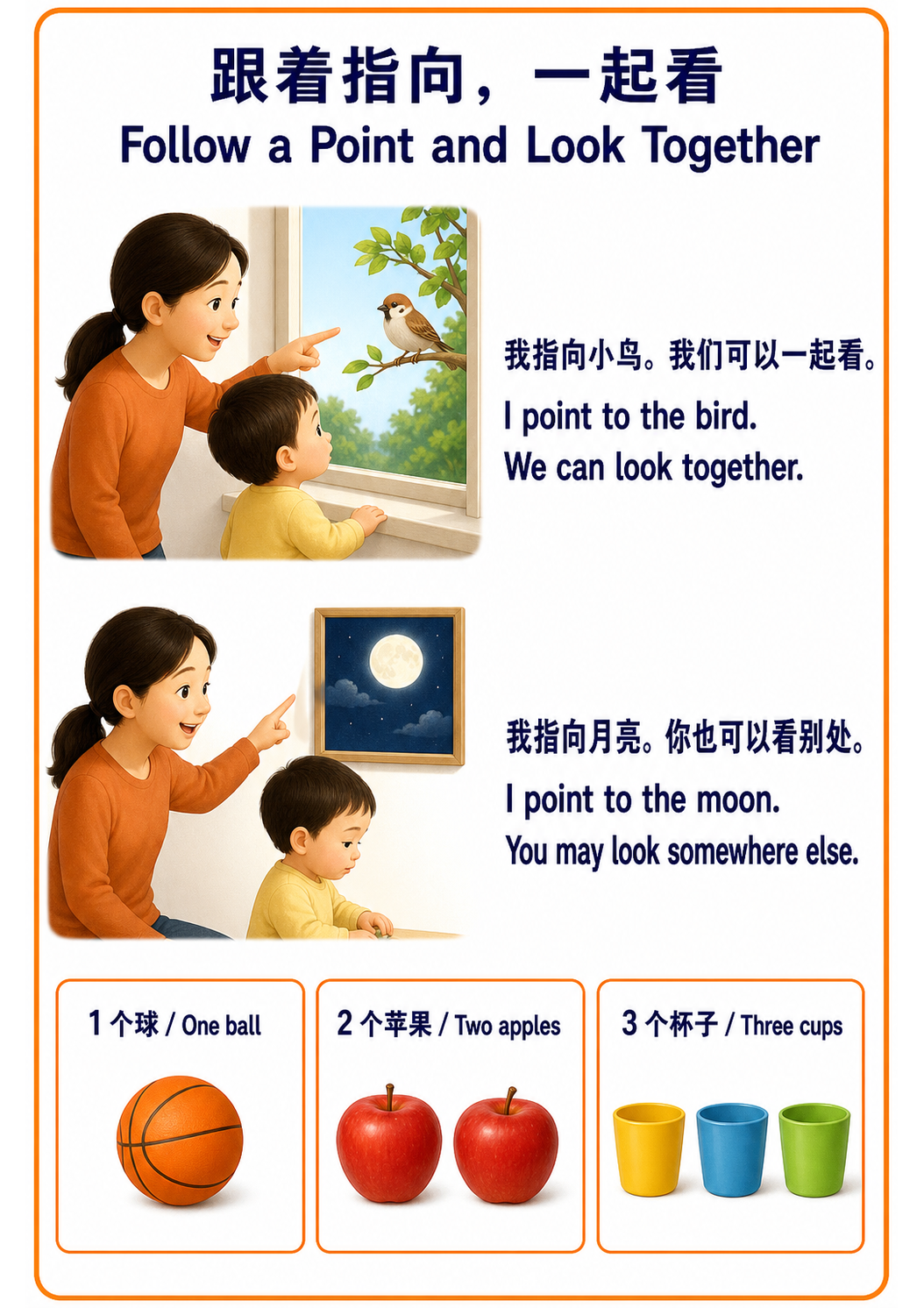
Open the high-resolution picture to download or print
This guide is adapted from our original family record, Follow a Point and Look Together. The diary keeps the full plan and context from that day; this page is reorganised around one parent question and keeps the parts another family can use quickly.
What This Activity Actually Supports
The useful unit here is a back-and-forth exchange, not a vocabulary score. Naming what a young child is seeing, doing, or communicating can add language while preserving the child's turn.
This is not a developmental test. A quick look, a point, one movement, a sound, a word, quiet observation, or a stop signal can all be valid participation.
Try It Today
1. Find the target
Move your eyes toward the place the child indicates. If you are unsure, name that uncertainty instead of guessing repeatedly.
2. Confirm with one description
Say what is visibly true: ‘You see the bird on the fence’ or ‘That light is flashing’. Avoid turning the point into a naming quiz.
3. Let the child lead the ending
Stay for one or two exchanges. If attention moves, follow it or finish instead of trying to pull the child back.
Ready-to-Use Parent Phrases
- I see where you are pointing.
- You noticed the bright light.
- We are looking at the same bird.
- Now your eyes moved to the tree.
Adapt It to the Child in Front of You
If pointing is not comfortable or available, follow eye direction, body orientation, a reach, a sound, or the object the child brings over.
Record One Real Observation
Write down what first attracted the child's attention and how the adult knew. This preserves the child's contribution instead of recording only adult prompts.
Avoid writing “can/cannot” or drawing a developmental conclusion from one activity. A more useful note records what the child noticed first, how the adult responded, and what helped the exchange continue or finish.
Safety and development boundary
A child may point toward something unsafe. Acknowledge the interest while keeping distance and using the necessary safety boundary.
How This Guide Was Made
This page uses the linked original family diary and picture as its experience base, with factual checks against the public sources below. AI assisted with structure and bilingual editing. It is not medical, psychological, or therapeutic advice. Read the editorial and fact-checking policy.
Sources
- Harvard Center on the Developing Child: Serve and return
- CDC: Milestones and family activities for 2-year-olds