
Teach More, Help, and Stop with Toddler Gestures
Quick answer: Gestures can carry a complete message before, beside, or instead of spoken words. Three especially useful messages in family life are more, help, and stop because they give a toddler a way to influence what happens next.
| Suggested age | Activity time | What you need | Participation can include |
|---|---|---|---|
| About 2–3 years | 3–10 minutes | One picture or one real routine | Looking, listening, pointing, moving, communicating, or stopping |
Begin with a Real Family Activity Picture
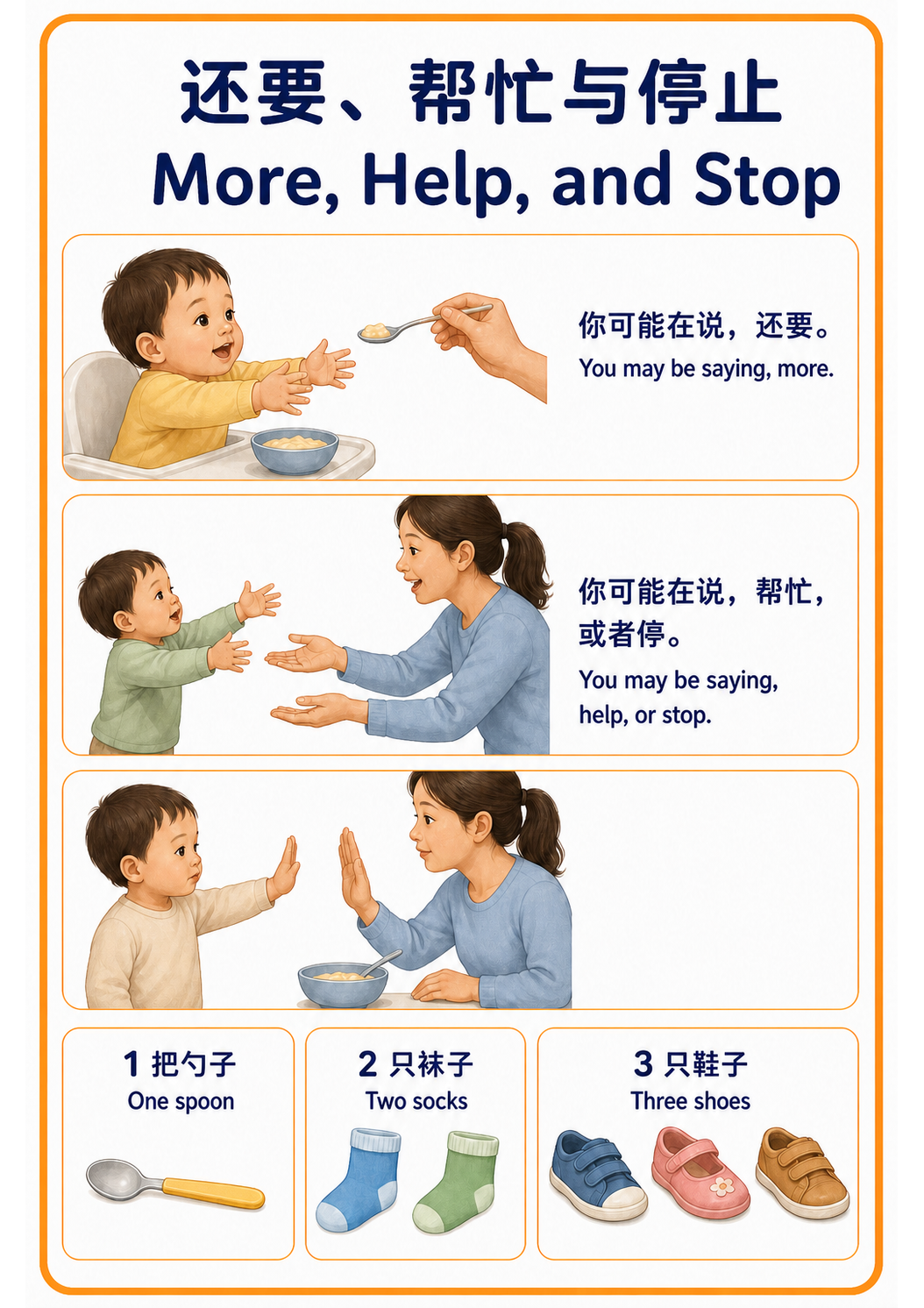
Open the high-resolution picture to download or print
This guide is adapted from our original family record, More, Help, and Stop. The diary keeps the full plan and context from that day; this page is reorganised around one parent question and keeps the parts another family can use quickly.
What This Activity Actually Supports
The useful unit here is a back-and-forth exchange, not a vocabulary score. Naming what a young child is seeing, doing, or communicating can add language while preserving the child's turn.
This is not a developmental test. A quick look, a point, one movement, a sound, a word, quiet observation, or a stop signal can all be valid participation.
Try It Today
1. Model during a real need
Show the gesture when the meaning is already obvious: more during another turn, help beside a difficult lid, and stop before ending an activity.
2. Pair gesture and word
Use one consistent movement and one short word. Keep your face and voice neutral so the gesture does not feel like a test.
3. Respond to approximations
A reach, open hand, push-away, look, or sound may be the child's version. Respond to the message, then model the clearer form once.
Ready-to-Use Parent Phrases
- ‘More?’ You can show me.
- ‘Help.’ I will hold the box.
- ‘Stop.’ I heard you.
- You can use your hand, a sound, or a word.
Adapt It to the Child in Front of You
Start with the message the child already tries to communicate most often. Add the other two only after the first feels familiar; there is no need to drill all three together.
Record One Real Observation
Notice whether communication becomes quicker or frustration becomes easier to understand. Count spontaneous attempts, not perfect hand shapes.
Avoid writing “can/cannot” or drawing a developmental conclusion from one activity. A more useful note records what the child noticed first, how the adult responded, and what helped the exchange continue or finish.
Safety and development boundary
A stop signal must be respected whenever possible, especially around touch. Adults still make immediate safety decisions when a child is in danger.
How This Guide Was Made
This page uses the linked original family diary and picture as its experience base, with factual checks against the public sources below. AI assisted with structure and bilingual editing. It is not medical, psychological, or therapeutic advice. Read the editorial and fact-checking policy.
Sources
- Harvard Center on the Developing Child: Serve and return
- CDC: Milestones and family activities for 2-year-olds