
Clues for Tired and Thirsty
Clues for Tired and Thirsty
Notice possible clues for tired, thirsty, or uncomfortable, while adults use real context to provide care. The aim is connection and response, not a performance task.
Today's Approach
Amara is about 1 year 10–11 months old. Keep each activity to 3–8 minutes. Looking, pointing, making a sound or saying one word, staying quiet, pausing, or declining all count. Use only the poster and audio; do not require objects, answers, repetition, performance, touch, or eye contact.
A4 Teaching Picture
Open the teaching picture to download or print
Goals
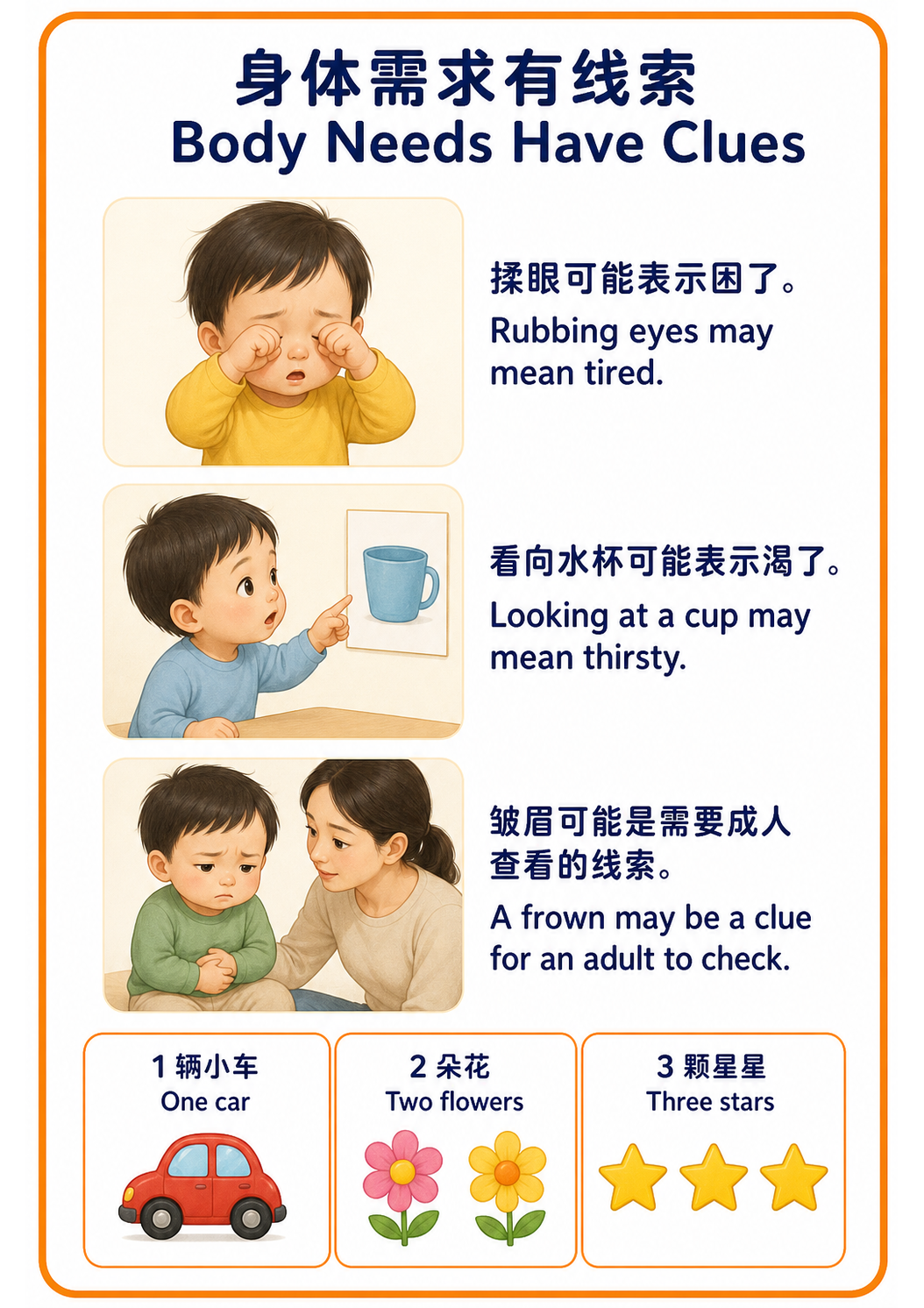
- Communication: hear and see “The child rubs their eyes. The child may be tired.” and “The child looks at the cup. The child may be thirsty.” in natural descriptions.
- Understanding: A frown may be a clue for an adult to check.
- English: understand two short descriptions with picture support, without repeating.
- Quantity: the adult points one-to-one through one car, two flowers, and three stars, without requiring an answer.
Materials
- Only the A4 teaching picture above, printed or displayed full-screen.
- The English audio below at a comfortable volume.
- No cards, toys, food, containers, or any other physical objects are needed.
1. Chinese Picture Talk
Time: 5–8 minutes.
Three gentle pictures show rubbing eyes, looking at a cup picture, and frowning while holding the body, with no imitation required. Say slowly, “孩子揉眼睛。孩子可能困了。” and “孩子看向水杯。孩子可能渴了。” once each, then pause to notice what Amara actually attends to.
Amara may look anywhere, point, make a sound, say one word, stay quiet, pause, or decline. Do not ask “What is this?” or “Who is doing it?” Do not correct, score, or request a retelling.
2. English Time
Time: 3–5 minutes.
Download today's English audio
Transcript: English time. Listen, look, or point. The child rubs their eyes. The child may be tired. The child looks at the cup. The child may be thirsty. One car. Two flowers. Three stars. All done.
Play it once. The adult may gently point to the matching picture as the audio plays. Repetition, movement, and looking at the adult are not tasks.
| English | Chinese | Possible response |
|---|---|---|
The child rubs their eyes. The child may be tired. | 孩子揉眼睛。孩子可能困了。 | Look, point, make a sound, or say one word |
The child looks at the cup. The child may be thirsty. | 孩子看向水杯。孩子可能渴了。 | Listen quietly, pause, or decline |
3. Early Quantity: 1, 2, 3
Time: 3–5 minutes.
Use only the three separate bottom boxes: one car, two flowers, and three stars. The adult moves one fingertip one-to-one and says “one, two, three” once. Do not count the main picture, words, or border, and do not ask Amara to identify numerals.
4. Adult Response and Boundaries
Time: 3–5 minutes.
The adult can say, “I noticed your signal.” Describe the place Amara looks toward. If she turns away, pushes the screen, becomes quiet, or says no, respond promptly: “You want to pause. We will stop.”
Safety and Development Note
A frown may be a clue for an adult to check. The poster and audio support shared looking only; they never replace real supervision. Adults are responsible for real safety, hygiene, feeding, body care, and necessary boundaries. Do not use quizzes, correction, rewards, scores, forced repetition, or comparison.
Gentle Bedtime Recall
Time: 3–5 minutes.
Say “The child rubs their eyes. The child may be tired.” and “The child looks at the cup. The child may be thirsty.” once, then point through the bottom groups of one, two, and three. Looking, pointing, a sound, one word, quiet, pausing, or declining may all end today's recall.