
How to Help a Toddler Get Dressed Without Taking Over
Quick answer: Choose one part the child can attempt—push an arm through, pull trousers from knees, or place a hat—while the adult manages orientation, fasteners, weather, and time. Independence grows with shared help, not all-or-nothing waiting.
| Suggested age | Activity time | What you need | Participation can include |
|---|---|---|---|
| About 2–3 years | 3–10 minutes | One picture or one real routine | Looking, listening, pointing, moving, communicating, or stopping |
Begin with a Real Family Activity Picture
Open the high-resolution picture to download or print
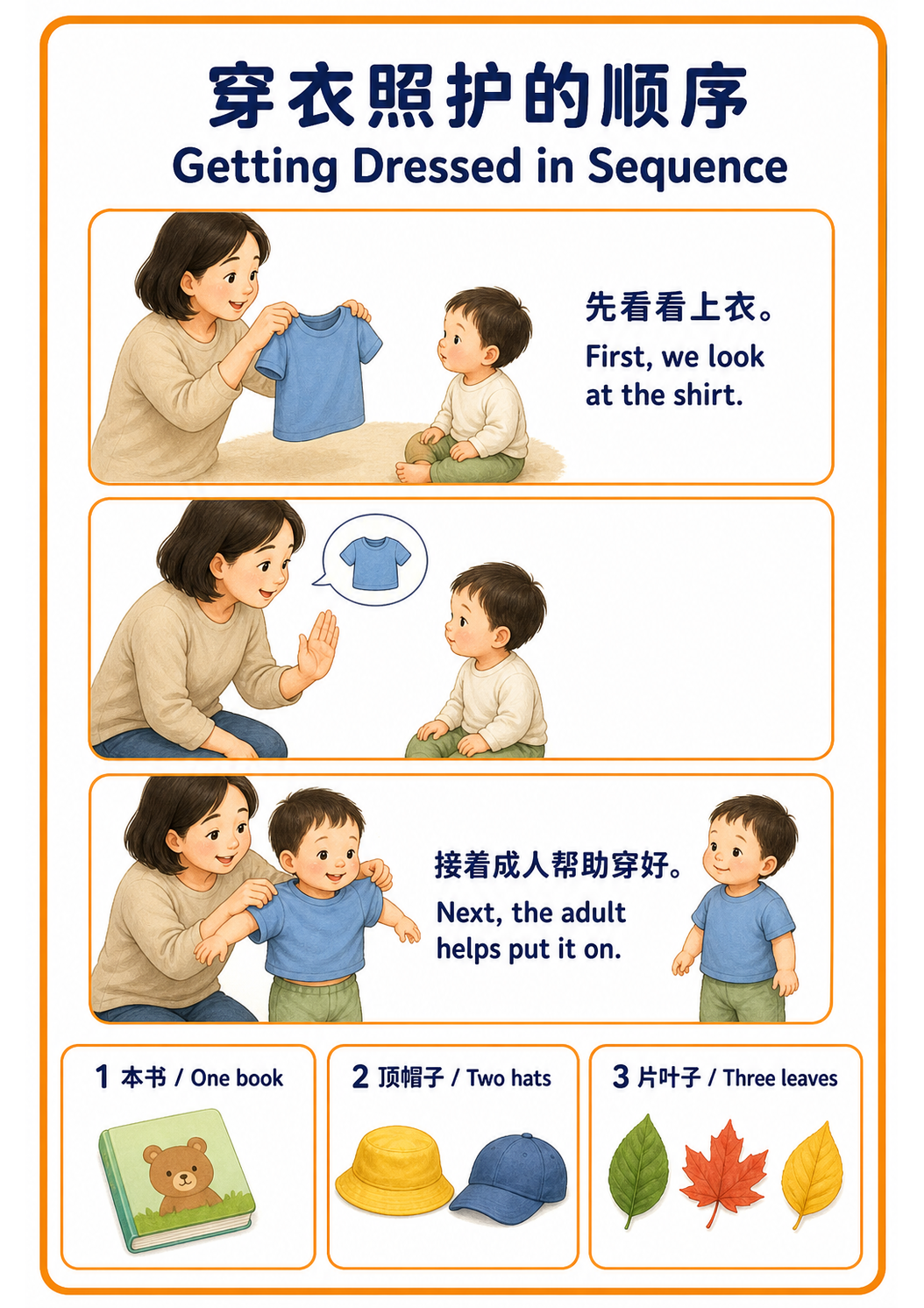
This guide is adapted from our original family record, Getting Dressed in Sequence. The diary keeps the full plan and context from that day; this page is reorganised around one parent question and keeps the parts another family can use quickly.
Record boundary: Our January 25 record used pictures to make the dressing-care sequence predictable. The linked diary records that practice activity; it does not claim that the exact conflict in this guide happened on that day.
What This Activity Actually Supports
Body care combines a real adult responsibility with a child's need for predictability, dignity, and small participation. Choices can shape how care happens, while the adult remains responsible for health, weather, hygiene, and immediate safety.
This is not a developmental test. A quick look, a point, one movement, a sound, a word, quiet observation, or a stop signal can all be valid participation.
Try It Today
1. State the care boundary clearly
Lay out one weather-appropriate outfit in order and start the difficult orientation. Say only the next body action: ‘Find the sleeve opening.’ A pile of choices and repeated corrections can hide the part the child could do.
2. Offer control inside the boundary
Pause long enough for one attempt, then ask or announce help: ‘You pull to your knees; I help over your hips.’ Use backward chaining when useful—the adult does the first steps and the child completes the final satisfying action.
3. Finish with dignity and reconnection
When time or frustration is high, help directly without calling the child a baby. Say ‘Today needs more help.’ Reconnection and leaving safely matter more than using every morning as an independence lesson.
Ready-to-Use Parent Phrases
- Your job is finding the sleeve.
- You start; I will help the tight part.
- Do you want a little help or big help?
- Today needs more help; we can practise another time.
Adapt It to the Child in Front of You
Try softer fabric, wider openings, fewer fasteners, seated dressing, or removing tags if sensory discomfort is clear. Practise one skill when there is no deadline. Occupational or medical guidance may help with persistent pain, movement, or sensory concerns.
Record One Real Observation
Record which garment and movement were difficult, whether the clothing fit, how much setup helped, and the point at which frustration rose. This identifies a skill or clothing mismatch better than ‘won't dress’.
Avoid writing “can/cannot” or drawing a developmental conclusion from one activity. A more useful note records what the child noticed first, how the adult responded, and what helped the exchange continue or finish.
Safety and development boundary
Adults choose clothing needed for temperature, sun, rain, visibility, footwear, and activity safety. Check cords, loose parts, choking hazards, circulation, and fit. Sudden pain, weakness, swelling, or loss of dressing skills needs professional attention.
How This Guide Was Made
This page uses the linked original family diary and picture as its experience base, with factual checks against the public sources below. AI assisted with structure and bilingual editing. It is not medical, psychological, or therapeutic advice. Read the editorial and fact-checking policy.
Sources
- CDC: Positive parenting tips for toddlers ages 2–3
- Harvard Center on the Developing Child: Serve and return