
What to Say When a Toddler Hits a Parent
Quick answer: Move close enough to block the next hit and say, ‘I will not let you hit me.’ Keep the limit physical and brief. After calm returns, name what the child wanted and practise one safer way to communicate it.
| Suggested age | Activity time | What you need | Participation can include |
|---|---|---|---|
| About 2–3 years | 3–10 minutes | One picture or one real routine | Looking, listening, pointing, moving, communicating, or stopping |
Begin with a Real Family Activity Picture
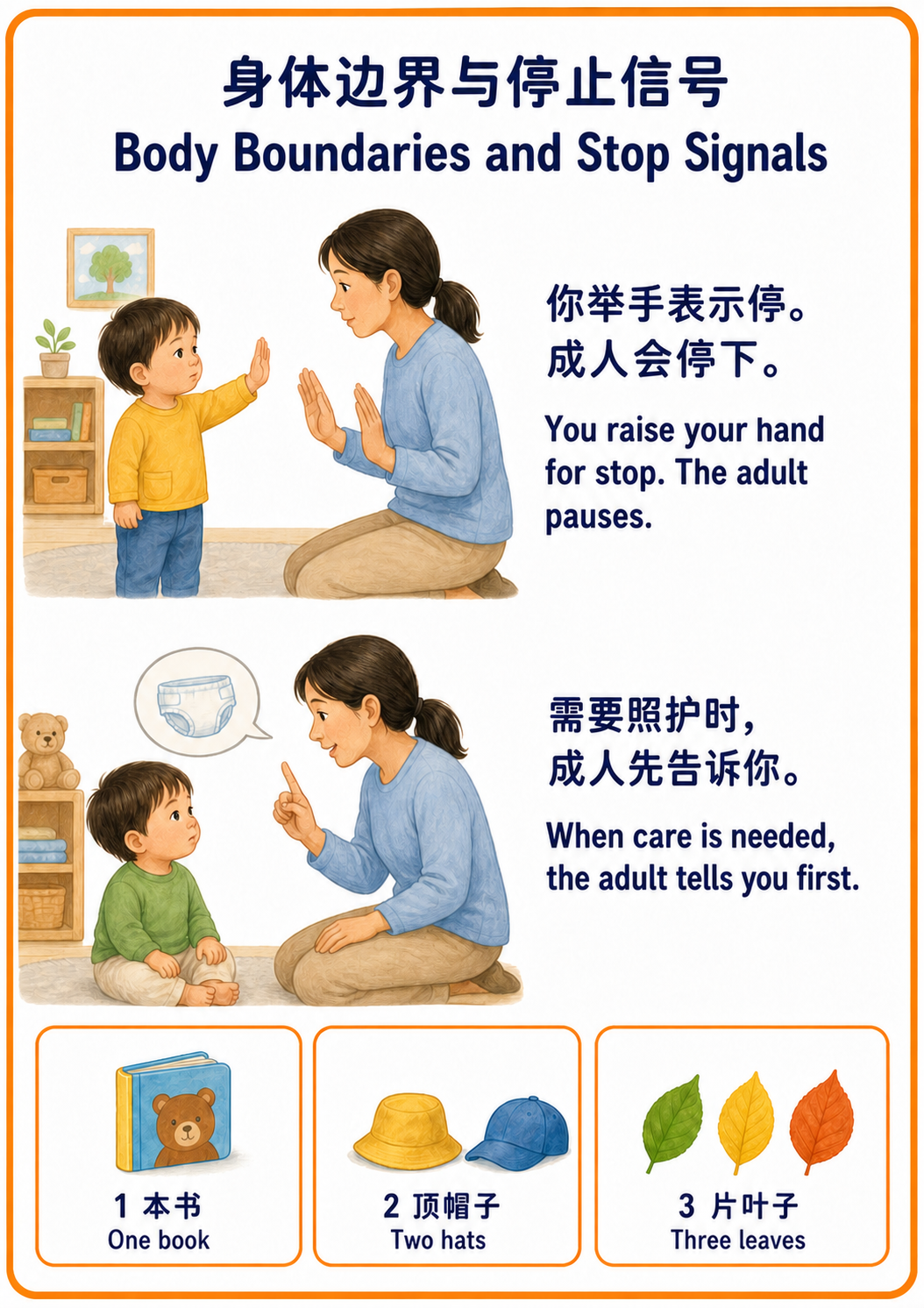
Open the high-resolution picture to download or print
This guide is adapted from our original family record, Body Boundaries and Stop Signals. The diary keeps the full plan and context from that day; this page is reorganised around one parent question and keeps the parts another family can use quickly.
Record boundary: Our January 14 record practised body boundaries and a clear stop signal with familiar pictures. The linked diary records that practice activity; it does not claim that the exact conflict in this guide happened on that day.
What This Activity Actually Supports
When bodies are unsafe, the adult stops the action first and teaches later. A two- or three-year-old still needs close help with waiting, turn-taking, repair, and finding a safe action; labels such as ‘mean’ do not teach the missing skill.
This is not a developmental test. A quick look, a point, one movement, a sound, a word, quiet observation, or a stop signal can all be valid participation.
Try It Today
1. Stop harm and check bodies
Turn your body, move objects, and gently block hands or create distance. Check whether anyone is injured. A long question—‘Why did you do that?’—does not protect the next second and may be impossible to answer during high arousal.
2. Name the problem without a label
Describe the action and likely problem separately: ‘You hit. You wanted me to stop.’ Do not call the child violent, bad, or manipulative. The action is not allowed, while the underlying need can still be heard.
3. Practise one safe alternative
When the child can attend, rehearse one option: say or sign stop, push against a cushion, move away, or bring the adult to the problem. Keep the practice brief and do not force an apology as proof of understanding.
Ready-to-Use Parent Phrases
- I will not let you hit me.
- Hitting hurts; I am moving back.
- You wanted me to stop.
- Show me stop with your hand.
Adapt It to the Child in Front of You
Use fewer words if talking increases the hitting. Notice whether touch, crowding, a removed object, fatigue, hunger, or a sudden transition reliably comes first. Prevention may mean more space, earlier food, or a clearer transition—not permissiveness about harm.
Record One Real Observation
Record what happened immediately before, which body part or object was involved, the adult response, and what ended the episode. Patterns across several moments are more useful than assuming a motive from one hit.
Avoid writing “can/cannot” or drawing a developmental conclusion from one activity. A more useful note records what the child noticed first, how the adult responded, and what helped the exchange continue or finish.
Safety and development boundary
Seek prompt professional support if hitting is frequent, severe, escalating, causes injury, involves weapons or dangerous objects, or makes anyone at home unsafe. Adults must never retaliate, shake, humiliate, or use painful restraint.
How This Guide Was Made
This page uses the linked original family diary and picture as its experience base, with factual checks against the public sources below. AI assisted with structure and bilingual editing. It is not medical, psychological, or therapeutic advice. Read the editorial and fact-checking policy.
Sources
- CDC: Positive parenting tips for toddlers ages 2–3
- Harvard Center on the Developing Child: Serve and return