
How to Respond When a Toddler Bites
Quick answer: Separate the bodies immediately, attend to the person who was bitten, and state, ‘I will not let biting continue.’ Keep the response calm and direct; investigate triggers and teach alternatives only after safety is restored.
| Suggested age | Activity time | What you need | Participation can include |
|---|---|---|---|
| About 2–3 years | 3–10 minutes | One picture or one real routine | Looking, listening, pointing, moving, communicating, or stopping |
Begin with a Real Family Activity Picture
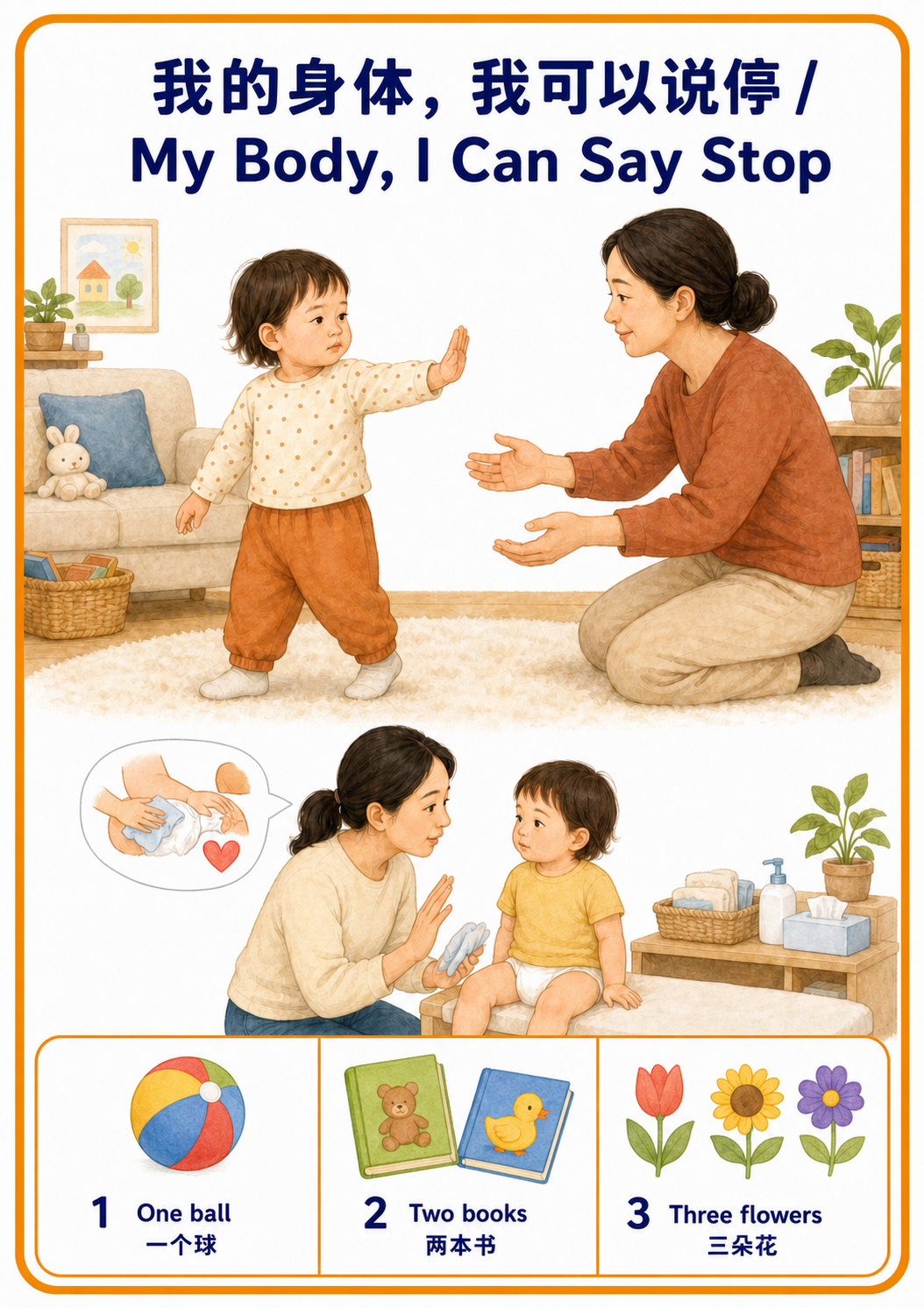
Open the high-resolution picture to download or print
This guide is adapted from our original family record, My Body, I Can Say Stop. The diary keeps the full plan and context from that day; this page is reorganised around one parent question and keeps the parts another family can use quickly.
Record boundary: Our June 29 record practised saying stop and respecting body boundaries through a picture activity. The linked diary records that practice activity; it does not claim that the exact conflict in this guide happened on that day.
What This Activity Actually Supports
When bodies are unsafe, the adult stops the action first and teaches later. A two- or three-year-old still needs close help with waiting, turn-taking, repair, and finding a safe action; labels such as ‘mean’ do not teach the missing skill.
This is not a developmental test. A quick look, a point, one movement, a sound, a word, quiet observation, or a stop signal can all be valid participation.
Try It Today
1. Stop harm and check bodies
Move the biting child away from skin and check the wound. Wash and care for the injury according to appropriate health guidance. Give attention to the hurt person first without turning care into a public shaming performance.
2. Name the problem without a label
Say what happened: ‘Biting hurt. You both wanted the toy.’ Avoid ‘You are a biter’ or repeated interrogation. The adult can be completely firm about the injury while refusing to define the whole child by one action.
3. Practise one safe alternative
Later practise a replacement matched to the trigger: hand the toy problem to an adult, say stop, move away, bite an appropriate teether when biting is sensory, or wait with close adult help. Repair can be bringing ice or checking in, not a forced word.
Ready-to-Use Parent Phrases
- I will not let biting continue.
- First I am checking the hurt body.
- You wanted the same toy.
- Bring the toy problem to me.
Adapt It to the Child in Front of You
Track whether biting appears during teething, crowding, excitement, fatigue, language frustration, or competition. Increase supervision and create space before the predictable moment. An appropriate chew tool may help sensory biting but does not replace medical or developmental assessment when concerns persist.
Record One Real Observation
Record time, setting, trigger, location and severity of injury, supervision distance, and what helped. Share factual patterns with caregivers; avoid labels that can follow the child after the event.
Avoid writing “can/cannot” or drawing a developmental conclusion from one activity. A more useful note records what the child noticed first, how the adult responded, and what helped the exchange continue or finish.
Safety and development boundary
Human bites can break skin and become infected. Follow local health guidance and seek medical advice for broken skin, infection signs, significant injury, bites near eyes or hands, or any concern. Separate safely; never bite back.
How This Guide Was Made
This page uses the linked original family diary and picture as its experience base, with factual checks against the public sources below. AI assisted with structure and bilingual editing. It is not medical, psychological, or therapeutic advice. Read the editorial and fact-checking policy.
Sources
- CDC: Positive parenting tips for toddlers ages 2–3
- Harvard Center on the Developing Child: Serve and return