
Sound Detectives
Sound Detectives
Today we meet the sounds of a bell, drum, and bird. We practise listening and explore loud and quiet at a comfortable volume.
Today's Approach
Amara is about 2 years and 4 months old. Keep each guided activity to 3–8 minutes. Looking, pointing, cupping one ear, copying a sound, or saying one word all count as meaningful responses. No audio or instrument is needed; the adult can imitate each sound gently. Do not test reading or make a sudden loud noise.
A4 Teaching Picture
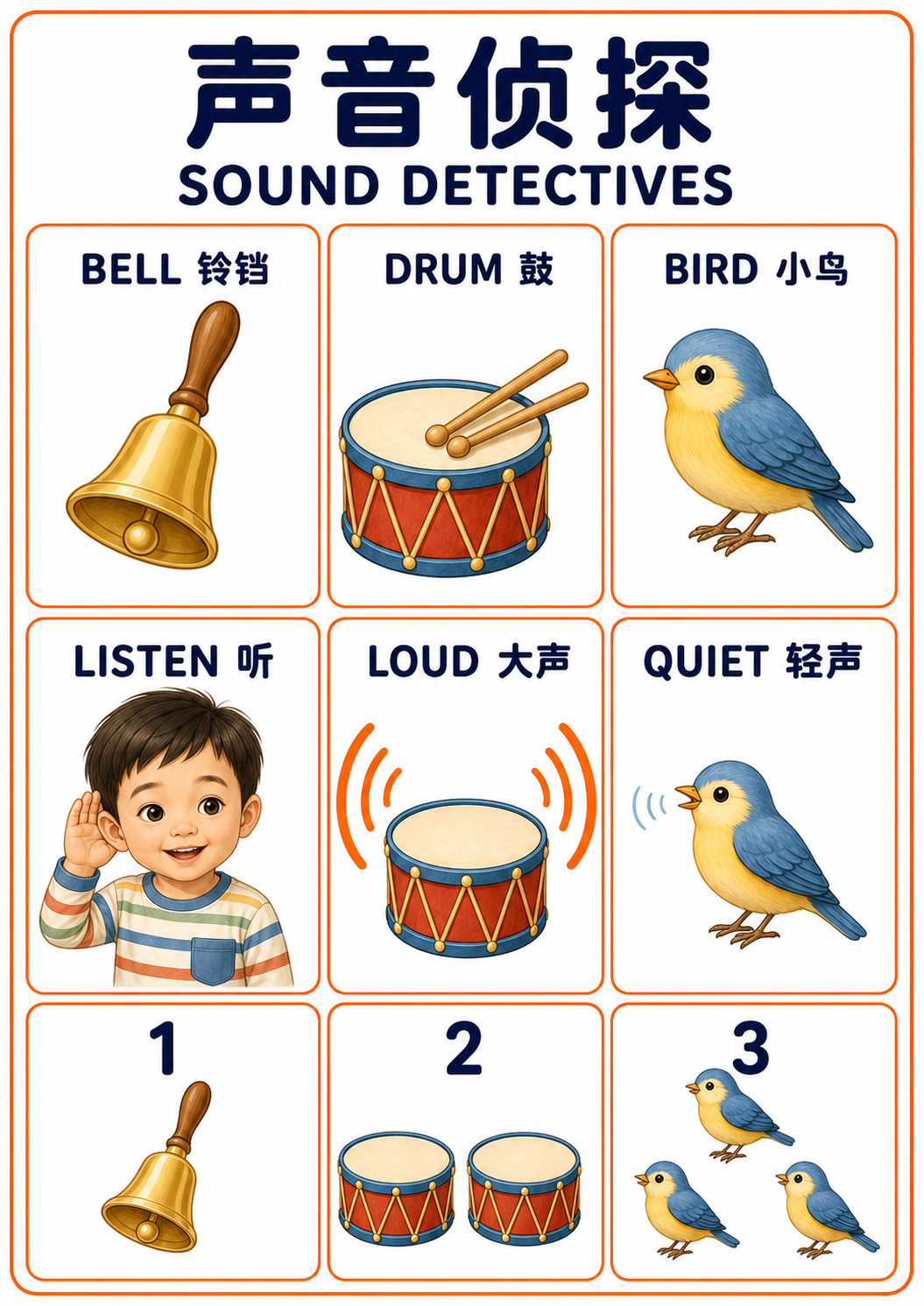
Open the original image to download or print
How to use it
Use only this A4 picture, printed or displayed full-screen. Look at the bell, drum, and bird along the top. In the middle, notice the child listening, the drum with large orange waves for LOUD, and the bird with small pale waves for QUIET. Finish by counting one bell, two drums, and three birds along the bottom. Reading is not required.
Goals
- Chinese: understand 铃铛, 鼓, 小鸟, 听, 大声, and 轻声.
- English: meet
bell,drum,bird,listen,loud, andquiet. - Listening: notice a sound source and volume difference, and learn that discomfort can be communicated.
- Early math: count the one bell, two drums, and three birds pictured at the bottom.
- Movement and life skills: become still, cup an ear, and use a gesture or word to say that a sound is too loud.
Materials
- Only the A4 teaching picture above, printed or displayed full-screen.
- The adult's voice and a relatively calm, comfortable place.
No bell, drum, audio file, speaker, or other teaching object is needed.
1. Chinese Picture Talk
Time: 5–8 minutes.
Begin with the three top cards:
- “这是铃铛,它可能发出叮叮声。”
- “这是鼓,它可能发出咚咚声。”
- “这是一只小鸟,它可能发出啾啾声。”
Then notice the middle row:
- “小朋友把手放在耳边,认真听。”
- “鼓旁边的波纹又大又多,表示声音比较大。”
- “小鸟旁边的波纹小小的,表示声音轻轻的。”
Choose only one or two prompts:
- “你想先听谁的声音?”
- “哪一格是大声?”
- “哪一格是轻声?”
- “怎样用身体表示正在听?”
A picture does not really make a sound, so use tentative language such as “might” and “sounds like” rather than fixing every picture to one volume.
Today's Original Mini Story
A sound detective becomes still and listens.
Far away, something sounds like a bell: “ding.”
A drum answers, “boom.” It is louder, but not frightening.
A bird in the tree calls softly, “tweet.”
The detective discovers that sounds have sources and can be loud or quiet.
Use a comfortable volume close to normal speech. Accuracy and loudness are not the goal.
2. English Time
Time: 3–5 minutes.
Words
| English | Meaning | Picture or sound action |
|---|---|---|
| bell | 铃铛 | Point to the golden bell and say ding |
| drum | 鼓 | Point to the drum and say boom |
| bird | 小鸟 | Point to the blue-and-yellow bird and say tweet |
| listen | 听 | Copy the pictured child cupping one ear |
| loud | 大声 | Point to the large orange waves beside the drum |
| quiet | 轻声 | Point to the small pale waves beside the bird |
Model:
A bell: ding.A drum: boom.A bird: tweet.Listen.A loud sound.A quiet sound.
Let Amara decide whether to imitate. Loud only needs to be slightly stronger than quiet; both must remain comfortable.
3. Early Math: Count the Sound Sources
Time: 3–5 minutes.
The bottom row shows:
- One bell: touch once and say
one bell. - Two drums: touch each one and say
one, two. - Three birds: touch each one and say
one, two, three.
After counting each group, imitate its sound only once: ding, boom, or tweet. Do not make a loud sound once per object; counting and volume are separate ideas.
4. Movement: Stop and Listen
Time: 3–8 minutes.
Choose two or three actions:
- Make both feet still and keep the body quiet for two or three seconds.
- Place one hand gently beside an ear, like the
LISTENchild on the poster. - Say a soft
tweet; Amara may answer with a tiny movement. - Say a slightly stronger but still comfortable
boom; she may open both arms to show “bigger”. - If she covers her ears, steps back, or says no, lower the volume or stop immediately.
Hearing Safety
Keep every imitation comfortable. Never make sounds close to Amara's ear, shout suddenly, create an explosive noise, or amplify the activity through a phone or speaker. Move away from any uncomfortable real-world sound. Covering ears and refusing are valid protective responses.
5. Everyday Listening
Listen for 3–8 minutes in a relatively calm real setting:
- Become still and notice footsteps, wind, voices, or birds.
- Model first: “我听到一个轻轻的声音。”
- Then offer an optional question: “你听到了吗?”
- If the source is unclear, say: “我听见了,但还不知道在哪里。”
Never remain near traffic, construction, or another high-noise area just to finish the activity.
6. Life Skill: Tell an Adult It Is Too Loud
Time: 3–5 minutes.
Practise one communication option while calm:
- Cover the ears and look towards the adult.
- Say “太响了” or
Too loud. - Say “轻一点” or
Quiet, please. - Move away from the uncomfortable sound with the adult.
These are protective skills. Amara is not expected to tolerate or keep listening.
Bedtime Recall
- “今天哪一个声音像
ding?” - “鼓和小鸟,哪一个画成大声,哪一个画成轻声?”
Bell, drum, or bird?- “声音不舒服时,可以怎么告诉我?”