
Sorting Baskets
Sorting Baskets
Today we use three broad picture groups—animals, food, and clothes—to find, group, and check. The adult says the sorting rule aloud; Amara can respond by looking, pointing, or showing a different idea.
Today's Approach
Amara is about 2 years and 4 months old. Keep each guided activity to 3–8 minutes. Looking, pointing, moving a finger, making a sound, or saying one word all count as meaningful responses. Sorting depends on the rule we choose, so describe her idea before deciding whether it matches today's rule. There is no right-or-wrong pressure.
A4 Teaching Picture
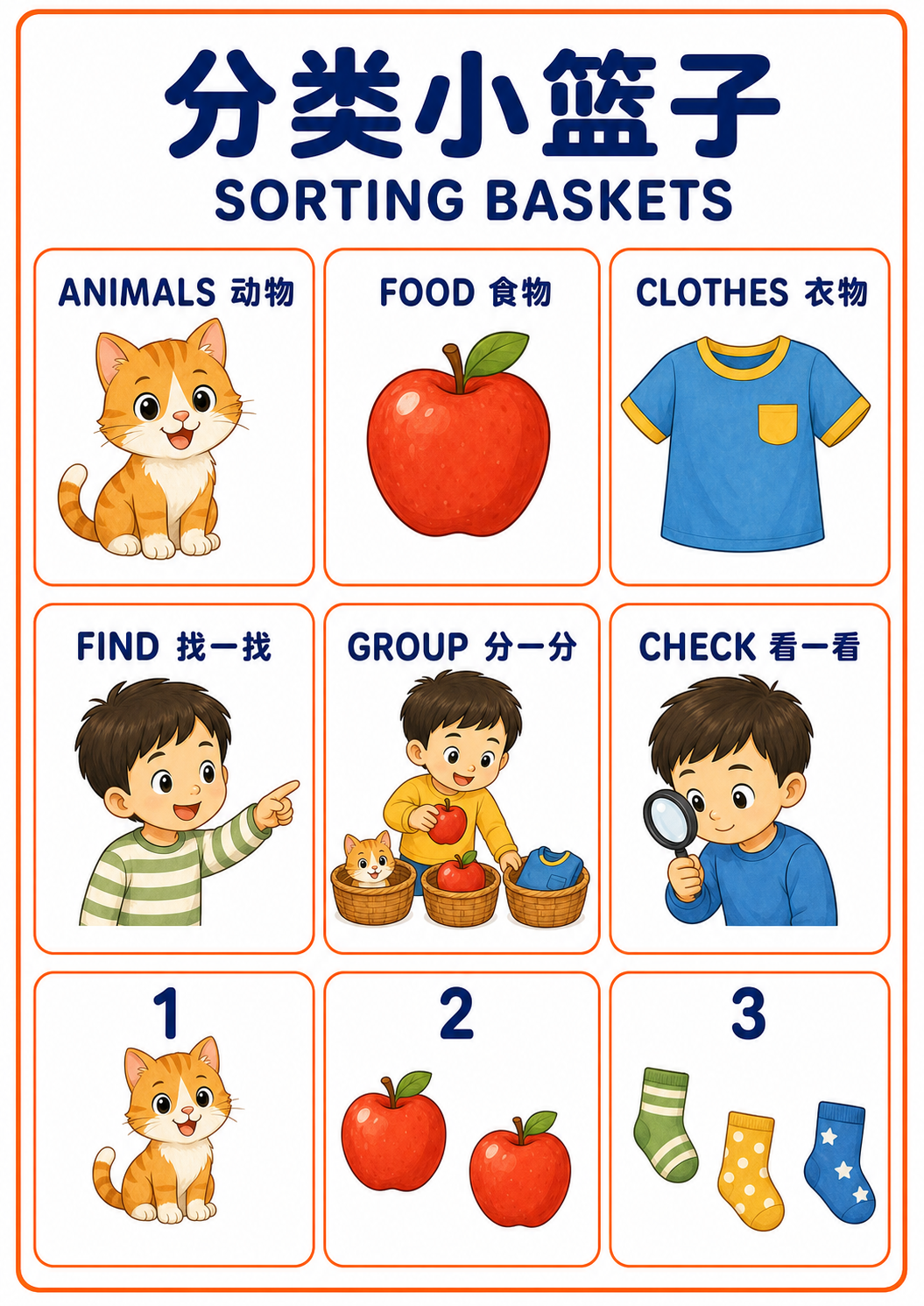
Open the original image to download or print
How to use it
Print in colour on portrait A4 paper with “Fit to page” selected, or show it full-screen. First point to the cat, apple, and shirt. Then say today's rule: “We are grouping by animals, food, and clothes.” Follow the middle row from find to group to check. Count only the bottom row. Amara does not need to read a label, remember all three groups, or complete every prompt.
Goals
- Chinese: understand 动物, 食物, 衣物, 找一找, 分一分, and 看一看 through pictures and adult descriptions.
- English: meet
animal,food,clothes,find,group, andcheck, and hear short natural chunks. - Cognition: notice one adult-stated sorting rule and indicate where one picture could go.
- Early math: touch exactly one cat, two apples, and three individual socks in the bottom row.
- Movement: copy three gentle gestures for find, group, and check.
- Life skills: hear sorting language during a normal tidy-up without turning it into a test.
Materials
- Only the A4 teaching picture above, printed or displayed full-screen.
- No baskets, cards, toys, or other teaching objects are required.
1. Chinese Picture Talk
Time: 5–8 minutes.
Let Amara look first, then describe one picture at a time:
- “这是一只猫,今天把它放在动物这一组。”
- “这是苹果,今天把它放在食物这一组。”
- “这是一件上衣,今天把它放在衣物这一组。”
- “先找一找,再分一分,最后看一看。”
Choose only one or two prompts:
- “猫在哪里?”
- “苹果今天放在哪一组?”
- “你想先找动物,还是衣物?”
If she points somewhere unexpected, stay curious: “你觉得它放这里。你是怎么想的?” Then restate the current rule gently: “今天我们按动物、食物和衣物来分。” A point or glance is already an answer.
2. English Time
Time: 3–5 minutes, focused on listening and pointing.
| English | Meaning | Picture or gesture |
|---|---|---|
animal | 动物 | Point to the cat |
food | 食物 | Point to the apple |
clothes | 衣物 | Point to the shirt |
find | 找 | Shade the eyes with one hand |
group | 分组 | Bring both hands gently together |
check | 看一看 | Point and look slowly |
Use short chunks:
Find the cat.Animals go here.Food goes here.Clothes go here.Let's group them.Let's check.
Say one chunk, pause, and accept a look, point, gesture, sound, or single word. Do not ask Amara to translate, recite the list, or produce a complete sentence.
3. Cognition: Find, Group, Check
Time: 3–5 minutes.
Use only the pictures on the poster:
- Say the basis clearly: “Today we group by animals, food, and clothes.”
- Ask Amara to find one picture that interests her.
- Point from that picture to the group named by today's rule.
- Say
Let's checkand describe the match: “The apple is food.”
If Amara indicates another place, first name what she did: “You put the apple with the red pictures.” That may be a sensible rule of her own. You can then model today's different rule without saying she is wrong.
4. Early Math: One, Two, Three
Time: 3–5 minutes.
Use only the three numbered cards at the bottom:
- Under 1, touch the one cat once and say
one cat. - Under 2, touch the two apples one at a time and say
one, two. - Under 3, touch the three separate socks one at a time and say
one, two, three.
The three socks are individual socks, not three pairs. Do not count the cat, apple, shirt, baskets, or people in the upper rows, and do not test numeral recognition.
5. Movement: Three Sorting Gestures
Time: 3–5 minutes.
Move away from the screen before acting:
Find— shade the eyes and look gently from side to side.Group— sweep both hands slowly towards the middle.Check— hold still, point, and look once more.
The adult can model all three while Amara copies only the gesture she likes. Small or incomplete movements count.
6. Everyday Connection: Adult-Led Tidy Language
During a tidy-up that is already happening, the adult may describe one broad group:
- “衣服放在这里。”
Clothes go here.- “这是吃的,先交给大人。”
Let's check together.
There is no need to set out objects or ask Amara to sort independently. The purpose is to connect a picture idea with calm everyday language.
Sorting Safety and Feelings
Do not offer small loose objects for this activity. If sorting language comes up during real tidying, the adult first removes choking hazards, food, medicines, sharp items, and anything breakable. Categories can change with the chosen rule, so avoid “wrong,” repeated correction, or pressure to finish. Stop while Amara is still comfortable.
Bedtime Recall
Keep it conversational:
- “今天看到了哪三组?”
- “猫放在动物组,还是衣物组?”
Find or check?Where does the apple go today?
Amara may answer with a look, point, gesture, sound, or one word. Model the answer if she does not respond.