Ready to Go
Ready to Go
Today we look at shoes, a hat, and a bag while practising three calm leaving-home cues: put on, wait, and hold hands. The adult remains responsible for every safety decision and transition.
Today's Approach
Amara is about 2 years and 4 months old. Keep each guided activity to 3–8 minutes. Looking, pointing, pretending to put something on, pausing, offering a hand, or saying one word all count as meaningful responses. The poster supports predictable routine language; it does not expect independence at doors, roads, lifts, or car parks.
A4 Teaching Picture
Open the original image to download or print
How to use it
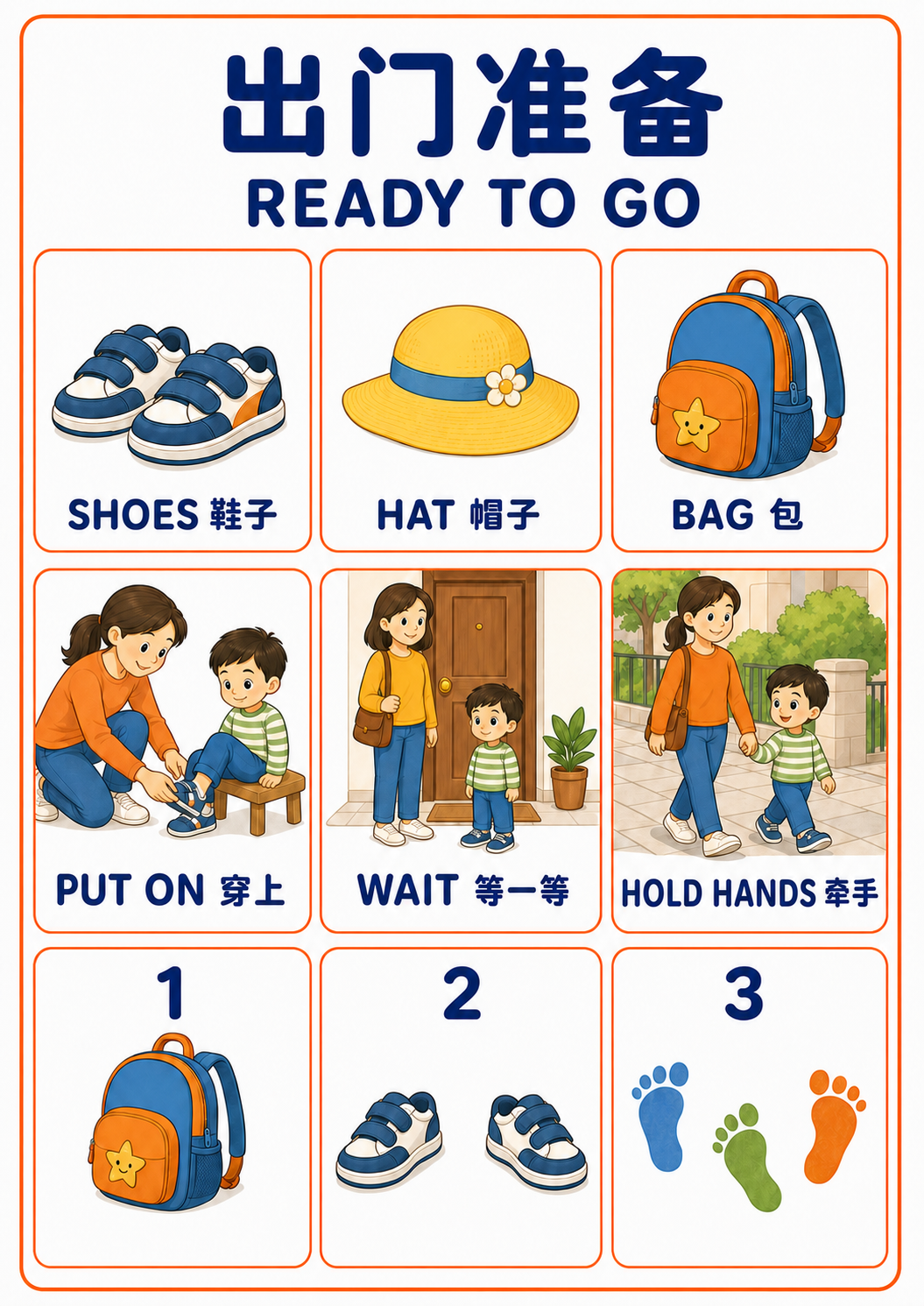
Print in colour on portrait A4 paper with “Fit to page” selected, or show it full-screen. First find the shoes, hat, and bag. Then point through put on, wait, and hold hands. Copy the actions with empty hands away from the screen. Count only the bottom row. Amara does not need to read, remember a sequence, dress independently, or answer every prompt.
Goals
- Chinese: understand 鞋子, 帽子, 包, 穿上, 等一等, and 牵手 through pictures and a familiar routine.
- English: meet
shoes,hat,bag,put on,wait,hold,hand, and natural leaving-home chunks. - Cognition: notice three simple parts of a familiar transition without being tested on their order.
- Early math: touch exactly one bag, two individual shoes, and three individual footprints in the bottom row.
- Movement: copy pretend dressing, calm waiting, and offering-a-hand gestures.
- Life skills: participate in one adult-led step when naturally leaving home.
Materials
- Only the A4 teaching picture above, printed or displayed full-screen.
- No clothing, bag, dressing practice, or outdoor trip is required for the lesson.
1. Chinese Picture Talk
Time: 5–8 minutes.
Describe one picture at a time:
- “这是两只鞋,出门时由大人帮忙看看有没有穿好。”
- “这是帽子,什么时候戴由大人看天气和场合决定。”
- “这是包,包由大人检查和保管。”
- “准备好后先等一等,再和大人一起走。”
Choose only one or two prompts:
- “鞋子在哪里?”
- “哪一张图在等一等?”
- “你想指帽子,还是包?”
If Amara offers her hand, name the action warmly: “你伸手来牵手了。” Do not ask her to demonstrate at an open doorway or near traffic.
2. English Time
Time: 3–5 minutes, focused on listening, pointing, and gestures.
| English | Meaning | Picture or gesture |
|---|---|---|
shoes | 鞋子 | Point to the pair of shoes |
hat | 帽子 | Point to the hat |
bag | 包 | Point to the bag |
put on | 穿上 | Pretend to guide a shoe onto a foot |
wait | 等一等 | Relax hands and become still |
hold my hand | 牵着我的手 | Offer one open hand |
Use short chunks:
Shoes on.Hat on.Bag ready.Wait with me.Hold my hand.Let's go together.
The poster uses the compact label HOLD HANDS. In everyday English, Hold my hand or Let's hold hands is more natural. Accept a look, point, gesture, sound, or one word; do not require translation or repetition.
3. Cognition: Three Calm Cues
Time: 3–5 minutes.
Point to the middle row:
Put on— pretend to put on one shoe or hat.Wait— pause together for one comfortable breath.Hold my hand— the adult offers a hand; Amara may touch it, look at it, or choose not to during picture play.
The adult can show the three pictures from left to right, but does not ask Amara to memorise or recite the order. Real departures vary, and the adult manages the actual sequence.
4. Early Math: Bag, Shoes, Footprints
Time: 3–5 minutes.
Use only the bottom cards:
- Under 1, touch the one bag once and say
one bag. - Under 2, touch the two separate shoes one at a time and say
one, two. - Under 3, touch the three separate footprint shapes one at a time and say
one, two, three.
The bottom shows three individual footprints, not three pairs. Do not count shoe straps, toes within a footprint, people, or objects in the upper rows. Do not test numeral recognition.
5. Movement: Put On, Wait, Reach
Time: 3–5 minutes.
Move away from the screen before acting:
Put on— tap one foot, then pretend to place a hat gently on the head.Wait— place hands comfortably by the body and pause.Hold my hand— reach one relaxed hand towards the adult.Together— take two slow steps only in a clear indoor space.
The adult follows Amara's comfort. Reaching is optional in pretend play, and one small gesture is enough.
6. Everyday Connection: Leaving with an Adult
At a departure that is already happening, use one or two familiar cues:
Shoes on.Wait with me.- “大人准备好了,我们再一起走。”
Hold my hand.
The adult checks clothing, weather needs, the bag, doorway, route, and transport. Holding an adult's hand, being carried, or riding securely in an appropriate stroller are all acceptable ways to stay together; the adult chooses what is safest in the moment.
Leaving-Home Safety
The adult—not the toddler—is responsible for deciding when and how to leave, operating the door or lift, checking the route, and supervising continuously. Use hand-holding, carrying, or an age-appropriate secured stroller as conditions require. Keep Amara beside the adult at doors, stairs, lifts, driveways, car parks, and roads. This activity never means she may open a door, walk ahead, or cross a road independently.
Bedtime Recall
Keep it conversational:
- “今天出门前看到了什么?”
- “等一等的时候,身体可以怎么做?”
Shoes, hat, or bag?Wait with me or hold my hand?
Amara may answer with a point, pause, hand gesture, sound, or one word. Model the answer instead of asking repeatedly.