
Push, Pull & Roll
Push, Pull & Roll
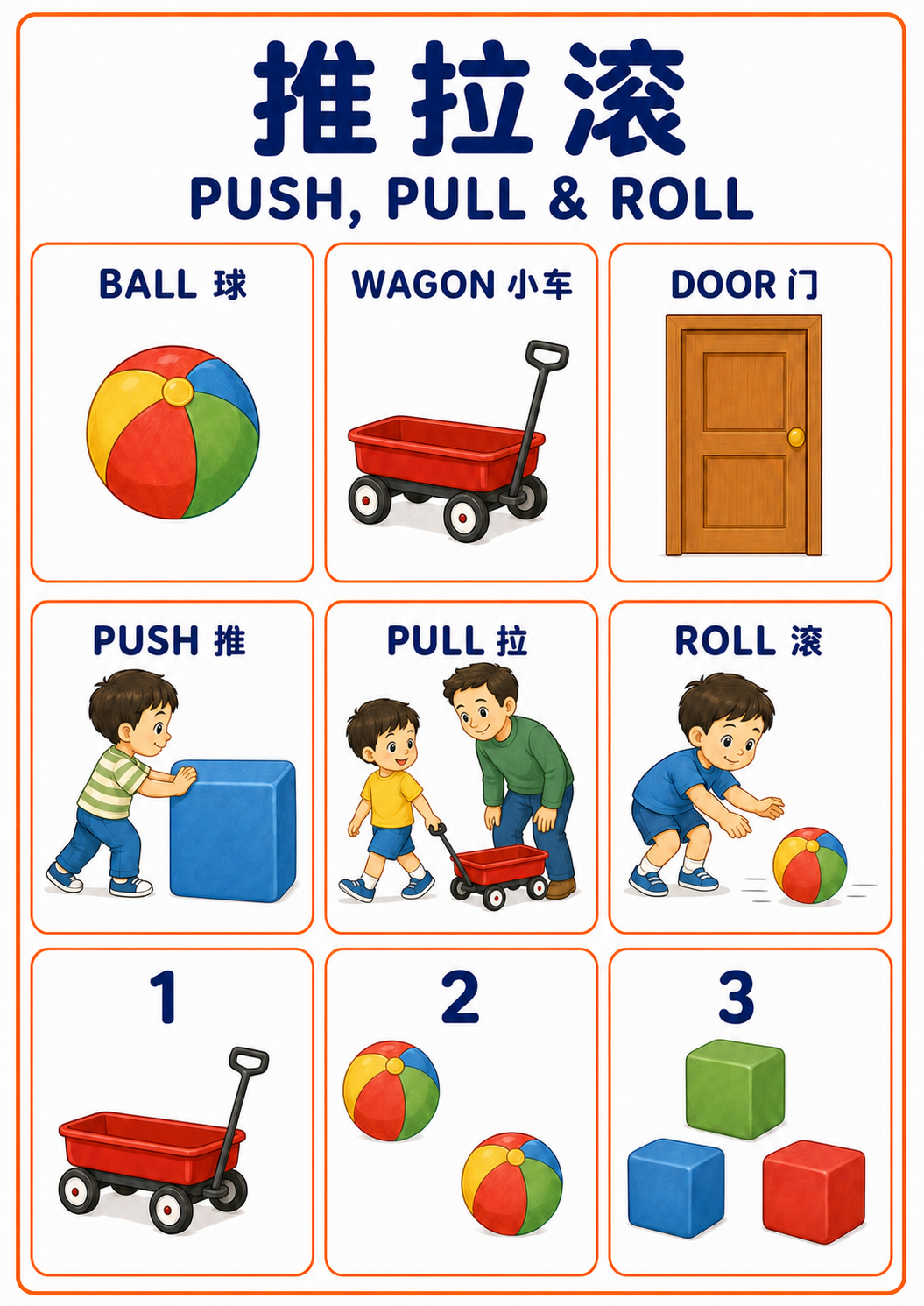
Today we look at a ball, wagon, and door while hearing three movement words: push, pull, and roll. All practice uses gentle gestures and pointing; Amara does not need to move a real object.
Today's Approach
Amara is about 2 years and 4 months old. Keep each guided activity to 3–8 minutes. Looking, pointing, copying one small gesture, making a sound, or saying one word all count as meaningful responses. The pictures introduce cause-and-effect language; they are not instructions to push people, handle doors, or use a wagon alone.
A4 Teaching Picture
Open the original image to download or print
How to use it
Print in colour on portrait A4 paper with “Fit to page” selected, or show it full-screen. First find the ball, wagon, and door. Next point to push, pull, and roll one at a time. Copy the actions with empty hands, well away from the screen and other people. Count only the bottom row. Amara does not need to read, memorise the three actions, or demonstrate them accurately.
Goals
- Chinese: understand 球, 小车, 门, 推, 拉, and 滚 through pictures and gentle gestures.
- English: meet
ball,wagon,door,push,pull,roll,gently, andstop. - Cognition: notice that an action can change how an object moves.
- Early math: touch exactly one wagon, two balls, and three soft blocks in the bottom row.
- Movement: copy small open-hand push, pull, and roll gestures without using force.
- Life skills: hear safe movement language during ordinary adult-supervised routines.
Materials
- Only the A4 teaching picture above, printed or displayed full-screen.
- A clear, dry space for small hand gestures; no ball, wagon, door practice, or other object is required.
1. Chinese Picture Talk
Time: 5–8 minutes.
Describe one card at a time:
- “这是球,球可以滚。”
- “这是小车,图里的小朋友轻轻拉。”
- “这是门。门由大人来开关,小手离门缝远一点。”
- “推、拉、滚,都会让东西的位置发生变化。”
Choose only one or two prompts:
- “球在哪里?”
- “哪一张图在拉?”
- “你想用手比一比推,还是滚?”
If Amara points or moves her hand, add the word: “你在做‘拉’的动作。” Do not ask her to move furniture, a door, or another person.
2. English Time
Time: 3–5 minutes, focused on listening, pointing, and empty-hand gestures.
| English | Meaning | Safe response |
|---|---|---|
ball | 球 | Point to the ball |
wagon | 小车 | Point to the wagon |
door | 门 | Point from a distance |
push | 推 | Move two open palms forward gently |
pull | 拉 | Draw two relaxed hands towards the body |
roll | 滚 | Make a slow circle with one hand |
Use short chunks:
Push gently.Pull it slowly.Roll the ball.Stop here.Hands off the door.
The poster label PULL names the action. Pull it slowly is a natural chunk for a supervised situation. Accept a look, point, gesture, sound, or one word; do not require translation or repetition.
3. Cognition: What Changes?
Time: 3–5 minutes.
Use the middle row:
- Point to
PUSHand move open palms a few centimetres forward. - Point to
PULLand move relaxed hands back towards the body. - Point to
ROLLand trace a slow circle in the air. - Describe the result simply: “The block moves away. The wagon comes closer. The ball rolls.”
These are picture observations, not predictions Amara must get right. If she uses the same gesture for two words, model the contrast once and continue without correcting her repeatedly.
4. Early Math: Wagon, Balls, Blocks
Time: 3–5 minutes.
Use only the bottom cards:
- Under 1, touch the one wagon once and say
one wagon. - Under 2, touch the two balls one at a time and say
one, two. - Under 3, touch the three separate soft blocks one at a time and say
one, two, three.
Do not count the objects repeated in the upper rows, the wagon wheels, or the colours on the ball. The goal is one finger touch for one whole pictured object, not numeral recognition.
5. Movement: Gentle Hands
Time: 3–5 minutes.
Stand or sit in a clear space away from the screen:
Push— open the palms and move them forward without touching anyone.Pull— pretend to hold a wide handle and draw it slowly closer.Roll— turn the forearms gently or trace a circle in the air.Stop— relax both hands and become still.
The adult controls the speed. One small motion is enough; there is no need for force or a full-body action.
6. Everyday Observation: Adult Handles the Object
Connect the words only when a safe situation happens naturally:
- The adult rolls a ball-sized object away from Amara's body and says
Roll. - The adult moves a suitable wagon and says
Pull it slowly. - At a doorway, the adult operates the door while saying, “小手离门缝远一点。”
Amara can watch from a safe position or point to the poster. She does not need to touch anything.
Push, Door, and Wagon Safety
Use only gentle gestures for this lesson. Never push a person, climb on or push furniture, or practise with a heavy object. An adult operates doors; keep fingers, feet, and the whole body away from hinges and closing gaps. A real wagon is used only with close adult supervision on a clear path after checking the handle and wheels. Do not ride in it unless the product is designed for riding and the adult follows its instructions.
Bedtime Recall
Keep it relaxed:
- “今天看到了球、小车和什么?”
- “哪个动作会让球滚起来?”
Push, pull, or roll?What do we do near a door? Hands off.
Amara may answer with a point, hand motion, sound, or one word. Supply the answer rather than asking repeatedly.