
Animal Homes
Animal Homes
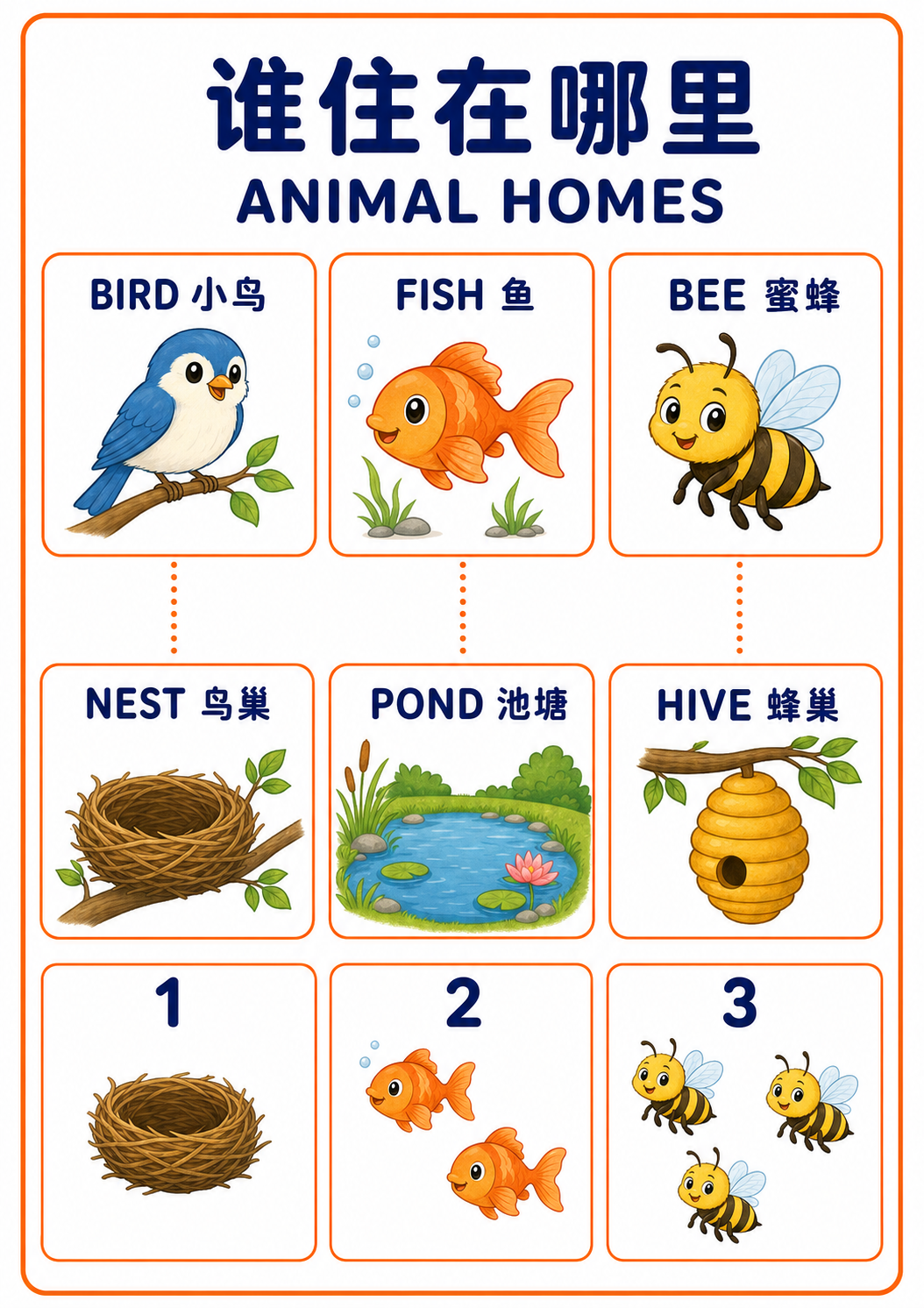
Today we follow three dotted paths from a bird, fish, and bee to a nest, pond, and hive. These are familiar toddler-friendly examples, not a rule that every animal of that kind has only one possible home.
Today's Approach
Amara is about 2 years and 4 months old. Keep each guided activity to 3–8 minutes. Looking, pointing, tracing a path, copying a movement, making a sound, or saying one word all count as meaningful responses. This is a picture conversation, not a memory test, and no outdoor visit is needed.
A4 Teaching Picture
Open the original image to download or print
How to use it
Print in colour on portrait A4 paper with “Fit to page” selected, or show it full-screen. Begin with one animal Amara notices. Name it, trace its dotted path with one finger, and name the pictured home. Try another path only if she remains interested. Count only the bottom row. She does not need to read labels, remember all three pairs, or repeat the sentences.
Goals
- Chinese: understand 小鸟, 鱼, 蜜蜂, 鸟巢, 池塘, and 蜂巢 through pictures and simple descriptions.
- English: meet
bird,fish,bee,nest,pond,hive,home, andfollow. - Cognition: visually follow one clear dotted path and notice an animal–place relationship.
- Early math: touch exactly one nest, two fish, and three bees in the bottom row.
- Movement: copy gentle bird, fish, and bee movements in a safe indoor space.
- Nature care: observe wildlife without touching, feeding, collecting, or disturbing it.
Materials
- Only the A4 teaching picture above, printed or displayed full-screen.
- No animal figures, outdoor trip, nest, pond, hive, or other object is required.
1. Chinese Picture Talk
Time: 5–8 minutes.
Describe one pair at a time:
- “这是一只小鸟,虚线走到一个鸟巢。”
- “这是一条鱼,虚线走到池塘。”
- “这是一只蜜蜂,虚线走到蜂巢。”
- “这些是常见例子,动物还可能住在别的地方。”
Choose only one or two prompts:
- “小鸟在哪里?”
- “从鱼开始,虚线走到哪里?”
- “你想找鸟巢,还是池塘?”
If Amara traces only part of a path, name what she found: “你的手指走到池塘了。” Do not require her to say both words in a pair.
2. English Time
Time: 3–5 minutes, focused on listening, pointing, and path tracing.
| English | Meaning | Picture or response |
|---|---|---|
bird | 小鸟 | Point to the bird |
fish | 鱼 | Point to the fish |
bee | 蜜蜂 | Point to the bee |
nest | 鸟巢 | Point to the nest |
pond | 池塘 | Point to the pond |
hive | 蜂巢 | Point to the hive |
Use short chunks:
This bird has a nest.This fish lives in a pond.This bee lives in a hive.Follow the dots.Here is its home.
Use this and these to keep the statements about the pictured examples. Accept a look, point, partial trace, sound, or one word. Do not ask for translation or memorised pair names.
3. Cognition: Follow the Dotted Paths
Time: 3–5 minutes.
Use one path at a time:
- Place a finger just below the bird and say
bird. - Follow the dots down to the nest and say
nest. - Repeat with fish–pond or bee–hive only if Amara wants more.
- Finish by describing one relationship: “This fish is pictured with a pond.”
If her finger moves to a different card, name that card rather than marking the path wrong. The adult can model the intended path once.
A More Accurate Adult Note
The poster uses three common, simplified pairings. Many birds use nests mainly for eggs and young, and species differ. Fish live in many kinds of water; a pond is one example. Bee nesting also varies: some colonies live in hives, while many bees use other nests or live solitarily. Keep toddler language simple while avoiding “all” or “only.”
4. Early Math: Nest, Fish, Bees
Time: 3–5 minutes.
Use only the bottom cards:
- Under 1, touch the one nest once and say
one nest. - Under 2, touch the two fish one at a time and say
one, two. - Under 3, touch the three bees one at a time and say
one, two, three.
Do not count bubbles, leaves, wings, stripes, or animals repeated in the upper cards. The aim is one touch for one whole pictured item, not numeral recognition.
5. Movement: Bird, Fish, Bee
Time: 3–5 minutes.
Move away from the screen before acting:
Bird— open and close both arms slowly like wings.Fish— place palms together and move them gently side to side.Bee— wiggle two fingers and make a quietbuzz.Home— bring both hands calmly together and become still.
Keep movements small. Amara may choose only one animal, and an approximation counts.
6. Everyday Observation: Look, Do Not Disturb
The poster is enough for today's learning. If a bird, fish, or bee happens to be visible from a safe place later, the adult may say:
- “我们远远看,不去碰。”
A bird. Let's watch quietly.The bee needs space.
There is no need to search for wildlife or arrange an outing.
Wildlife Safety
Never touch, move, open, or collect a nest or hive, and do not approach bees or other wild animals for this activity. Do not feed wildlife or put fingers into pond water. Observe only from an adult-chosen safe distance. If a bee comes close, the adult calmly moves the child away without swatting. Follow local medical advice for any sting or allergic reaction.
Bedtime Recall
Keep it conversational:
- “今天手指沿着哪条虚线走了?”
- “鱼和池塘是哪一组?”
Bird, fish, or bee?Nest, pond, or hive?
Amara may answer with a point, movement, sound, or one word. Model a pair if she does not respond.