
Opposite Moves
Opposite Moves
Today we use three clear pairs—fast and slow, up and down, open and close—to hear opposite words, choose a movement, and practise moving and stopping safely.
Today's Approach
Amara is about 2 years and 4 months old. Keep each guided activity to 3–8 minutes. Looking, pointing, moving, choosing, or saying one word all count as meaningful responses. The numbers at the bottom label three matching cards; they are not a quantity question.
A4 Teaching Picture
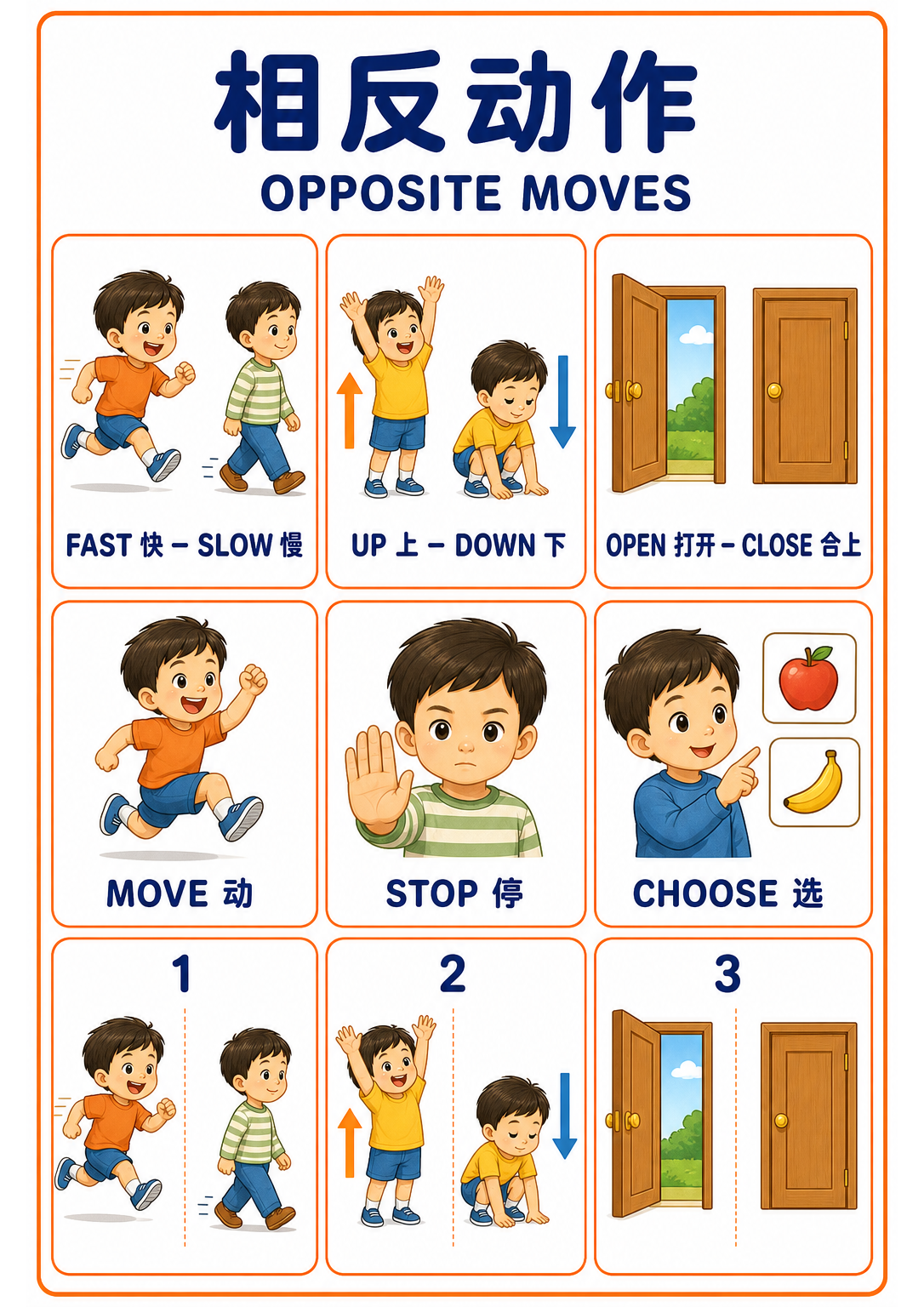
Open the original image to download or print
How to use it
Print in colour on portrait A4 paper with “Fit to page” selected, or show it full-screen. Begin with one pair that interests Amara, point to both sides, and copy the two actions. She does not need to read any words or finish all three pairs.
Goals
- Chinese: understand 快/慢, 上/下, 打开/合上, and respond through a point or action.
- English: meet
fast,slow,up,down,open,close,move,stop, andchoose. - Cognition: notice that two actions can be opposites and match the three bottom cards to the three top pairs.
- Movement: change speed and body position, then stop on a calm cue.
- Life skills: make one simple choice and notice opposite actions in an ordinary routine.
Materials
- Only the A4 teaching picture above, printed or displayed full-screen.
- A clear, dry, non-slip space for gentle movement.
1. Chinese Picture Talk
Time: 5–8 minutes.
Describe the top row one pair at a time:
- “这个小朋友跑得快,旁边的小朋友走得慢。”
- “手举到上面,再把身体放低到下面。”
- “门打开了,门又合上了。”
Offer one or two prompts:
- “你想做快,还是慢?”
- “上在哪里?下在哪里?”
- “哪扇门打开了?”
If Amara points without speaking, add the word for her: “对,这是打开。” Do not require her to say both sides of a pair.
2. English Time
Time: 3–5 minutes, focused on listening and moving.
| Pair or action | Meaning | Response |
|---|---|---|
fast / slow | 快 / 慢 | Move quickly for two safe steps, then slowly |
up / down | 上 / 下 | Reach up, then bend down |
open / close | 打开 / 合上 | Open, then close the hands |
move / stop | 动 / 停 | Move gently, then become still |
choose | 选 | Point to one of two actions |
Use short chunks:
Fast. Slow.Up. Down.Open. Close.Move. Stop.Choose one.
A correct look, point, action, sound, or single word is enough; no translation or full sentence is required.
3. Cognition: Match the Opposites
Time: 3–5 minutes.
Point to the three bottom cards:
- Card 1 shows the fast–slow pair. Match it to
FAST 快 – SLOW 慢. - Card 2 shows the up–down pair. Match it to
UP 上 – DOWN 下. - Card 3 shows the open–close pair. Match it to
OPEN 打开 – CLOSE 合上.
Say “card one, card two, card three” only to locate the cards. Do not ask “How many?” and do not count the children, arrows, or doors. Here, 1/2/3 are labels for three pair cards, not cardinal quantities.
4. Movement Game: Move, Stop, Choose
Time: 3–5 minutes.
Move away from the screen before beginning:
- Ask Amara to choose
fastorslow. - Do the chosen movement for two or three safe steps.
- Say
Stopand become still together. - Choose
upordown, thenopenorclose.
Follow her movement instead of correcting it. A raised hand can mean “up”; a small knee bend can mean “down.”
Movement Safety
“Fast” means only a few controlled steps in a clear space. Do not run towards a screen, furniture, stairs, or a doorway. Stop immediately if the floor is slippery or Amara becomes overexcited.
5. Everyday Observation and Life Skills
Connect one pair to something already happening:
- While walking together: “We are slow now.
Slow.” - While lifting and lowering the arms to dress: “Up, then down.”
- While using a familiar door or container with an adult: “Open, then close.”
Offer a real choice: “快还是慢?” or Up or down? Accept a point or movement as her answer.
Bedtime Recall
- “今天做了哪一组相反动作?”
- “快和慢,你喜欢哪一个?”
Open or close?- “什么时候需要停下来?”
Keep it conversational; model an answer if she does not respond.