
My Feelings
My Feelings
Today we look at happy, sad, and angry, then practise a simple co-regulation routine: stop, breathe, and offer a hug. Every feeling is welcome; feelings are not divided into good and bad.
Today's Approach
Amara is about 2 years and 4 months old. At this age, naming a feeling may still be difficult, especially in the middle of it. The adult notices and offers words without demanding an answer: “You look upset. Are you sad?” A point, facial expression, movement, sound, or no response at all is acceptable. Regulation is practised together, never used as a test.
A4 Teaching Picture
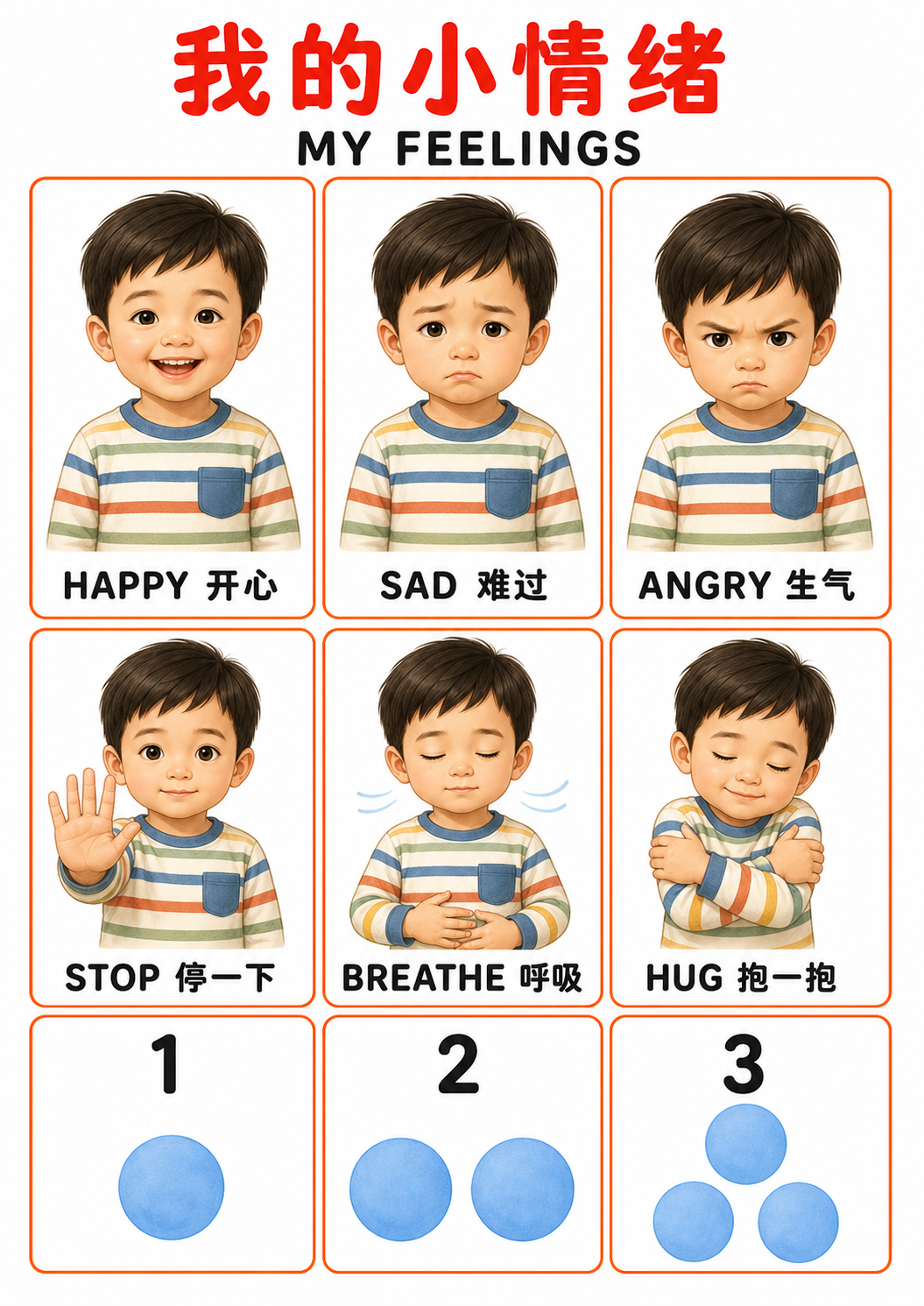
Open the original image to download or print
How to use it
Print in colour on portrait A4 paper with “Fit to page” selected, or show it full-screen. Let Amara look at the faces and regulation steps. Name what is shown, copy an expression only if she enjoys it, and practise the three actions together. She does not need to read the words or correctly label every face.
Goals
- Chinese: hear and begin to connect 开心, 难过, and 生气 with facial expressions and everyday experiences.
- English: meet
happy,sad,angry,stop,breathe, andhug. - Emotional development: understand that all feelings are allowed, while adults help keep bodies and behaviour safe.
- Early math: experience the three-step order stop–breathe–hug and count one to three blue circles along the bottom.
- Movement and life skills: pause the body, breathe with an adult, and choose a hug, closeness, or space.
Materials
- Only the A4 teaching picture above, printed or displayed full-screen.
- A calm place where the adult and child can sit or stand safely.
1. Chinese Picture Talk
Time: 5–8 minutes.
Start by describing rather than testing:
- “这个小朋友笑了,看起来很开心。”
- “这个小朋友嘴角向下,看起来有一点难过。”
- “这个小朋友皱着眉、身体紧紧的,好像很生气。”
Then make space for uncertainty:
- “你觉得她是什么感觉?”
- “也可能不是,我们再看看。”
- “开心、难过、生气都可以告诉我。”
- “情绪没有好坏,每一种感觉都在告诉我们一些事情。”
Do not ask Amara to smile on command when she is sad or to stop feeling angry. Separate feeling from behaviour: “生气可以。打人会痛,我会帮你把手停下来。”
Today's Original Mini Story
A little child builds a tall tower and feels happy.
The tower falls. She feels sad, and then her body becomes tight and angry.
Mum stays nearby: “All your feelings are welcome. I am here.”
They stop, breathe together, and Mum asks, “Would you like a hug?”
The child chooses a cuddle, rests, and decides what to do next.
Amara may point, listen, or walk away. The story does not promise that one breath will make a feeling disappear; the goal is to experience safe support.
2. English Time
Time: 3–5 minutes.
Words
| English | Meaning | Gentle cue |
|---|---|---|
| happy | 开心 | Point to the smiling face |
| sad | 难过 | Point to the face with a downturned mouth |
| angry | 生气 | Point to the tense face |
| stop | 停下来 | Hold one open palm |
| breathe | 呼吸 | Slowly breathe together |
| hug | 拥抱 | Self-hug, or open arms and wait for a choice |
Useful chunks for the adult to model:
Happy.Sad.Angry.All feelings are okay.Stop. Breathe with me.Would you like a hug?
Point to one pictured face and name it. If Amara chooses a different word, accept the attempt: facial expressions do not always tell us exactly how someone feels.
3. Three Gentle Steps: Stop, Breathe, Hug?
Time: 2–4 minutes when calm.
First look at the three groups of blue circles along the bottom:
- Touch the one circle in the first group and say
one. - Touch the two circles in the second group one at a time and say
one, two. - Touch the three circles in the third group one at a time and say
one, two, three.
Then practise the regulation steps before a difficult moment:
Stop.Make the feet still and keep hands safe.Breathe.Invite one slow breath together; take one or two more only if Amara wants to.Hug?Offer open arms, or model a self-hug. She may choose to hug the adult, hug herself, sit nearby, or have space.
Counting the circles and breathing are separate experiences. Three breaths are never a task to complete; looking, touching one circle, or declining the breathing practice is enough.
Co-regulation First
When a toddler is very upset, use fewer words, lower your body, protect everyone from hitting or throwing, and stay nearby. Do not force eye contact, breathing, or a hug. An adult's calm presence comes before teaching the steps.
4. Movement: Show Feelings with the Body
Time: 3–5 minutes.
Invite, but do not require, three brief body shapes:
Happy: open arms or sway.Sad: make the body small or rest hands together.Angry: press the feet safely into the floor, then relax.
Finish with:
- Hold up a gentle stop hand.
- Let the shoulders soften on a slow breath out.
- Ask
Hug?and respect the answer.
Avoid exaggerated imitation if Amara seems uncomfortable. The purpose is body awareness, not performing the “correct” face.
5. Everyday Observation
Use one real moment, preferably after everyone is calm:
- “You smiled when we played. Maybe you felt happy.”
- “You cried when it ended. Maybe you felt sad.”
- “Your hands became tight when you waited. Maybe you felt angry.”
Use tentative words such as “maybe” and let Amara disagree. Do not turn an active meltdown into a quiz. Later, record what happened before the feeling, how the body showed it, and what support helped.
6. Life Skill: Ask for Help
Model one short way to seek support:
- “抱抱。” /
Hug, please. - “帮忙。” /
Help, please. - “不要。” /
No. - “休息。” /
Rest.
Accept a gesture, reaching arms, moving closer, moving away, or pointing as communication. A hug is offered, never required.
Bedtime Recall
Keep it gentle:
- “今天什么时候很开心?”
- “有难过或生气的时候吗?”
- “什么让身体舒服一点?”
Hug or space?
If she does not want to revisit the day, simply say: “每一种感觉都可以来,我会陪着你。”