
More & Less
More & Less
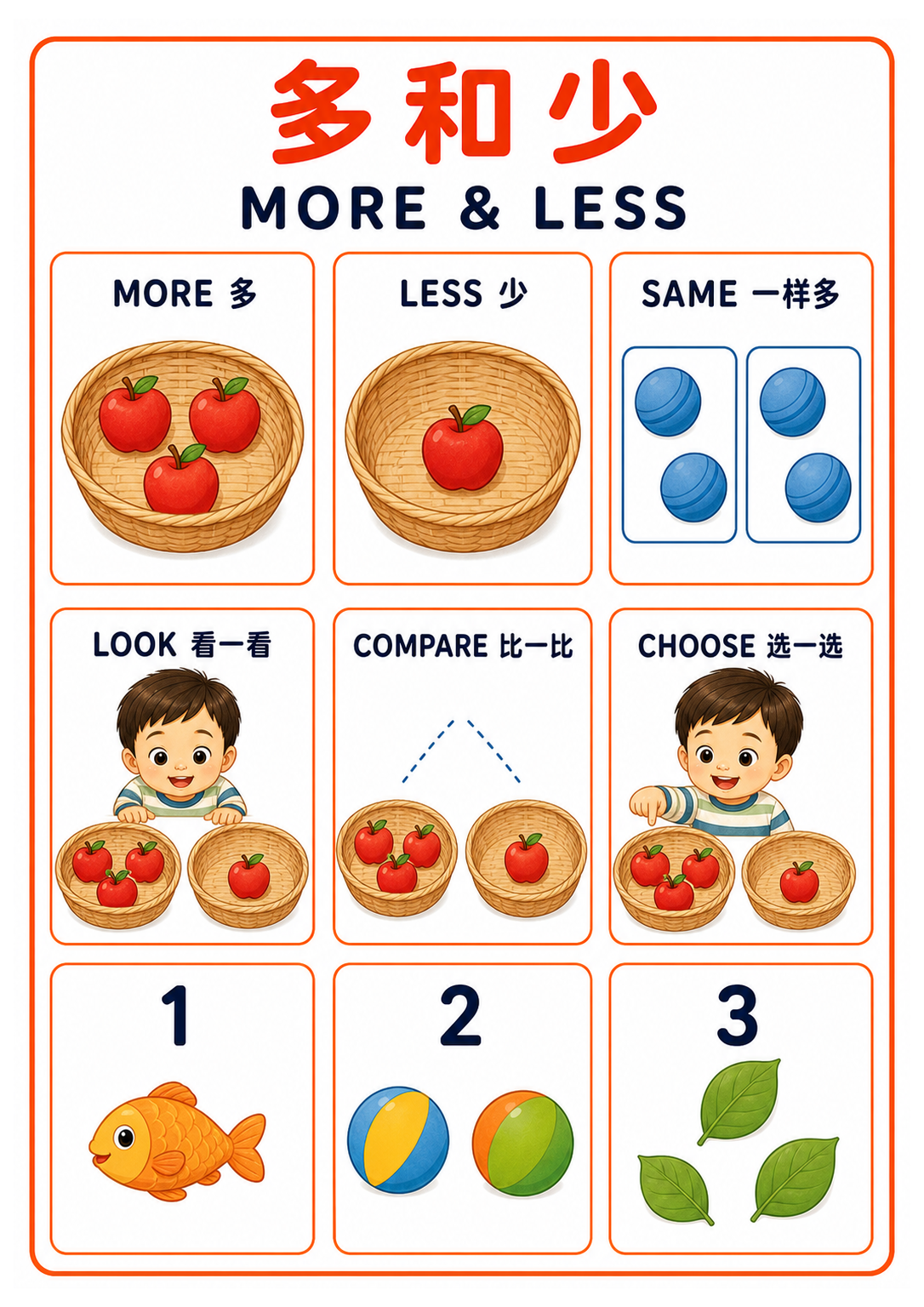
Today we compare two matching baskets to notice more and fewer apples, then look at two frames that have the same number of balls. At the bottom, we count one fish, two balls, and three leaves.
Today's Approach
Amara is about 2 years and 4 months old. Keep each guided activity to 3–8 minutes. Looking back and forth, pointing, choosing, or saying one word all count as meaningful responses. “More” and “less” only make sense when two groups are compared; they are not permanent names for an object. Do not teach symbols or equations.
A4 Teaching Picture
Open the original image to download or print
How to use it
Use only this A4 picture, printed or displayed full-screen. Compare the two matching apple baskets: MORE 多 has three apples and LESS 少 has one. In SAME 一样多, each blue frame has two balls. Follow LOOK 看一看, COMPARE 比一比, and CHOOSE 选一选, then count only the bottom row. Reading is not required.
Goals
- Chinese: understand 多, 少, 一样多 and 看一看, 比一比, 选一选.
- English: meet
more,less,same,look,compare, andchoose. - Cognition: compare two groups directly and notice more, fewer, or the same number.
- Early math: touch and count exactly 1 fish, 2 balls, and 3 leaves along the bottom.
- Movement and life skills: look between two options, make one choice, and hear fair quantity language in a normal routine.
Materials
- Only the A4 teaching picture above, printed or displayed full-screen.
- A calm place to sit or stand while looking between groups.
No apples, baskets, balls, fish, leaves, counters, cards, or other lesson objects are needed.
1. Chinese Picture Talk
Time: 5–8 minutes.
Look back and forth between the first two baskets:
- “两个篮子一样大,苹果数量不一样。”
- “这个篮子有三个苹果,比旁边的多。”
- “旁边的篮子有一个苹果,比三个少。”
Then look at the right card:
- “左边小框有两个球,右边小框也有两个球。”
- “两边一样多。”
Choose only one or two prompts:
- “哪一篮苹果比较多?”
- “哪一篮比较少?”
- “两个小框里的球一样多吗?”
If Amara points, describe the comparison instead of asking her to explain: “对,和一个苹果比,三个苹果比较多。”
2. English Time
Time: 3–5 minutes.
| English | Meaning | Picture response |
|---|---|---|
more | 多 | Point to the basket with three apples |
less | 少 | Point to the basket with one apple |
same | 一样多 | Look at the two frames with two balls each |
look | 看一看 | Look between two groups |
compare | 比一比 | Move a finger from one group to the other |
choose | 选一选 | Point to one group |
Use natural short chunks:
This basket has more apples.This basket has fewer apples.They have the same number.Look and compare.Choose one.
The poster label is LESS; when talking about countable apples, fewer apples is natural English. A point or one word is enough.
3. Cognition: Compare Two Groups
Time: 3–5 minutes.
Use the three middle actions:
LOOK: pause and look at both groups.COMPARE: move one finger between the two baskets.CHOOSE: point to the group with more, fewer, or the same number.
Always name both groups in the comparison: “Three apples are more than one apple.” Avoid calling an apple, basket, or child “more” or “less” on its own.
Do not introduce >, <, =, written sums, subtraction, or a worksheet-style correct answer.
4. Early Math: Count the Bottom Row
Time: 3–5 minutes.
Count only the bottom quantity cards:
- Touch the 1 fish once:
one fish. - Touch the 2 balls one at a time:
one, two. - Touch the 3 leaves one at a time:
one, two, three.
One complete object receives one touch and one number word. Do not count the colour patches on the balls or the lines inside the leaves.
5. Movement: Look, Compare, Choose
Time: 3–5 minutes.
Keep the body activity simple:
- Face the left picture group and
look. - Turn slowly towards the right group and
compare. - Point to the chosen group.
- Adult offers two safe movements—open arms or hands together—and Amara chooses one to do.
The choice does not need to be connected to a “correct” quantity answer.
Comparison Safety and Respect
Keep turns and pointing slow around a screen. Do not use more/less to compare children's food intake, body size, worth, affection, or ability. During meals, follow hunger and fullness cues rather than asking Amara to eat “more” for the lesson.
6. Everyday Observation and Life Skills
During a naturally occurring routine, compare two visible groups without arranging a test:
- “这里有两只鞋,那里有一只鞋。这里比较多。”
- “两个位置各有一只鞋,一样多。”
Look. Which group has more?
It is fine if Amara does not answer. Finish by letting her choose which picture station to close or revisit.
Bedtime Recall
- “哪一篮有三个苹果?”
- “和三个苹果比,一个苹果是多还是少?”
More, fewer, or the same?- “今天你最喜欢看、比,还是选?”
Keep it conversational and avoid repeating a question after she loses interest.