
Ocean Friends
Ocean Friends
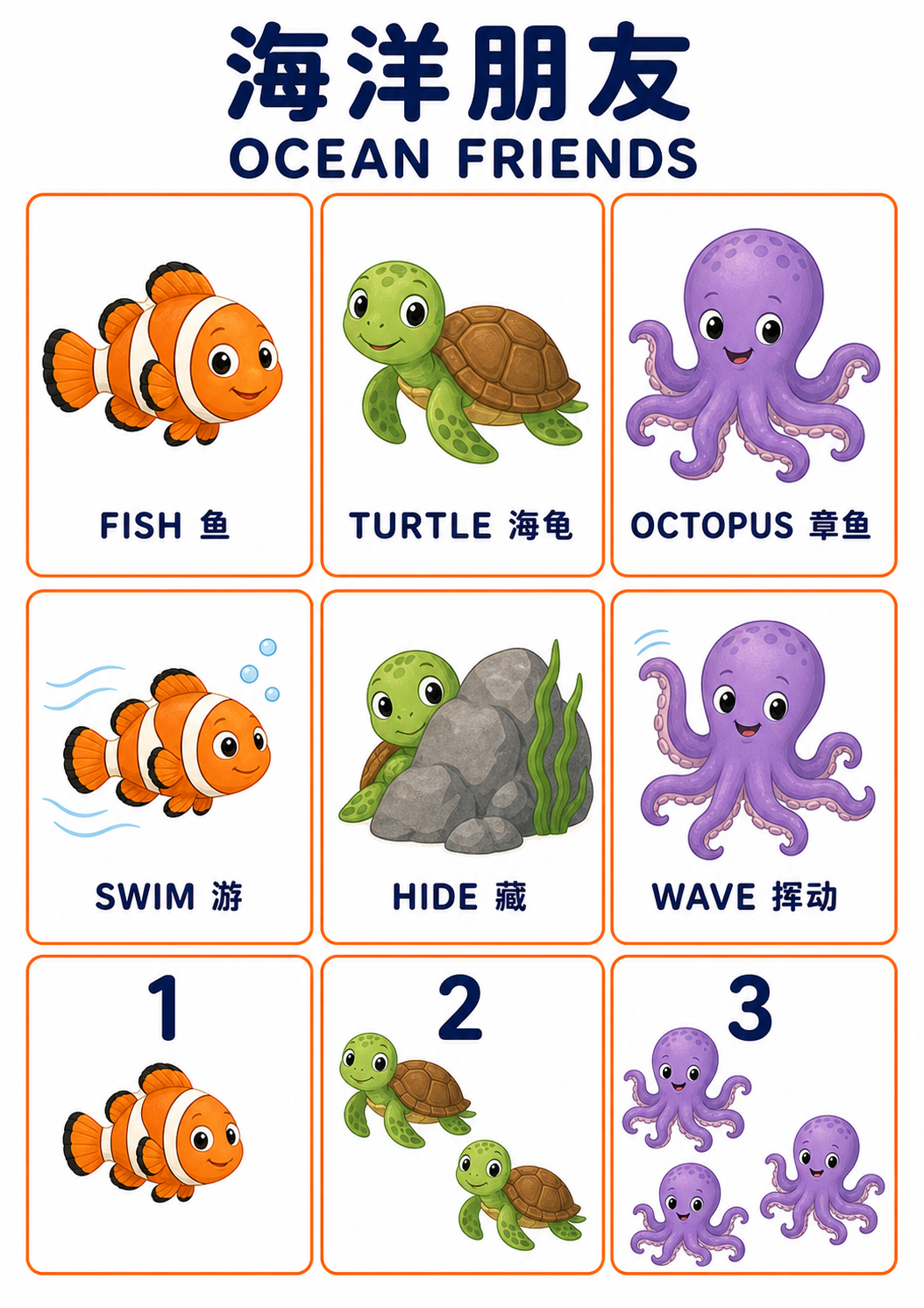
Today we meet a fish, turtle, and octopus, then connect them with swim, hide, and wave. Everything can be done with the A4 picture and dry-land movements; this lesson does not require a trip to the sea, river, pool, or aquarium.
Today's Approach
Amara is about 2 years and 4 months old. Keep each guided activity to 3–8 minutes. Looking, pointing, making a movement, producing an animal sound, or saying one word all count as meaningful responses. The action pairings are examples, not rules about the only thing each animal can do.
A4 Teaching Picture
Open the original image to download or print
How to use it
Print in colour on portrait A4 paper with “Fit to page” selected, or show it full-screen. First find the fish, turtle, and octopus. Next point to swim, hide, and wave. For counting, use only the bottom numbered row: one fish, two turtles, and three octopuses. Amara does not need to read the labels or retell the lesson.
Goals
- Chinese: understand 鱼, 海龟, 章鱼 and 游, 藏, 挥动 through picture talk and movement.
- English: meet
fish,turtle,octopus,swim,hide, andwavein short natural sentences. - Early math: touch exactly one fish, two turtles, and three octopuses one at a time.
- Movement: copy three gentle dry-land movements inspired by ocean animals.
- Nature and life skills: notice different animal bodies while learning that real water and wildlife require adult protection.
Materials
- Only the A4 teaching picture above, printed or displayed full-screen.
- A dry, clear, non-slip space for gentle movements.
No toy animals, water tray, bath, or visit to real water is needed.
1. Morning Chinese Picture Talk
Time: 5–8 minutes.
Let Amara choose where to look first:
- “这是一条鱼。鱼摆动身体向前游。”
- “这是一只海龟。它有可以保护身体的壳。”
- “这是一只章鱼。章鱼的手臂在水里挥动。”
- “鱼会游,海龟也会游;动物可以做很多不同的动作。”
Choose only one or two prompts:
- “鱼在哪里?”
- “谁背着壳?”
- “哪一只是章鱼?”
- “你想模仿游、藏,还是挥动?”
If she says “鱼”, expand it to “对,一条鱼在游。” If she waves an arm, respond with “你在像章鱼一样挥动。”
Today's Original Mini Story
A little fish swims through the blue water. A turtle peeks out, then hides safely behind some rocks. An octopus lifts its arms and waves hello. The three ocean friends move in different ways. They stay in their ocean home while Amara waves from dry land.
Pause for Amara to find or move like one animal. She does not need to remember the plot.
2. English Time
Time: 3–5 minutes, focused on listening, pointing, and moving.
Words
| English | Meaning | Gentle response |
|---|---|---|
| fish | 鱼 | Point to the fish |
| turtle | 海龟 | Point to the turtle and its shell |
| octopus | 章鱼 | Point to the octopus |
| swim | 游 | Move joined hands gently side to side |
| hide | 藏 | Tuck the chin or cover the face briefly |
| wave | 挥动 | Wave one hand or arm |
Useful Chunks
Show me the fish.Show me the turtle.Show me the octopus.The fish swims.The turtle hides.The octopus waves.
Play:
- Say
Show me the fish.and wait for a look or point. - Move joined hands and say
The fish swims. - Tuck in gently and say
The turtle hides. - Wave one arm and say
The octopus waves.
Do not require translation or full pronunciation of octopus. A point, partial word, or matching movement is enough.
3. Early Math: Ocean Friends One, Two, Three
Time: 3–5 minutes.
Use only the bottom counting row:
- Under 1, touch the one fish once and say
one fish. - Under 2, touch the two turtles one at a time and say
one, two. - Under 3, touch the three octopuses one at a time and say
one, two, three.
The aim is one finger touch for one complete animal picture. Do not count fins, shells, or arms, and do not test numeral recognition.
4. Movement: Swim, Hide, Wave
Time: 3–5 minutes.
Move in a dry space away from the screen:
Swim— join hands and move them gently from side to side.Hide— make the body small or briefly place hands near the face.Wave— wave one hand, two hands, or both arms slowly.- Let Amara choose one movement to repeat.
Movement Safety
These are pretend dry-land movements, not swimming instruction. Keep feet on a dry, non-slip floor and movements slow near furniture. Do not cover Amara's face or restrict her breathing; she controls how she pretends to hide.
5. Picture and Real-Life Observation
Use the poster for one short observation:
- Find the fish's tail, the turtle's shell, or the octopus's many arms.
- Notice that the three animals have different body shapes.
- Describe one detail without asking Amara to name it.
If the family naturally visits an aquarium, observe through the barrier and follow staff rules. This lesson does not ask the family to visit or approach real water.
Water and Wildlife Safety
Near any sea, river, pond, pool, bath, or other water, an adult provides continuous close supervision and stays within immediate reach. Never approach, chase, feed, or touch unfamiliar wildlife. Looking at the poster safely at home fully completes today's lesson.
Bedtime Recall
Keep it light:
- “今天最喜欢哪个海洋朋友?”
- “谁背着壳?”
Fish, turtle, or octopus?Swim, hide, or wave?
Amara may answer with a point, movement, sound, or one word.