
In Front and Behind
In Front and Behind
Today pictures of a chair, box, and ball introduce in front and behind. We name a reference object and use pointing instead of a hiding game.
Today's Approach
Amara is about 2 years and 5 months old. Keep each activity to 3–8 minutes. Looking, pointing, moving a hand, saying one word, or declining all count. Spatial words grow through shared attention and movement; full sentences and hiding behind objects are not needed.
A4 Teaching Picture
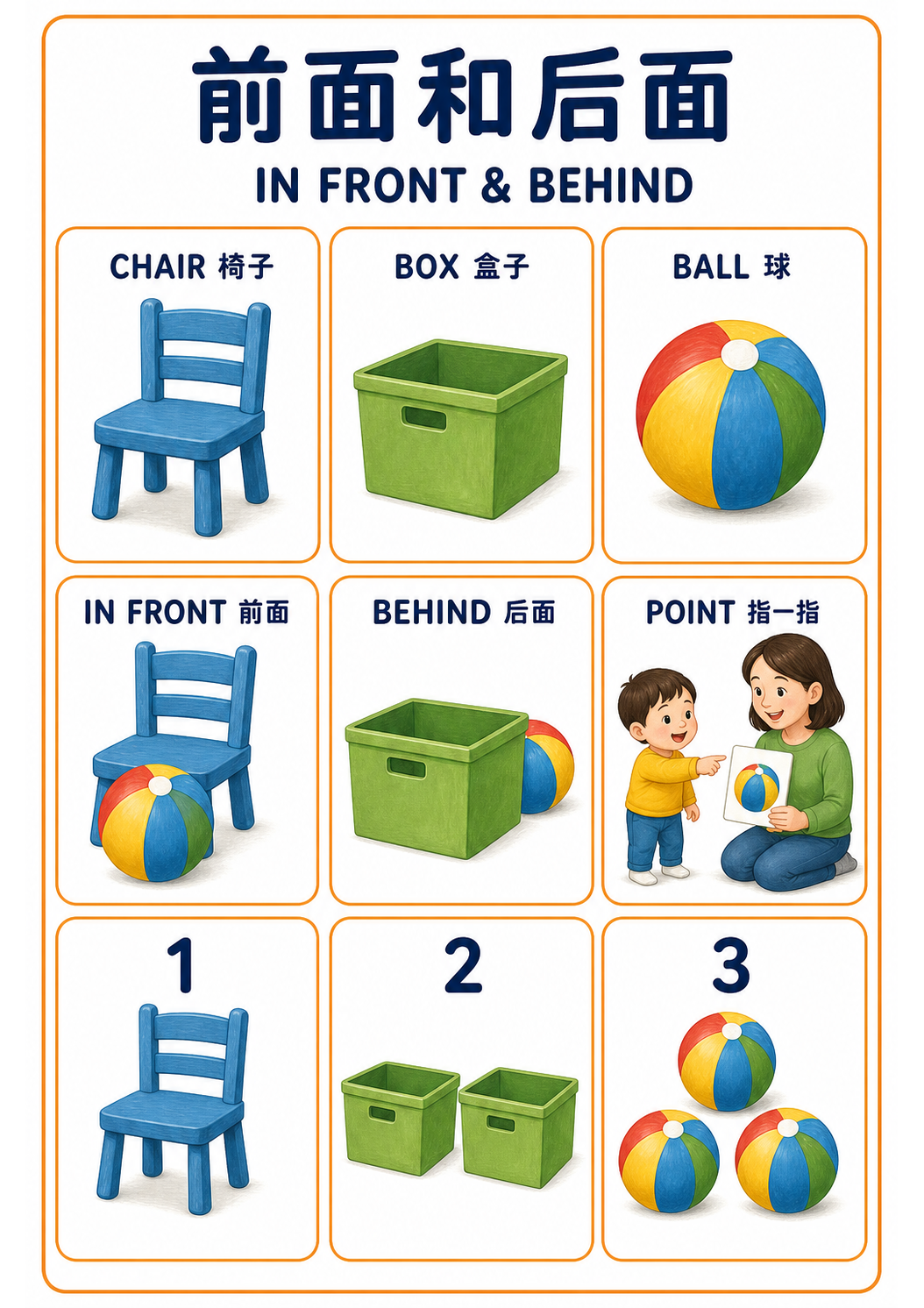
Open the original image to download or print
How to use it
Print in colour on portrait A4 paper with “Fit to page” selected, or display it full-screen. State the whole relationship—“The ball is in front of the box”—because front and behind need a reference object.
Goals
- Chinese: meet 椅子, 盒子, 球, 在前面, 在后面, and 指一指.
- English: meet
chair,box,ball,in front,behind, andpoint. - Cognition: use overlap and relative position to interpret front and behind in a picture.
- Early maths: count one chair, two boxes, and three balls.
- Movement and safety: show positions with the hands without climbing into boxes or hiding behind furniture.
Materials
- Only the A4 teaching picture above, printed or displayed full-screen.
- No chair, cardboard box, ball, or hiding prop is needed.
1. Chinese Picture Talk
Time: 5–8 minutes.
Point and use whole relationship statements:
- “球在盒子前面。”
- “球在盒子后面,能看到一部分。”
- “椅子在这里,指一指。”
Invite a response:
- “球在哪里?”
- “哪一张球在前面?”
- “你想指前面还是后面?”
If she gives the reverse answer, describe what she pointed to and trace the overlapping edge again; avoid “You are wrong.”
2. English Time
Time: 3–5 minutes.
| Chunk | Meaning | Possible response |
|---|---|---|
chair | 椅子 | Point to the chair |
box | 盒子 | Point to the box |
ball | 球 | Point to the ball |
in front | 在前面 | Place one hand in front of the other |
behind | 在后面 | Move one hand behind the other |
point | 指一指 | Point with a finger or whole hand |
Use Ball in front., Ball behind the box., and Point, please. Here, “please” is an invitation, not a demand.
3. Early Maths: Count the Bottom Objects
Time: 3–5 minutes.
- 1 chair:
one chair. - 2 boxes: touch each and say
two boxes. - 3 balls: touch each and say
three balls.
Model one round, then let Amara choose whether to join. Do not mix objects from the upper scenes into the bottom-row counts.
4. Gesture Game: Hand in Front, Hand Behind
Time: 3–5 minutes.
- Hold one upright hand as the “box.”
- Put the other hand before it:
in front. - Move that hand behind it:
behind. - Pause and let Amara point to choose what comes next; watching is also participation.
Two fingers can represent the ball and box, so the whole game remains seated.
Safety
Do not ask Amara to hide inside a cardboard box or climb behind large furniture, a door, or a curtain to practise “behind.” Keep her visible at all times. Gestures and picture pointing fully express the relationship.
5. Everyday Observation and Life Skills
Describe only naturally occurring, safe positions that will not invite climbing or hiding: “The shoes are in front of the door” or “The adult is behind the chair.” If she runs to hide, restore visibility and safety before returning to the picture.
Bedtime Recall
- “球在盒子前面,还是后面?”
- “你喜欢哪一张球?”
In front or behind?
Ask once. A point, hand movement, or no answer is acceptable.