What Are They Doing?
What Are They Doing?
Today we look at whether picture characters are eating, reading, or building. We use action clues to understand what is happening and respond through gaze, pointing, movement, or one word.
Today's Approach
Amara is about 2 years and 5 months old. Keep each activity to 3–8 minutes. Looking, pointing, copying an action, saying one word such as “eat” or “book,” or declining all count. A complete subject–verb sentence and exact pronunciation are not required.
A4 Teaching Picture
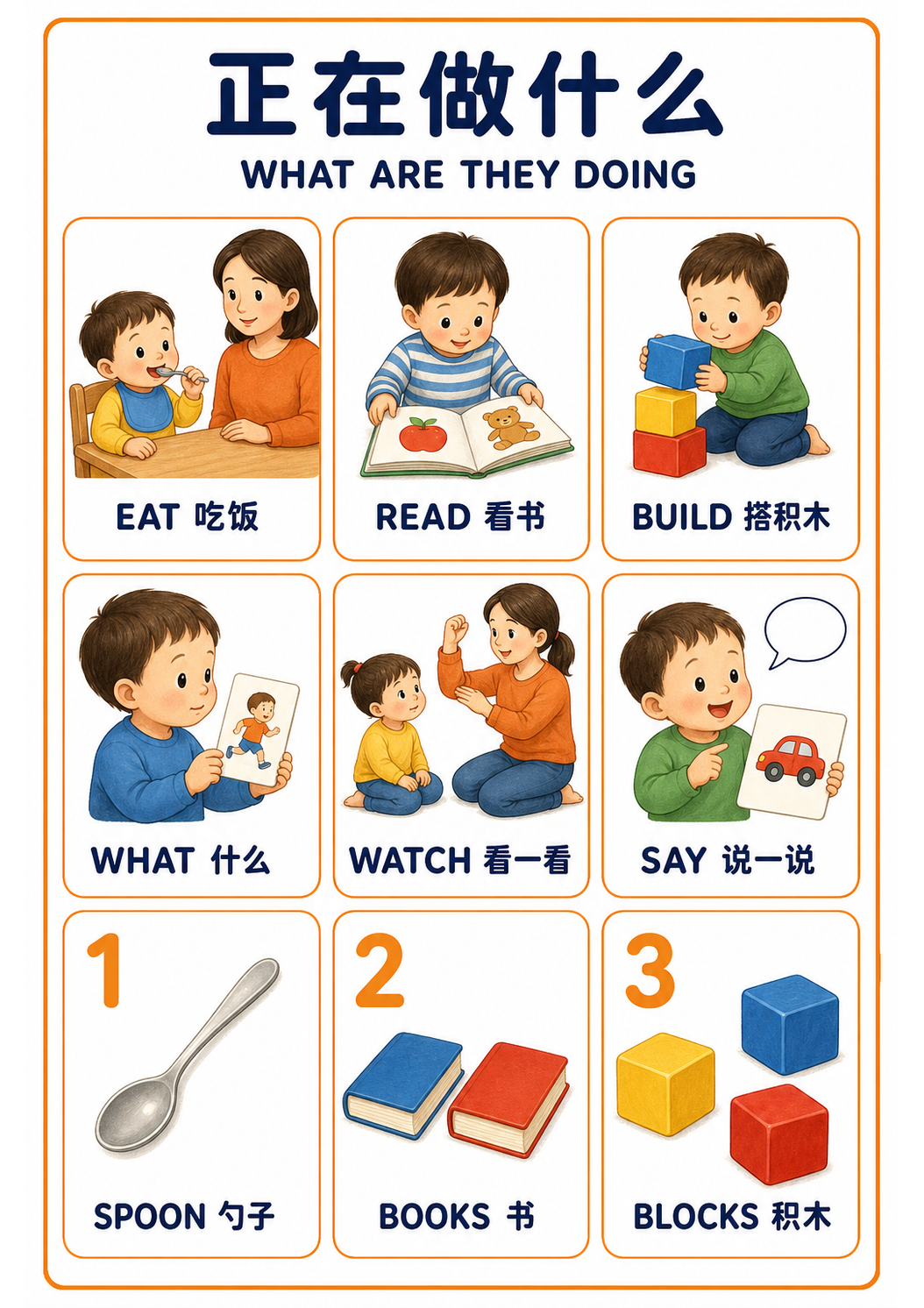
Open the original image to download or print
How to use it
Print in colour on portrait A4 paper with “Fit to page” selected, or display it full-screen. State one objective action description, then ask “What are they doing?” once. Avoid a chain of why, where, and what-with questions.
Goals
- Chinese: meet 吃饭, 看书, 搭积木, 什么, 看一看, and 说一说.
- English: meet
eat,read,build,what,watch, andsay. - Cognition: infer a pictured action from hands, objects, and body posture.
- Early maths: count one spoon, two books, and three blocks.
- Life skills: connect eating with sitting and adult supervision, and building with large, safe materials.
Materials
- Only the A4 teaching picture above, printed or displayed full-screen.
- Do not prepare food, a spoon, books, or blocks as test objects.
1. Chinese Picture Talk
Time: 5–8 minutes.
Describe each action:
- “孩子坐着吃饭,大人在旁边。”
- “孩子正在看书。”
- “孩子正在搭积木。”
Offer one or two prompts:
- “他在做什么?”
- “你想看吃饭、看书还是搭积木?”
- “哪张图里手正在动?”
If Amara says only “书,” expand it for her: “对,他在看书。” She does not need to repeat the expanded sentence.
2. English Time
Time: 3–5 minutes.
| Word | Meaning | Possible response |
|---|---|---|
eat | 吃饭 | Point or use a small eating gesture |
read | 看书 | Hold the hands like an open book |
build | 搭积木 | Place one hand above the other |
what | 什么 | Look towards an action card |
watch | 看一看 | Watch the adult model |
say | 说一说 | Make a sound, say one word, or stay quiet |
Use What are they doing?, Eat., Read., Build., and Watch and say. Here, say is an invitation; watching completes the interaction too.
3. Early Maths: 1, 2, 3 in the Actions
Time: 3–5 minutes.
- 1 spoon:
one spoon. - 2 books: touch each and say
two books. - 3 blocks: touch each and say
three blocks.
Count only the complete bottom objects, not book pages, cover lines, or block faces. Match one point to one object.
4. Action Guessing: Watching Is Enough
Time: 3–5 minutes, with no objects:
- Hold the hands like a book; Amara may watch or guess 看书.
- Make one slow stacking gesture; she may point to
BUILD. - Make one small eating gesture, then stop.
- Switch choice: she points to a card and the adult copies it.
If she does not want to imitate, the adult can do all the actions. She does not have to “perform.”
Everyday Safety
During real meals, Amara sits securely with close adult supervision; she does not eat while walking, running, laughing actively, or lying down. Real building uses age-appropriate large pieces without choking hazards. No food or toys are needed for this page.
5. Everyday Observation and Life Skills
Use parallel talk once during an ordinary routine: “你正在看书” or “我正在收拾.” Then leave quiet space rather than requesting an answer. This connects action words to experience without interrupting concentration.
Bedtime Recall
- “图里的孩子做了什么?”
- “吃饭、看书、搭积木,你喜欢看哪张?”
Eat, read, or build?
One action, noun, or point is a complete response.