
None, One & Many
None, One & Many
Today we learn everyday quantity words without turning numeral zero into a recognition task.
Today's Approach
Amara is about 2 years and 6 months old. Keep each part to 3–8 minutes and use only the poster and audio. Looking, pointing, one word, pausing, or declining all count. Adults describe the pictures without testing numeral recognition or asking exactly how many “many” means.
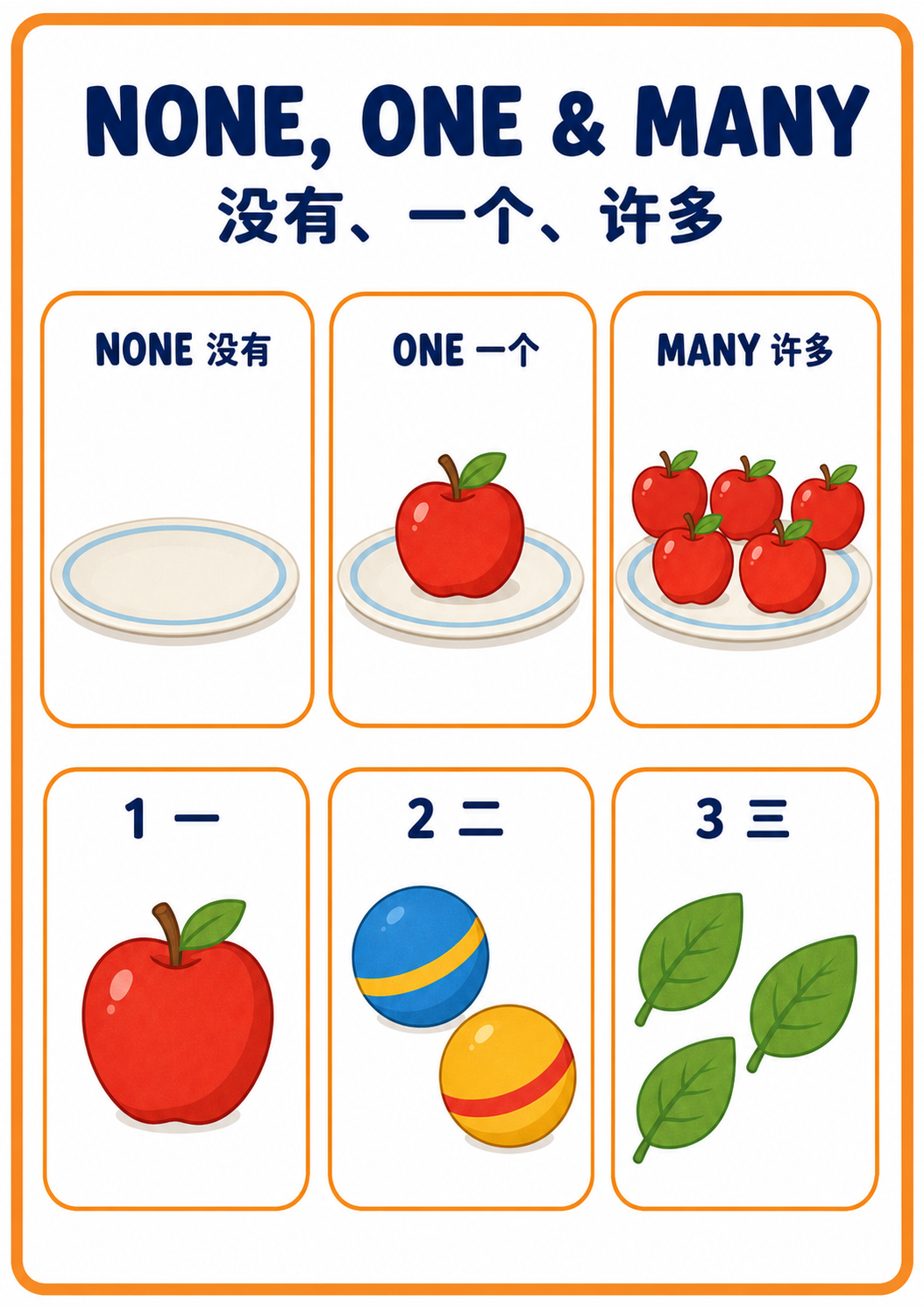
A4 Teaching Picture
Goals
- Chinese: understand “没有、一个、许多.”
- English: meet
none,one, andmany. - Early math: notice empty, single, and grouped quantities; count the bottom row from 1 to 3.
- Life skill: hear useful phrases such as “没有了” and “还有许多.”
Materials
- Only the A4 poster and English audio.
- No apples, plates, balls, or real leaves are needed.
1. Chinese Picture Talk
Time: 5–8 minutes.
Say from left to right, “盘子上没有苹果。这里有一个苹果。这里有许多苹果。” Then pause. Pointing to one card, saying “苹果,” or giving no response are all acceptable.
2. English Time
Time: 3–5 minutes.
Transcript:
English time. Listen, look, or point. None. One. Many. The plate has none. Here is one apple. Here are many apples. We are learning quantity words.
Point to each picture. Repetition is not requested.
3. Math 1 / 2 / 3
Time: 3–5 minutes. Count only 1 apple, 2 balls, and 3 leaves in the bottom row. Use many for the upper group without counting it through. Do not pair the empty plate with numeral zero.
4. Movement & Life
Time: 3–5 minutes. Show an empty adult palm for none, one adult finger for one, and open both hands for many. Amara may simply watch. Use quantity words naturally without removing the child's possessions to manufacture an example.
Early-Math Development
The focus is understandable quantity language, not recognising zero, matching symbols, rapid counting, or testing “how many.” The apples are pictures only; do not introduce food rewards or loose-object tasks.
Bedtime
Say, “No apple on the pillow; one in this picture; many in that picture.” Listening is enough.