
Where Did the Sound Come From?
Where Did the Sound Come From?
Today we look at three possible sound sources and listen only at a comfortable volume.
Today's Approach
Amara is about 2 years and 6 months old. Keep each activity to 3–8 minutes. Looking, pointing, making a listening gesture, saying one word, pausing, or declining all count. This is not a sound-identification test.
A4 Teaching Picture
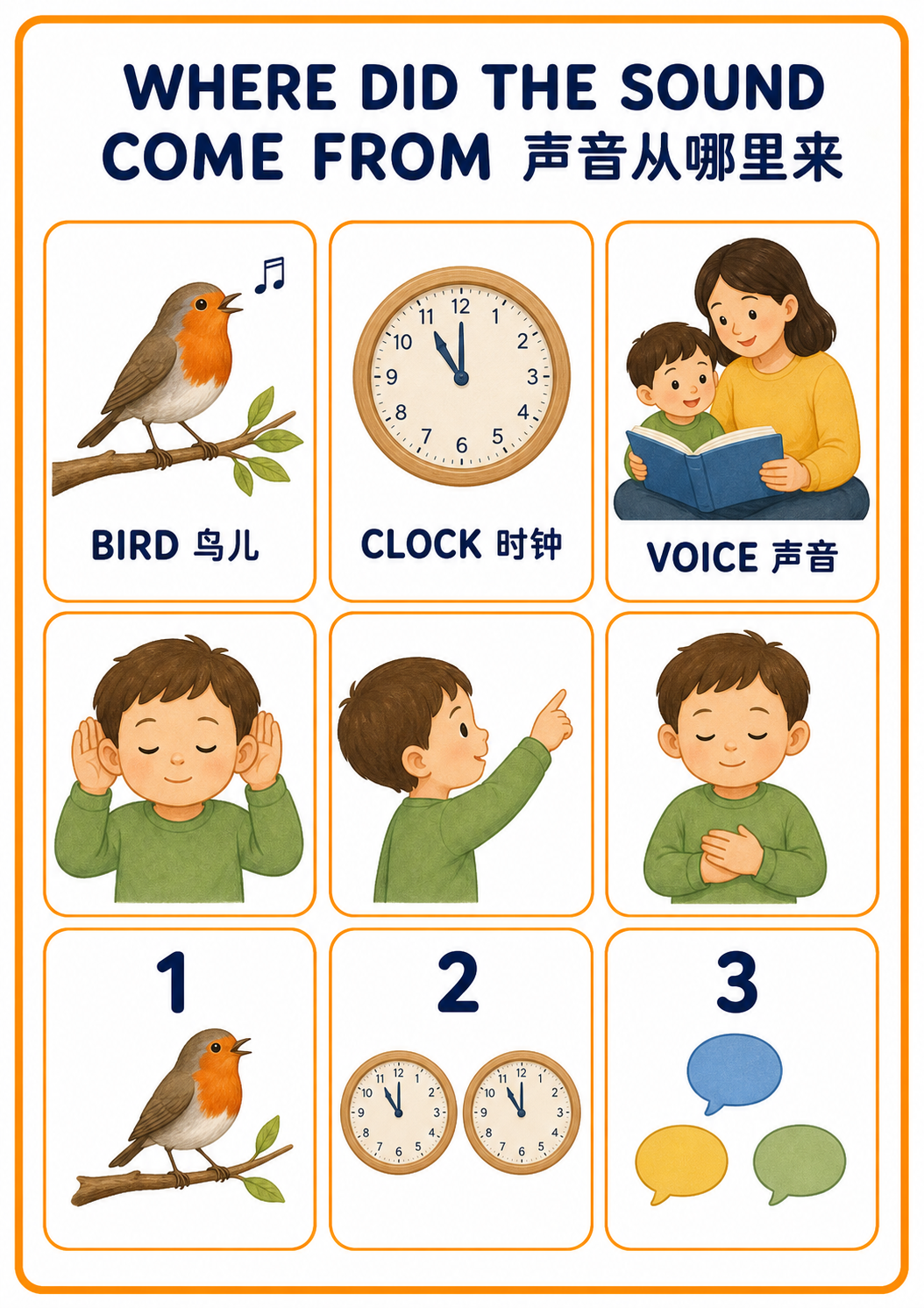
Open the original image to download or print
How to use it
Print on portrait A4 paper or show it full-screen. Use only the poster and audio. No clock, instrument, sound toy, or other object is needed.
Goals
- Chinese: understand “鸟儿、时钟、读书声、声音来源.”
- English: meet
bird,clock,voice, andsound. - Science: know that sound usually comes from a vibrating source; the poster gives simple examples.
- Early math: count one bird, two clocks, and three speech bubbles.
- Hearing care: keep sound comfortable and stop immediately if Amara covers her ears, leaves, or asks to stop.
Materials
- The A4 poster and audio only.
- No real sound-making object.
1. Chinese Picture Talk
Say: “鸟儿可能会叫。时钟可能会滴答。大人读书时有声音。声音可以从不同地方来。”
Ask once: “你想看鸟儿、时钟,还是读书的人?” No spoken answer is needed.
2. English Time
Download the 23 October English audio
Transcript:
English time. Listen, look, or point. Where did the sound come from? A bird. A clock. A reading voice. These are gentle picture sounds. One bird. Two clocks. Three speech bubbles. You may listen, point, or stop.
| English | 中文 | Possible response |
|---|---|---|
bird | 鸟儿 | Point to bird |
clock | 时钟 | Look at clock |
voice | 声音(如人声、读书声) | Point to reader |
sound | 声音 | Listen, cover ears, or stop |
Play at a comfortable volume once. Do not ask Amara to copy a sound.
3. Early Math: Picture Sources
- Under 1, touch the one complete bird.
- Under 2, touch the two complete clocks.
- Under 3, touch the three complete speech bubbles.
Do not count clock numbers, feathers, or upper pictures.
4. Listen, Then Rest
Make one empty-hand listening gesture beside an ear, then rest both hands. Amara may watch, copy, cover her ears, or stop.
5. Science and Hearing Boundary
A picture cannot prove that something is sounding now. It only supports the idea that sounds have sources. Loudness and perceived direction can change with distance and surroundings.
Comfortable Sound Only
Do not bang, clap close to ears, play alarms, pop balloons, or create sudden loud noises. Stop the audio and offer comfort at the first sign of distress.
Bedtime Recall
- “你想再看鸟儿、时钟,还是读书声?”
Bird, clock, or voice?