Same Number & Different Number
Same Number & Different Number
Today clear groups of 1–3 support the language of same and different quantities.
Today's Approach
Amara is about 2 years and 6 months old. Keep each part to 3–8 minutes and use only the poster and audio. Looking, pointing, one word, pausing, or declining all count. The adult models one-to-one matching without asking the child to judge independently.
A4 Teaching Picture
Goals
- Chinese: understand “一样多、不一样多.”
- English: meet
same numberanddifferent number. - Early math: see 2 matched with 2 and 1 compared with 3; count the bottom row.
- Thinking: use one-to-one pairing as a visual support.
Materials
- Only the A4 poster and English audio.
- No cups, toys, blocks, or other objects are needed.
1. Chinese Picture Talk
Time: 5–8 minutes.
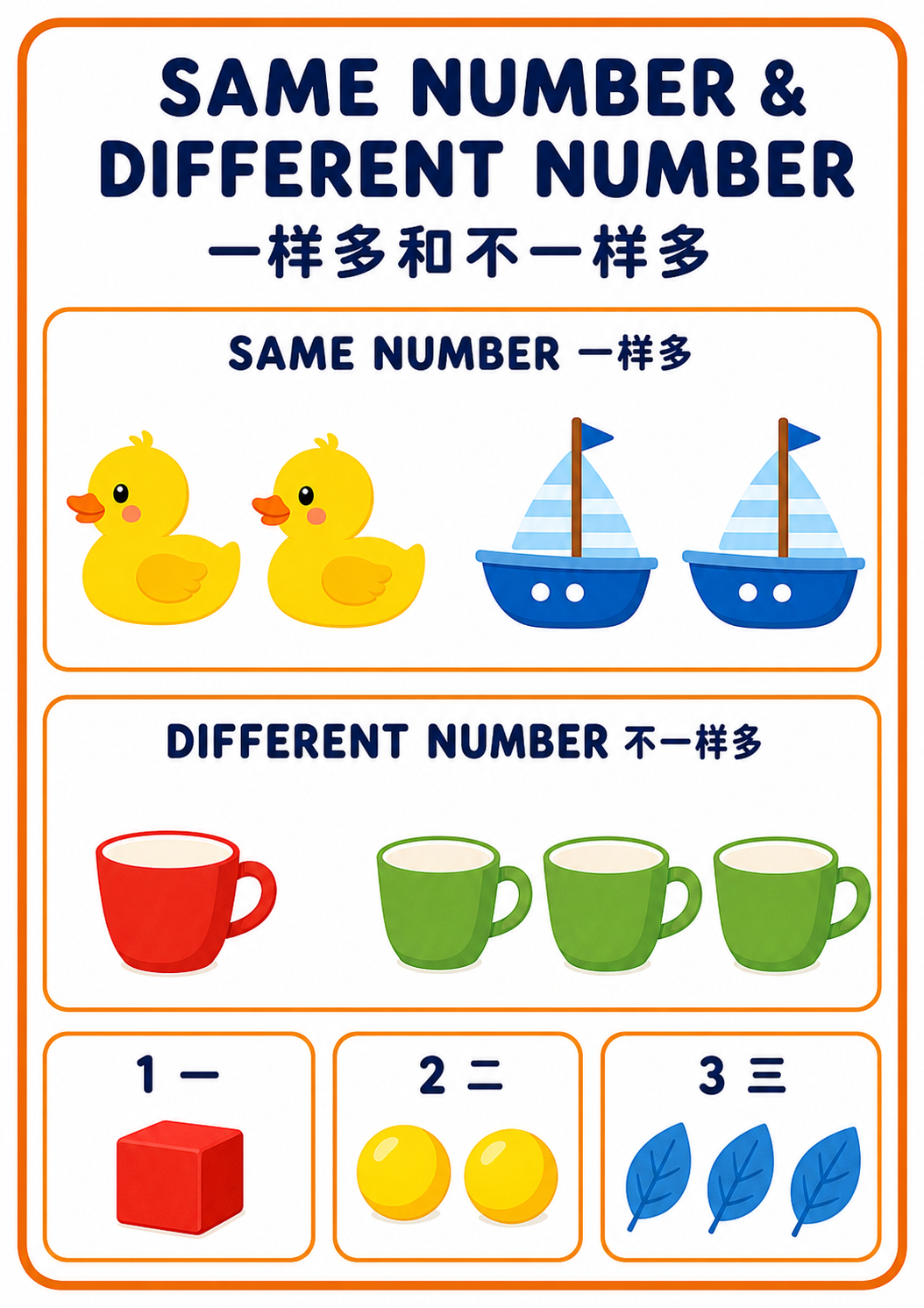
Match slowly: “一只鸭子对一艘船,再一只鸭子对一艘船——一样多。” Then describe one red cup and three green cups as “不一样多.” Asking which side has more is unnecessary.
2. English Time
Time: 3–5 minutes.
Transcript:
English time. Listen, look, or point. Same number. Two ducks and two boats. Different number. One cup and three cups. We can look. We do not have to answer.
Point along with the audio. Do not request same or different.
3. Math 1 / 2 / 3
Time: 3–5 minutes. Count only 1 block, 2 balls, and 3 leaves in the bottom row. Ignore boat windows, handles, and the comparison cards above.
4. Movement & Life
Time: 3–5 minutes. The adult uses two index fingers to make two slow duck-to-boat matches. Amara may watch or follow. Adults can describe quantities in daily life without turning fairness or sharing into a maths test.
Developmental Fit
This is visual comparison within 1–3, not inequality symbols, arithmetic, or speed. Do not place mouthing-size objects or make sharing possessions depend on a correct answer.
Bedtime
Point to 2 ducks and 2 boats and say, “Same number.” One glance is enough.