
Sort It Two Ways
Sort It Two Ways
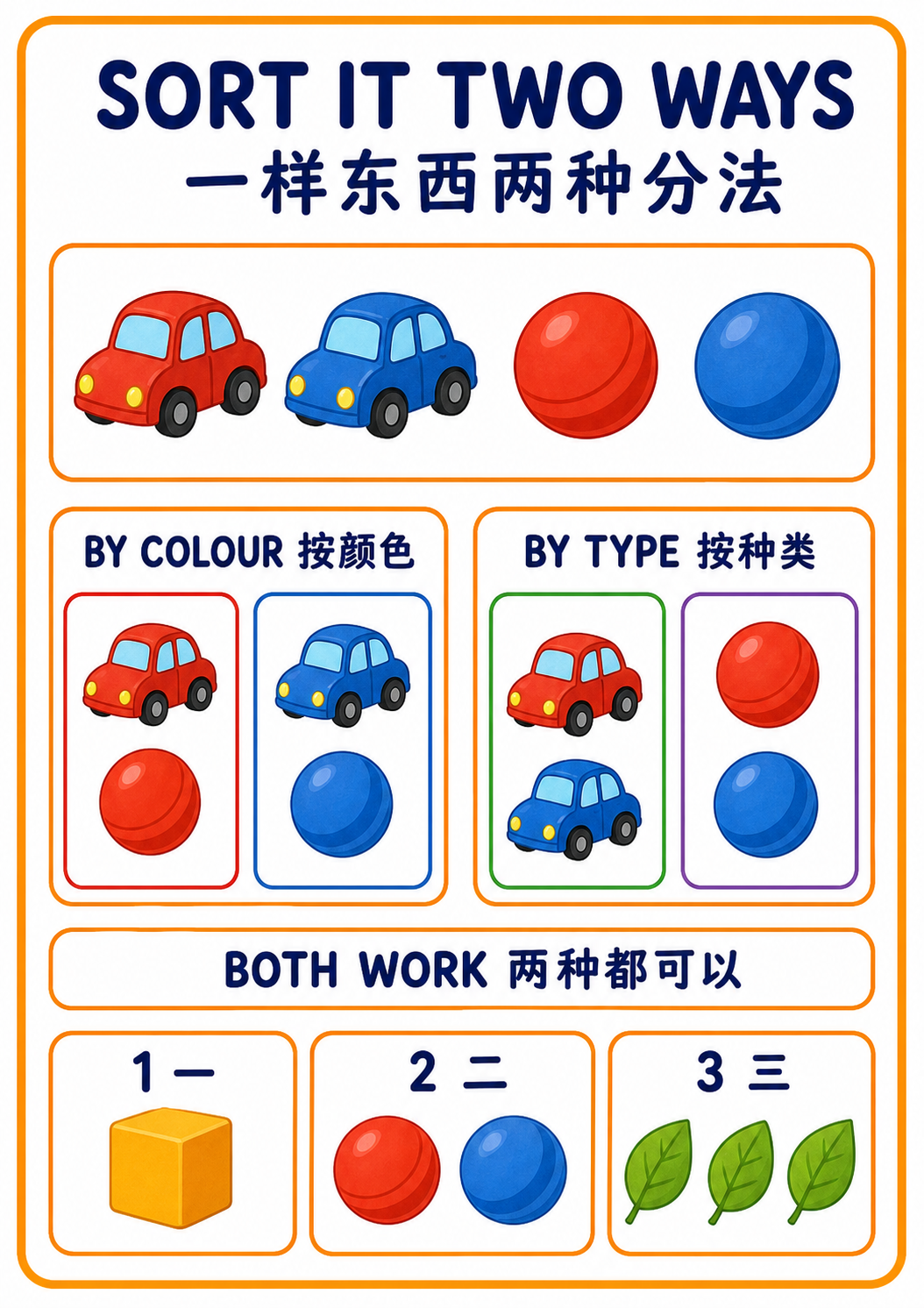
Today the same pictures are sorted by colour and by type, showing that a sorting rule can change.
Today's Approach
Amara is about 2 years and 6 months old. Keep each part to 3–8 minutes and use only the poster and audio. Looking, pointing, saying “red” or “car,” pausing, or declining all count. The adult demonstrates two valid methods rather than testing independent sorting.
A4 Teaching Picture
Goals
- Chinese: understand “按颜色、按种类、两种都可以.”
- English: meet
sort,colour,type, andboth work. - Early math: notice the same four pictures regrouped by different rules; count 1–3.
- Thinking: understand that classification depends on the property receiving attention.
Materials
- Only the A4 poster and English audio.
- No cars, balls, sorting trays, or loose objects are needed.
1. Chinese Picture Talk
Time: 5–8 minutes.
Name the set: “红汽车、蓝汽车、红球、蓝球。” On the left say, “按颜色.” On the right say, “按种类.” End with, “两种分法都可以。”
2. English Time
Time: 3–5 minutes.
Transcript:
English time. Listen, look, or point. Sort it two ways. By colour: red and blue. By type: cars and balls. Both ways can work.
Point to each grouping. Naming the rule is not requested.
3. Math 1 / 2 / 3
Time: 3–5 minutes. Count only 1 block, 2 balls, and 3 leaves in the bottom row. Ignore the repeated cars and balls above.
4. Movement & Life
Time: 3–5 minutes. The adult uses two hands to circle red and blue, then cars and balls. Amara may follow either once. In daily life, talk about how clothes could be described by colour or type without assigning a tidying task.
Development & Safety
A classification is not one permanent truth; the same item can join different groups for different purposes. Never rank personal preferences, identities, or groups of people, and do not use swallowable items for sorting.
Bedtime
Say, “Red and blue are one way; cars and balls are another.” No reply is needed.