Bigger & Smaller
Bigger & Smaller
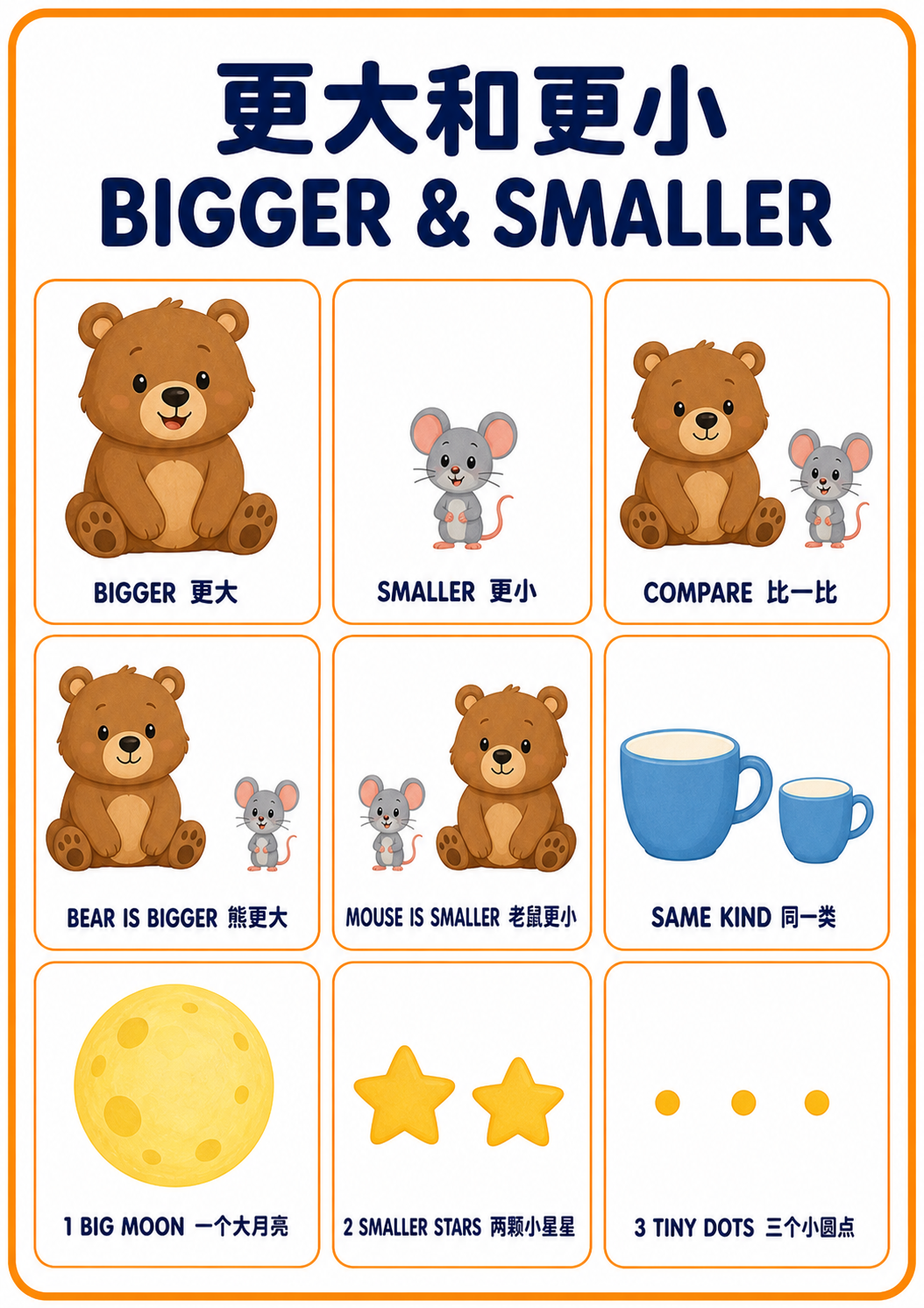
Today we begin with clear picture comparisons. Bigger and smaller describe the relationship between two pictured objects; neither means better.
Today's Approach
Amara is about 2 years and 6 months old. Keep each activity to 3–8 minutes. Looking towards one picture, pointing, widening or narrowing her hands, saying 大 or 小, pausing, or declining all count. Consistent comparative language is not expected yet.
A4 Teaching Picture
Open the original image to download or print
Goals
- Chinese: understand 更大, 更小, 比一比, and 同一类.
- English: meet
biggerandsmaller. - Early maths: count one big moon, two smaller stars, and three tiny dots.
- Cognition: compare same-kind, same-shape pictures first and notice that size is relative.
Materials
- Only the A4 teaching picture and English audio.
- No lifting, moving, or searching for real objects is needed.
1. Chinese Picture Talk
Time: 5–8 minutes.
Begin with the two cups: “它们都是杯子,这个更大,这个更小.” Then look at the bear and mouse. Use those pictures for an obvious visual contrast without presenting a cross-category comparison as precise measurement.
2. English Time
Time: 3–5 minutes.
Download today's English audio
Transcript: English time. Listen, look, or point. The bear is bigger. The mouse is smaller. Bigger. Smaller. One big moon. Two smaller stars. Three tiny dots. All done.
For bigger, point to the larger member of a pair; for smaller, point to the smaller one. Do not hold up one isolated picture and ask Amara to guess.
3. Early Maths: Size and Number
Time: 3–5 minutes.
Count only the bottom row: one big moon, two smaller stars, and three tiny dots. Quantity and individual size are different dimensions; bigger does not mean more.
4. Movement and Everyday Connection
Time: 3–5 minutes.
Widen the space between your hands for “bigger” and narrow it for “smaller.” Amara may track the motion with her eyes. Do not ask her to lift a heavy object to demonstrate size.
Respect and Safety
Do not compare the size of children, family members, or body parts, and never equate bigger with “better.” This is a picture observation, not a reason to move furniture or heavy items.
Bedtime Recall
- “Which of these two cups is bigger?”
- “Does smaller mean worse?” Answer: “No, it only means a different size.”
Bigger and smaller.