
Faces Give Us Clues
Faces Give Us Clues
Today we notice a smile, tears, and looking away. A face may offer a clue, but it cannot prove what someone feels inside. The adult describes what is visible and leaves room for uncertainty.
Today's Approach
Amara is about 2 years and 7 months old. Keep each activity to 3–8 minutes. Looking, pointing, moving, saying one word, staying quiet, pausing, or declining all count. Use only the poster and audio; do not ask her to copy a face or make eye contact.
A4 Teaching Picture
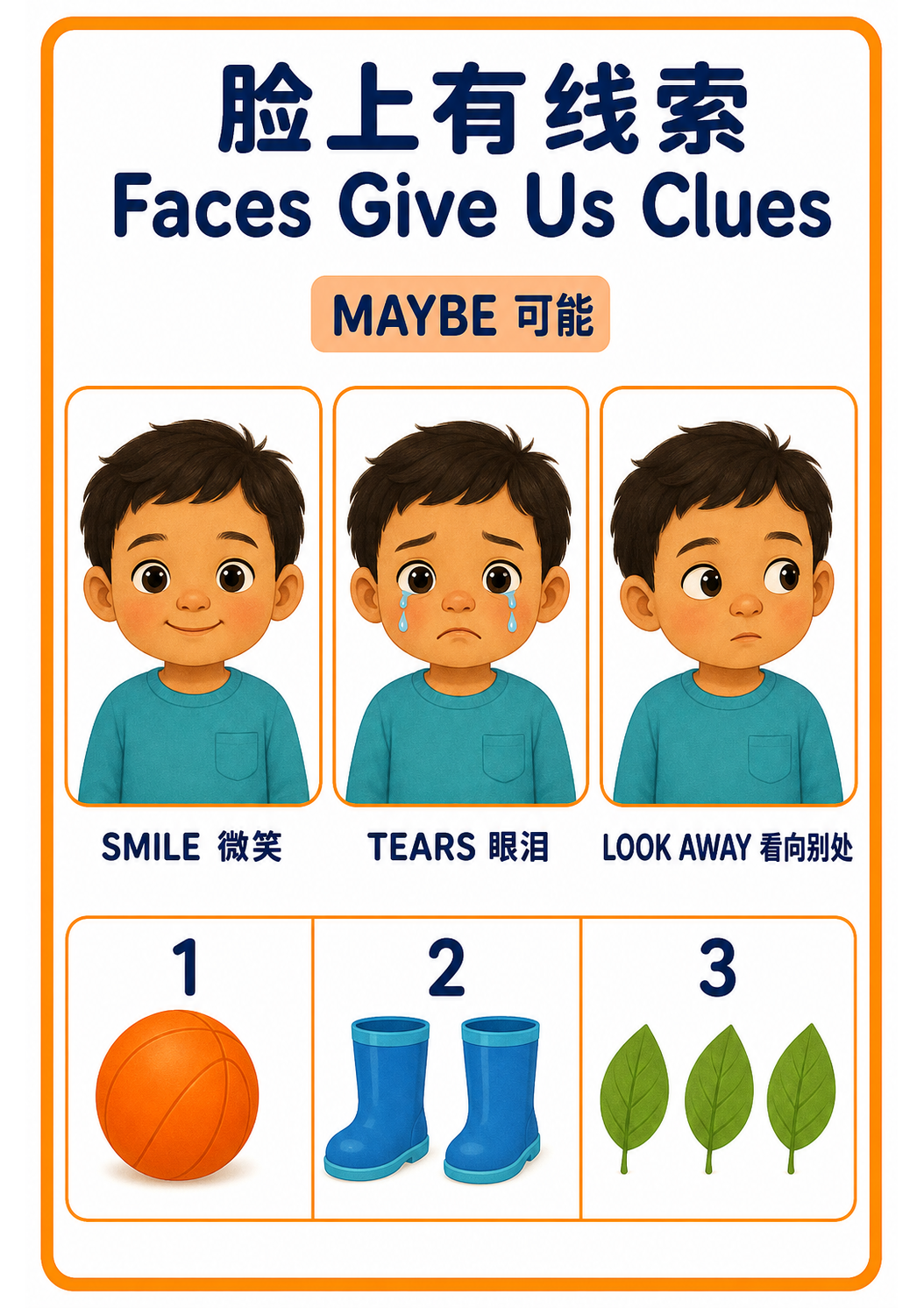
Open the teaching poster to download or print
Goals
- Chinese: hear 微笑, 眼泪, and 看向别处 as descriptions of visible clues.
- English: notice
smile,tears, andlook awayin context. - Early maths: count one ball, two boots, and three leaves with one-to-one pointing.
- Social understanding: use “maybe” instead of claiming to know another person's feelings.
Materials
- Only the A4 teaching picture above, printed or displayed full-screen.
- The English audio below.
- No mirror, dolls, emotion cards, or other objects are needed.
1. Chinese Picture Talk
Time: 5–8 minutes.
Move from left to right and say, “嘴角弯弯,这是微笑。”“脸上有眼泪。”“眼睛看向旁边。” Then add only, “这些是线索,他可能有一种感受,也可能有别的原因,我们还不知道。”
Amara may look at any panel, point, say “笑” or “眼泪,” stay quiet, or turn away. Do not quiz her about the character's “real” feeling or label her own expression.
2. English Time
Time: 3–5 minutes.
Download today's English audio
Transcript: English time. Listen, look, or point. Smile. Tears. Look away. A face may give us a clue, but it does not tell us everything. We can notice and wait. All done.
Play it once and point to the matching picture. Repetition and eye contact are optional.
| English | Chinese | Possible response |
|---|---|---|
Smile. | 微笑。 | Look, point, or say 笑 |
Tears. | 眼泪。 | Point to the tears or listen |
Look away. | 看向别处。 | Look at panel three, turn away, or pause |
3. Early Maths: 1, 2, 3
Time: 3–5 minutes.
Count only the separate bottom strip: one ball, two boots, and three leaves. Touch one complete object for each number; ignore the ball lines, boot edges, and leaf veins.
4. Movement, Everyday Life, and Boundaries
Time: 3–5 minutes.
The adult may move an open hand towards their own mouth, cheek, and then the side while saying, “I notice first, and then I wait.” Amara may copy or only watch. Never ask her to perform “happy” or “sad,” and do not treat looking away as bad manners.
Safety and Development
“Maybe” must never delay urgent care. Respond immediately to visible injury, breathing trouble, severe ongoing pain, or danger. For ordinary facial clues, observe and ask gently without diagnosing.
Bedtime Recall
- “The middle panel shows tears; the adult names only the visible clue.”
- “Looking away is a clue; we still do not know everything.”
- Say
A face may give us a clue.once, then accept any response or quiet.