
Different Looks, Same Job
Different Looks, Same Job
Today we notice differences among objects, support tools, families, and ways of living. Function is described without ranking appearance.
Today's Approach
Amara is about 2 years and 7 months old. Keep each part to 3–8 minutes and use only the poster and audio. Looking, pointing, saying one word, staying quiet, pausing, or declining all count. Classification is adult narration, not an “odd one out” test or a judgment of which form is better.
A4 Teaching Picture
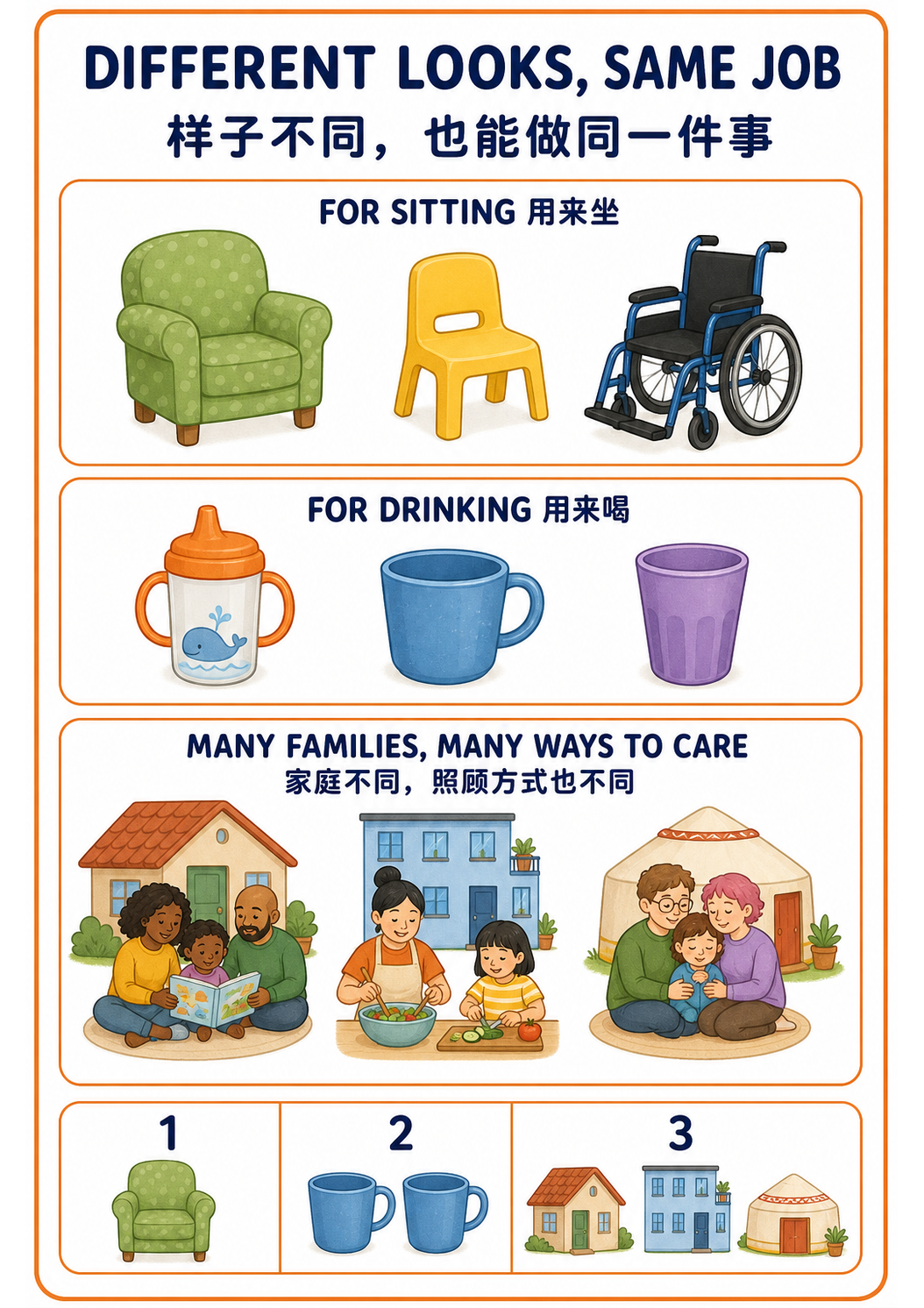
Goals
- Chinese: meet “样子不同、用途、支持、照顾方式.”
- English: hear
different,same job,posture,mobility, anddrinking. - Cognition: accept that different forms support related needs and families may do things differently.
- Early math: count only the bottom 1/2/3 strip.
Materials
- The A4 poster and today's English audio.
- No real family, body, or assistive device is used for comparison.
1. Chinese Picture Talk
Time: 5–8 minutes.
Say, “沙发和小椅子样子不同,都能支持坐姿。轮椅是帮助移动和坐姿的支持工具,功能不只是普通椅子;不同工具支持不同身体需要。” Do not guess why anyone uses a wheelchair or turn disability into a puzzle. Continue, “杯子样子不同,都能装饮品。家庭、住房和照顾方式也可以不同。”
2. English Time
Time: 3–5 minutes.
Transcript:
English time. Listen, look, or point. Different looks, same job. A sofa and a small chair support sitting. A wheelchair supports posture and mobility. Cups can look different and still hold a drink. Families and homes can do things in different ways. You may look or stop.
Do not ask Amara to label the pictured people or families.
3. Math 1 / 2 / 3
Time: 3–5 minutes.
Count only the bottom strip: 1 seat, 2 cups, and 3 homes. Number describes quantity; it does not rank a family's size, a tool's value, or a way of living.
4. Life & Inclusion
Time: 3–5 minutes.
Offer one neutral description from each section: “This tool supports posture and mobility.” “This cup has a handle.” “Each home may have its own way of caring.” Amara may watch or stop. Do not imitate disability, guess a diagnosis, or call one family form “normal.”
Classification Boundaries
Noticing related functions does not erase differences. A wheelchair is an important mobility and postural support, not simply a decorative version of an ordinary chair. Families also do not need to look alike. Avoid appearance rankings, stereotypes, and “which one is different?” tests.
Bedtime
Time: 3 minutes. Say quietly, “Things may look different, and every need deserves support.” End without a question.