
Loud and Quiet Sounds
Loud and Quiet Sounds
Today one calm A4 poster introduces loud and quiet while teaching the essential hearing boundary: Amara may cover her ears, move away with a grown-up, or stop immediately.
Today's Approach
Amara is about 2 years and 7 months old. Keep each activity to 3–8 minutes. Looking, pointing, gesturing, saying one word, staying quiet, pausing, or declining are valid. Never ask her to create a loud sound or use real noise to test tolerance.
A4 Teaching Picture
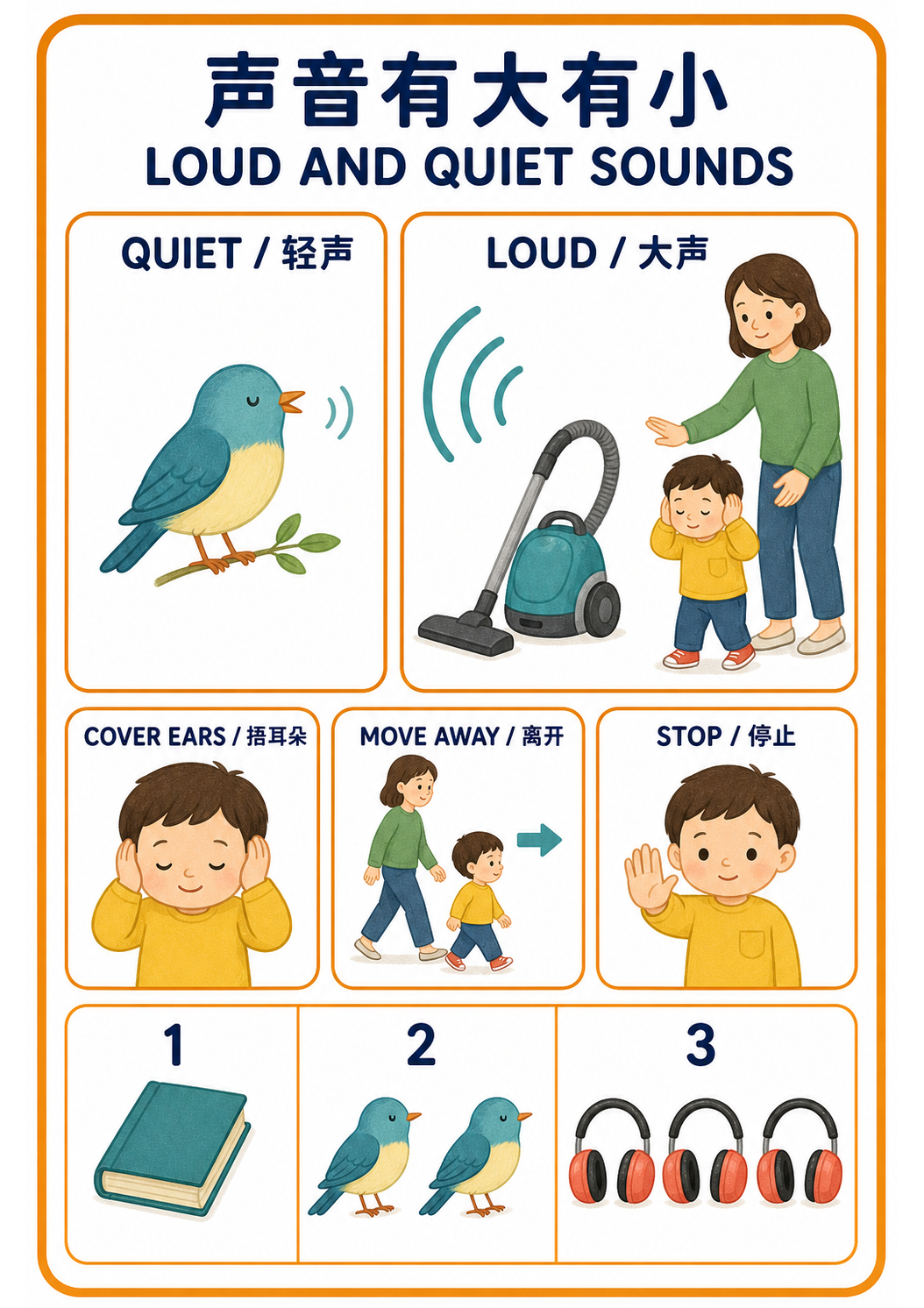
Open the original picture to download or print
Goals
- Chinese: understand “声音轻一些、声音大一些、我可以停止.”
- English: meet
quiet,loud,cover ears,move away, andstop. - Science: know that sound levels vary; loud does not mean good, and quiet does not mean bad.
- Self-protection: covering ears, moving away, approaching a caregiver, or declining all communicate.
Materials
- Only the A4 poster above, printed or displayed full-screen.
- The English audio below, played once at a comfortable low volume.
- No bell, vacuum, drum, headphones, or other object, and no sound experiment.
1. Chinese Picture Talk
Time: 3–8 minutes.
Point to the bird and say, “图里的鸟声比较轻。” Point to the vacuum picture and say, “有些声音会比较大。” Then move directly to the choices: “可以捂耳朵,可以和大人离开,也可以停。”
Do not imitate either sound. If Amara watches the earmuffs, covers her ears, or turns away, say, “你在告诉我声音要停。”
2. English Time
Time: 3–5 minutes.
Download the 23 November English audio
Transcript:
English time. Listen, look, or point. Some sounds are quiet. Some sounds are loud. You do not need to make a loud sound. You may cover your ears, move away with a grown-up, or stop. One book. Two birds. Three pairs of earmuffs.
| English | 中文 | Possible response |
|---|---|---|
quiet | 轻声、较小声 | Look at the bird or stay quiet |
loud | 大声、较响 | Look at the vacuum or look away |
cover ears | 捂耳朵 | Cover ears, point to earmuffs, or do nothing |
move away | 离开声音 | Point to the adult and child leaving |
stop | 停止 | Turn, say no, or leave |
If Amara covers her ears, frowns, moves away, or says stop, stop playback immediately. She never has to finish.
3. Early Math: 1, 2, 3
Time: 3–5 minutes.
Count only the independent bottom strip: 1 closed book, 2 birds, and 3 pairs of earmuffs. Each pair is one complete target; do not count its two ear cups separately.
4. Silent Safety Gesture
Time: 3–5 minutes.
Without making a sound, the adult can place their own hands gently outside their ears, then use fingers to show walking away together. Amara may copy, watch, or decline. Synchronised movement is not required.
5. Hearing and Developmental Boundary
Time: 3–5 minutes.
A young child's sound experience depends on distance, duration, suddenness, setting, and individual state. The poster gives language for an experience; it cannot be used to label her timid or say that she should get used to discomfort.
Stop When She Covers or Avoids
Do not clap, bang, shout, play alarms or high-volume recordings, or put headphones on Amara to test her. If she covers her ears, withdraws, freezes, cries, or declines, stop immediately and reduce stimulation.
Bedtime Recall
- “你想看小鸟,还是耳罩?”
- Say
You may stop.once and leave room for any response.