
Take Turns or Stay Quiet
Take Turns or Stay Quiet
Today we experience very short conversational turns: the adult says one line, leaves space, and invites a choice. On Amara's turn she may speak, point, pass, pause, or stay quiet. Turn-taking supports connection; it is not obedience practice.
Today's Approach
Amara is about 2 years and 7 months old. Keep each activity to 3–8 minutes. Looking, pointing, moving, saying one word, staying quiet, pausing, or declining all count. Use only the poster and audio; never hurry an answer or call quiet “uncooperative.”
A4 Teaching Picture
Open the teaching poster to download or print
Goals
- Chinese: understand 轮到我, 轮到你吗, and 安静也可以.
- English: hear
my turn,your turn, andstay quietwithin a choice. - Early maths: count one bird, two boats, and three apples.
- Conversation boundary: experience a turn that may be passed or paused, never a speaking task.
Materials
- Only the A4 teaching picture above, printed or displayed full-screen.
- The English audio below.
- No animal cards, toy boats, apples, or other objects are needed.
1. Chinese Picture Talk
Time: 5–8 minutes.
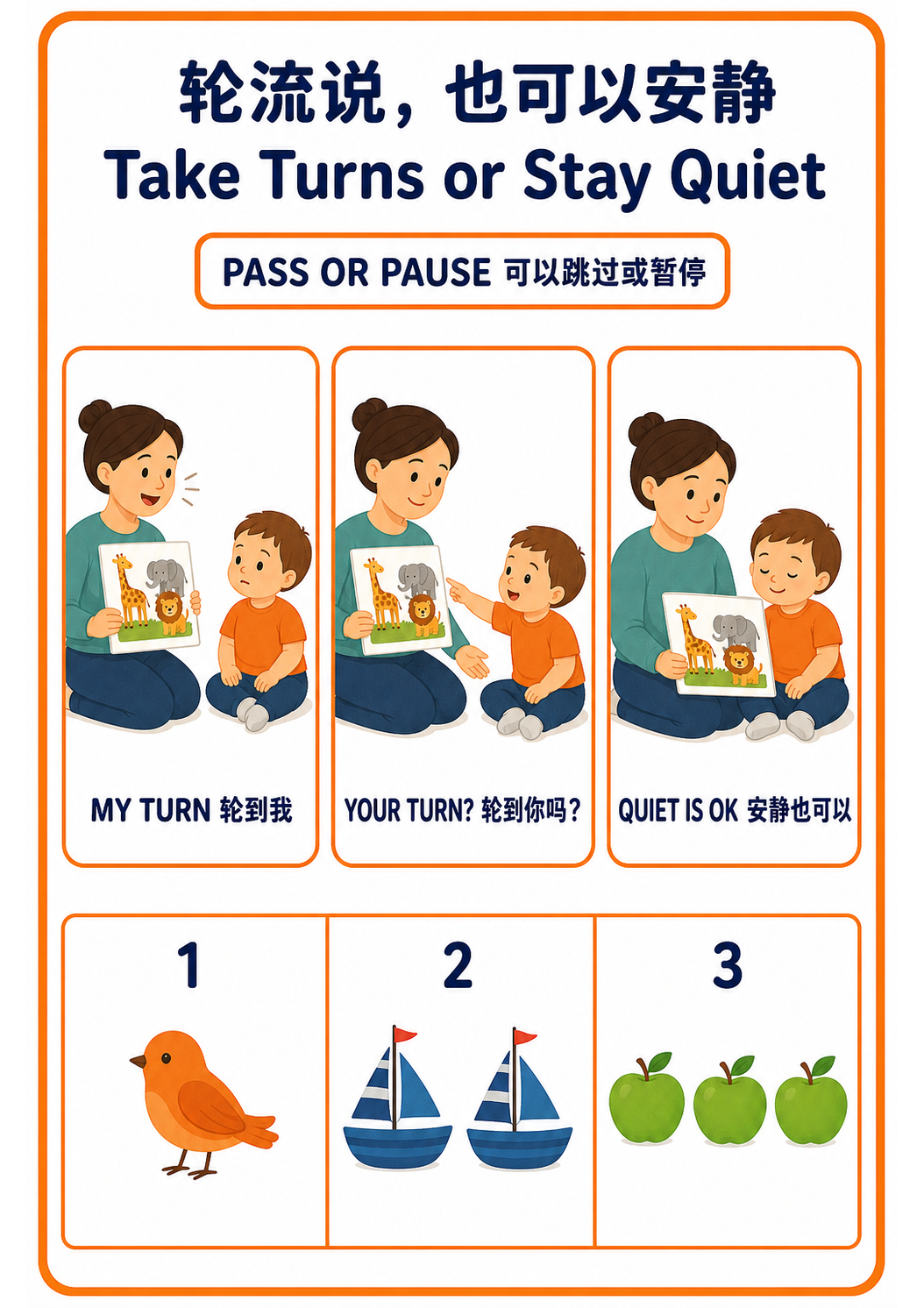
Point to panel one and say, “轮到我,我看见长颈鹿。” Pause for two seconds. Point to panel two: “轮到你吗?你可以说一个词,也可以指一指或跳过。” Then use panel three: “安静一起看,也可以。”
Accept turning away or stopping while the adult speaks. Do not repeatedly ask what she sees or use “your turn” to force speech.
2. English Time
Time: 3–5 minutes.
Download today's English audio
Transcript: English time. Listen, look, or point. My turn. Your turn, if you want. You may speak, point, pass, pause, or stay quiet. Taking turns is a choice, not a test. All done.
Play it once. Leave a brief space after if you want without prompting again.
| English | Chinese | Possible response |
|---|---|---|
My turn. | 轮到我。 | Listen, look, or turn away |
Your turn, if you want. | 如果你愿意,轮到你。 | Speak, point, pass, or pause |
Quiet is OK. | 安静也可以。 | Look quietly or finish |
3. Early Maths: 1, 2, 3
Time: 3–5 minutes.
Count only the bottom strip: one complete bird, two complete boats, and three complete apples. Each sail and flag remains part of its boat.
4. Movement, Everyday Life, and Boundaries
Time: 3–5 minutes.
The adult may move an open hand gently towards themselves for “my turn,” then towards the poster—not at Amara—for “would you like a turn?” Finally, relax both hands. She does not have to take a turn or wait for a fixed interval.
Safety and Development
Turn-taking must never delay toilet, drink, pain, comfort, or safety needs, and it must not become “obey first, then earn a turn.” Do not shush, criticise interruption, or punish quiet or withdrawal.
Bedtime Recall
- “Panel three shows looking quietly together; a turn may also be passed.”
- “You may pass when it is your turn.”
- Say
Taking turns is a choice, not a test.once, then finish.