
Soft and Hard Depend on Material
Soft and Hard Depend on Material
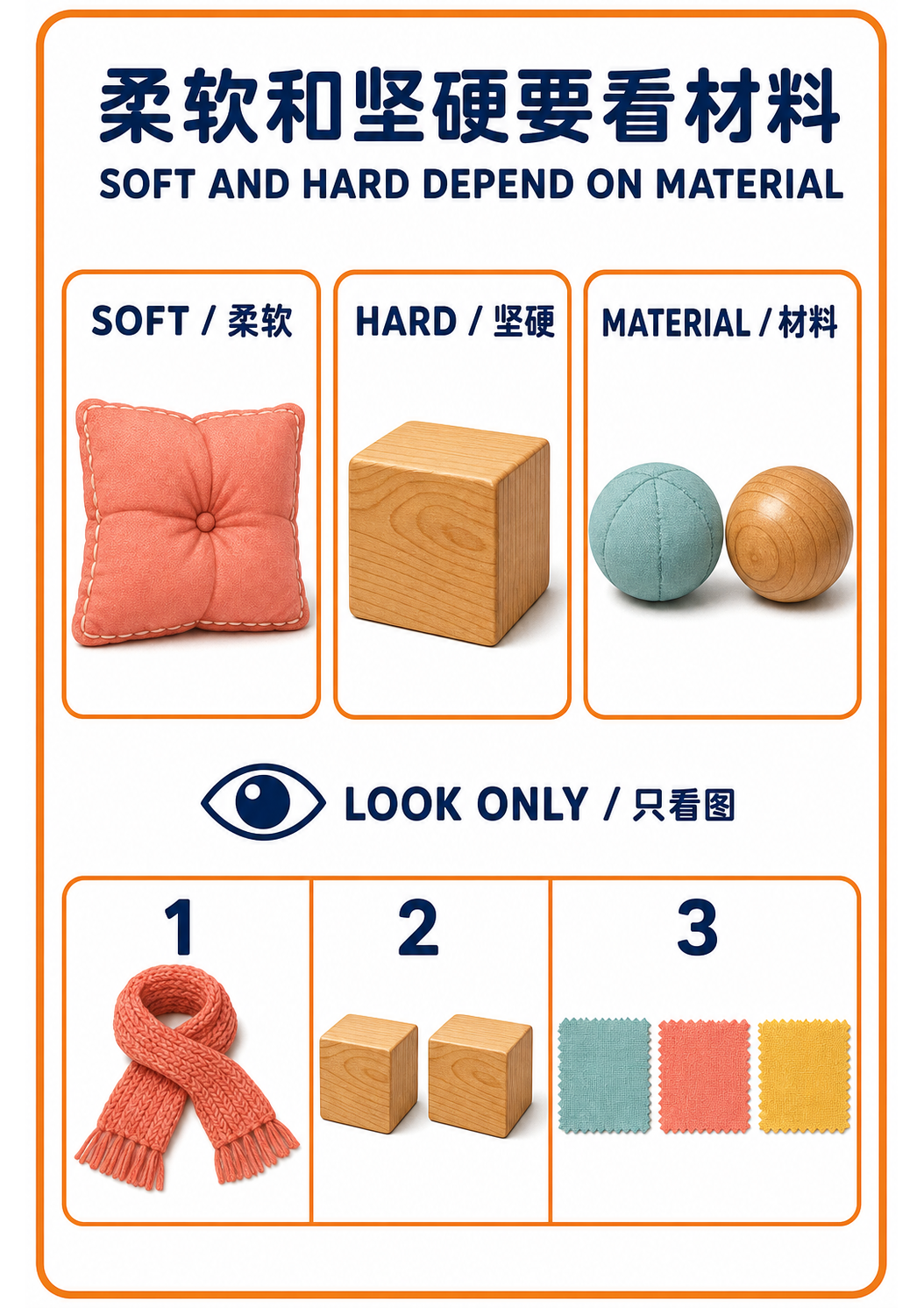
Today the poster introduces soft, hard, and material. Similar shapes can use different materials, and softness or hardness may vary with material, structure, and condition.
Today's Approach
Amara is about 2 years and 7 months old. Keep each activity to 3–8 minutes. Looking, pointing, gesturing, saying one word, staying quiet, pausing, or declining are valid. Use picture observation only; never ask her to touch, squeeze, tap, or test an unknown object.
A4 Teaching Picture
Open the original picture to download or print
Goals
- Chinese: understand “看起来柔软、看起来坚硬、材料不同.”
- English: meet
soft,hard,material, andlook only. - Science: know that softness and hardness are material properties, not consequences of a name or shape alone.
- Safety: do not approach or touch an unfamiliar object; let an adult assess it.
Materials
- Only the A4 poster above, printed or displayed full-screen.
- The English audio below.
- No fabric, wooden blocks, balls, or other objects, and no touch experiment.
1. Chinese Picture Talk
Time: 3–8 minutes.
Point and say, “这个垫子看起来柔软。”“这个木块看起来坚硬。”“两个球形状相似,材料不同。” Saying “看起来” keeps a useful distinction between a picture clue and a guarantee about a real object.
Amara may point only to a colour or shape. Follow her attention: “你在看蓝色的布球。” She does not need to say soft or hard.
2. English Time
Time: 3–5 minutes.
Download the 22 November English audio
Transcript:
English time. Listen, look, or point. Soft and hard depend on material. Fabric can feel soft. Wood can feel hard. Objects with the same shape can use different materials. We only look at the poster. We do not touch unknown things. One scarf. Two blocks. Three fabric squares.
| English | 中文 | Possible response |
|---|---|---|
soft | 柔软 | Look at the cushion or fabric ball |
hard | 坚硬 | Point to the wooden block or ball |
material | 材料 | Move gaze between the two balls |
look only | 只看图 | Look, look away, or stop |
Play the audio once. Pronunciation or classification is not required.
3. Early Math: 1, 2, 3
Time: 3–5 minutes.
Count only the bottom strip: 1 scarf, 2 wooden blocks, and 3 fabric swatches. The textured edges belong to each swatch; do not count patterns or notches.
4. Observation Gesture: Eyes Only
Time: 3–5 minutes.
The adult may point to their own eyes, then the poster, and say, “我们只看。” Amara may look, point, keep her hands resting, or leave. Do not turn “hands down” into a compliance demand.
5. Science and Safety Boundary
Time: 3–5 minutes.
Soft and hard are not permanent absolute labels. The same material can behave differently because of thickness, structure, temperature, or damage. The poster offers simple examples and never replaces adult assessment of real objects.
Unknown Means Look, Not Touch
Do not use sockets, glass, medicine, cleaners, hot items, sharp items, or any unknown material for a soft-and-hard experiment. Do not ask Amara to approach, touch, tap, smell, or taste. A grown-up handles unfamiliar real objects.
Bedtime Recall
- “你想看布球,还是木球?”
- Say
Look only.once and accept looking, pointing, quiet, or stopping.