
Plans Can Change
Plans Can Change
Today the A4 poster shows a first plan, a change, and a new plan. When change happens, Amara may feel sad, angry, quiet, or need time. The adult co-regulates and never uses change as obedience training.
Today's Approach
Amara is about 2 years and 7 months old. Keep each activity to 3–8 minutes. Looking, pointing, gesturing, saying one word, staying quiet, pausing, or declining are valid. Do not rush acceptance of a new plan or use rewards, distraction, or shame to suppress emotion.
A4 Teaching Picture
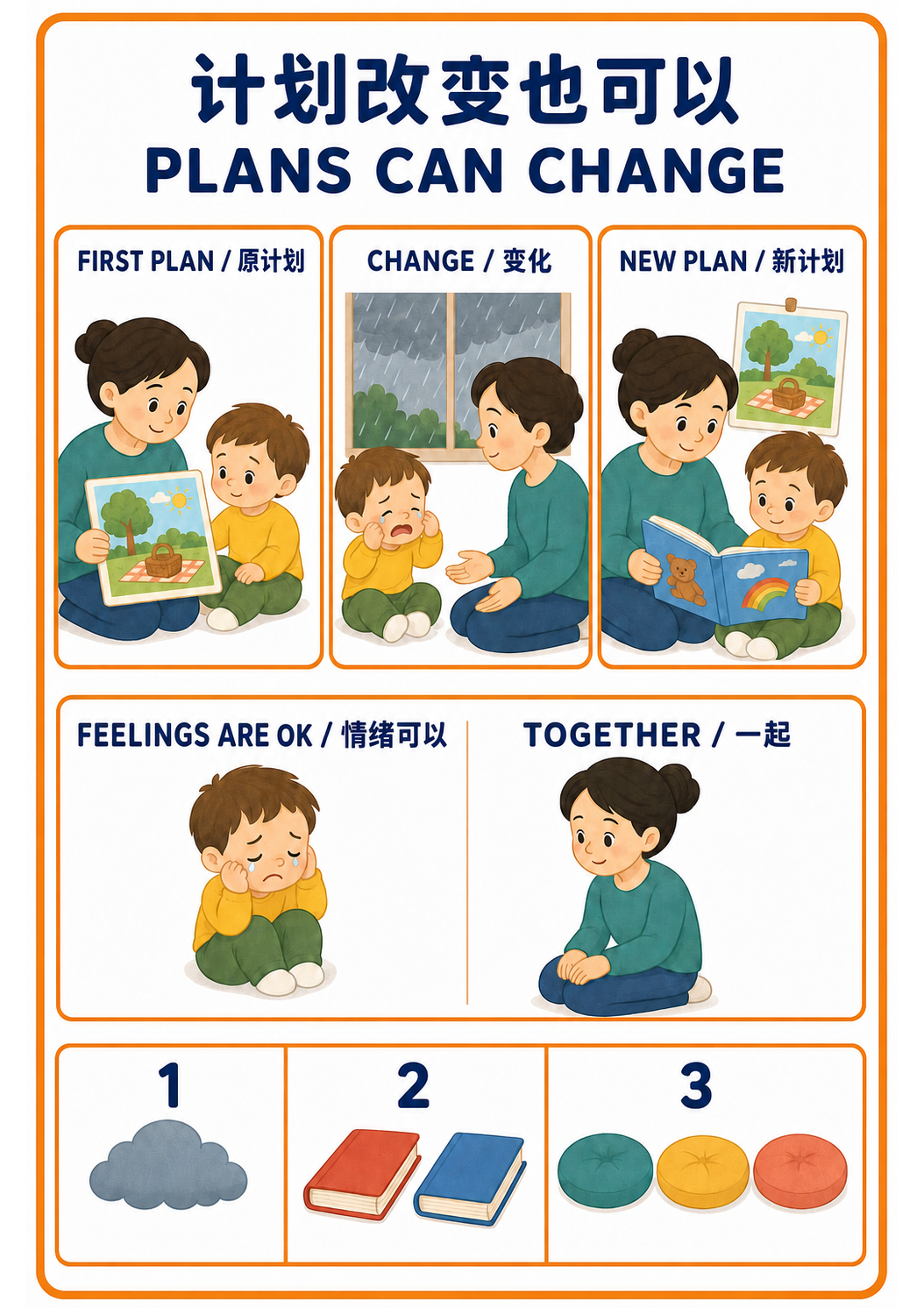
Open the original picture to download or print
Goals
- Chinese: understand “原来要去公园、下雨改变了、准备好后可以有新计划.”
- English: meet
first plan,change,new plan, andfeelings are okay. - Emotion: know that disappointment, crying, quiet, or not choosing a new plan yet are allowed.
- Relationship: the adult names the change, stays near, and waits for readiness.
Materials
- Only the A4 poster above, printed or displayed full-screen.
- The English audio below.
- No schedule card, toy, snack, or soothing reward, and no deliberate surprise change to test a reaction.
1. Chinese Picture Talk
Time: 3–8 minutes.
Describe the sequence: “原计划是去公园。”“下雨了,计划改变,孩子很难过。”“大人陪着;准备好以后,可以一起看书,新计划也可以。”
Point to the larger middle scene and say, “情绪可以在这里。大人陪在旁边。” Do not skip the crying picture and immediately sell the book as more fun.
2. English Time
Time: 3–5 minutes.
Download the 29 November English audio
Transcript:
English time. Listen, look, or point. Plans can change. Feelings are allowed. You may feel sad, angry, quiet, or need more time. A grown-up stays close, names the change, and helps with a new plan when you are ready. One cloud. Two books. Three cushions.
| English | 中文 | Possible response |
|---|---|---|
first plan | 原计划 | Look at the park picture |
change | 变化 | Point to the rain or crying scene |
new plan | 新计划 | Look at the picture book |
feelings are allowed | 情绪可以存在 | Watch the sad face, stay quiet, or look away |
more time | 还需要时间 | Pause, decline, or return later |
Do not require Amara to say it is okay or look cheerful. Play the audio once.
3. Early Math: 1, 2, 3
Time: 3–5 minutes.
Count only the independent bottom strip: 1 cloud, 2 closed books, and 3 cushions. Do not count rain lines, the book-cover pictures, or the park plan above.
4. Co-Regulation Language
Time: 3–5 minutes.
The adult can practise only their own short lines: “计划变了。”“你很难过。”“我在这里。”“你准备好时,我们再看看。” Amara does not need to answer, cuddle, high-five, or breathe on command.
5. Emotional and Developmental Boundary
Time: 3–5 minutes.
Crying, protesting, freezing, or needing repeated reassurance during transitions is common at this age. Co-regulation means adult stability, time, and genuine choice, not making emotion end faster or proving maturity.
Change Is Not Obedience Training
Do not deliberately cancel promises to test a reaction, dismiss feelings with “you must adapt,” or trade snacks, screens, stickers, or threats for rapid transition. When a real change is necessary, explain honestly, maintain safety, and stay with the child through it.
Bedtime Recall
- “你想看原计划,还是新计划?”
- Say
Feelings are allowed.once and accept any expression or no response.