
Small Groups Can Be Seen as a Whole
Small Groups Can Be Seen as a Whole
Today the adult gently describes small groups of 1–3. There are no flashcards, speed answers, or expectation of naming an amount instantly.
Today's Approach
Amara is about 2 years and 8 months old. Keep each part to 3–8 minutes and use only the poster and audio. Looking, pointing, saying one word, staying quiet, pausing, or declining all count. The adult describes complete pictures without testing, correction, scoring, rewards, forced retelling, performance, or touch.
A4 Teaching Picture
Goals
- Chinese: meet “一个、两个、三个、这一小组.”
- English: hear
one,two,three, andsmall group. - Early math: notice groups of 1–3 in stable, continuously visible pictures.
- Development: the adult names amounts; rapid quantity responses are not expected.
Materials
The A4 poster and today's English audio. No flashcards, dot cards, timer, cover, or toys are needed.
1. Chinese Picture Talk
Time: 5–8 minutes.
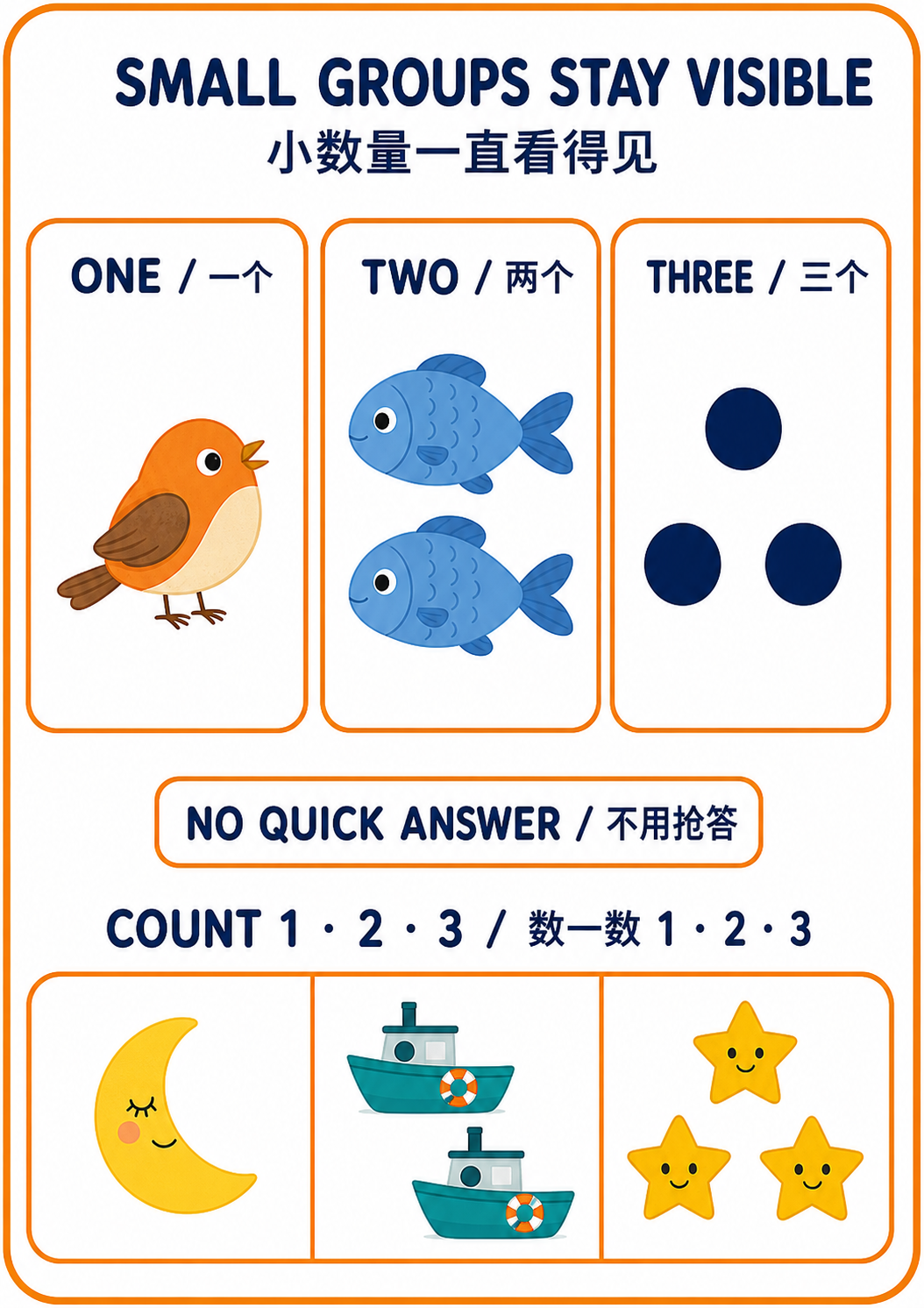
Keep the poster visible and say slowly in Chinese, “这里有 1 只鸟,这一小组是一个。这里有 2 条鱼,这一小组是两个。这里有 3 个圆点,这一小组是三个。” Glance across the group or touch each picture lightly; there is no speed requirement.
2. English Time
Time: 3–5 minutes.
Transcript:
English time. Listen, look, or point. Small groups can sometimes be seen all at once. Here is one bird. Here are two fish. Here are three dots. An adult can gently say the amount. You do not have to answer quickly. One moon. Two little boats. Three stars. You may look, point, stay quiet, or stop.
Listening, pausing, or declining all count. Repetition, retelling, and answers are not requested.
3. Math 1 / 2 / 3
Time: 3–5 minutes.
Count only the bottom strip: 1 moon, 2 little boats, and 3 stars. The bird, fish, and dots above form the viewing area and are not combined with the bottom strip.
4. Gentle Connection
Time: 3–5 minutes.
The adult may first rest their gaze on a whole group, then slowly count the same group, showing two gentle ways to notice quantity. Amara may watch either way, say one number word, stay quiet, or stop.
Development and Boundaries
Small-quantity perception is developing and varies with attention, arrangement, and familiarity. Never flash, time, repeatedly ask “how many,” compare performance, or score right and wrong.
Bedtime
Time: 3 minutes. Say softly, “One, two, three. The small groups stay visible.” No answer is requested.