
Living Things Grow and Change
Living Things Grow and Change
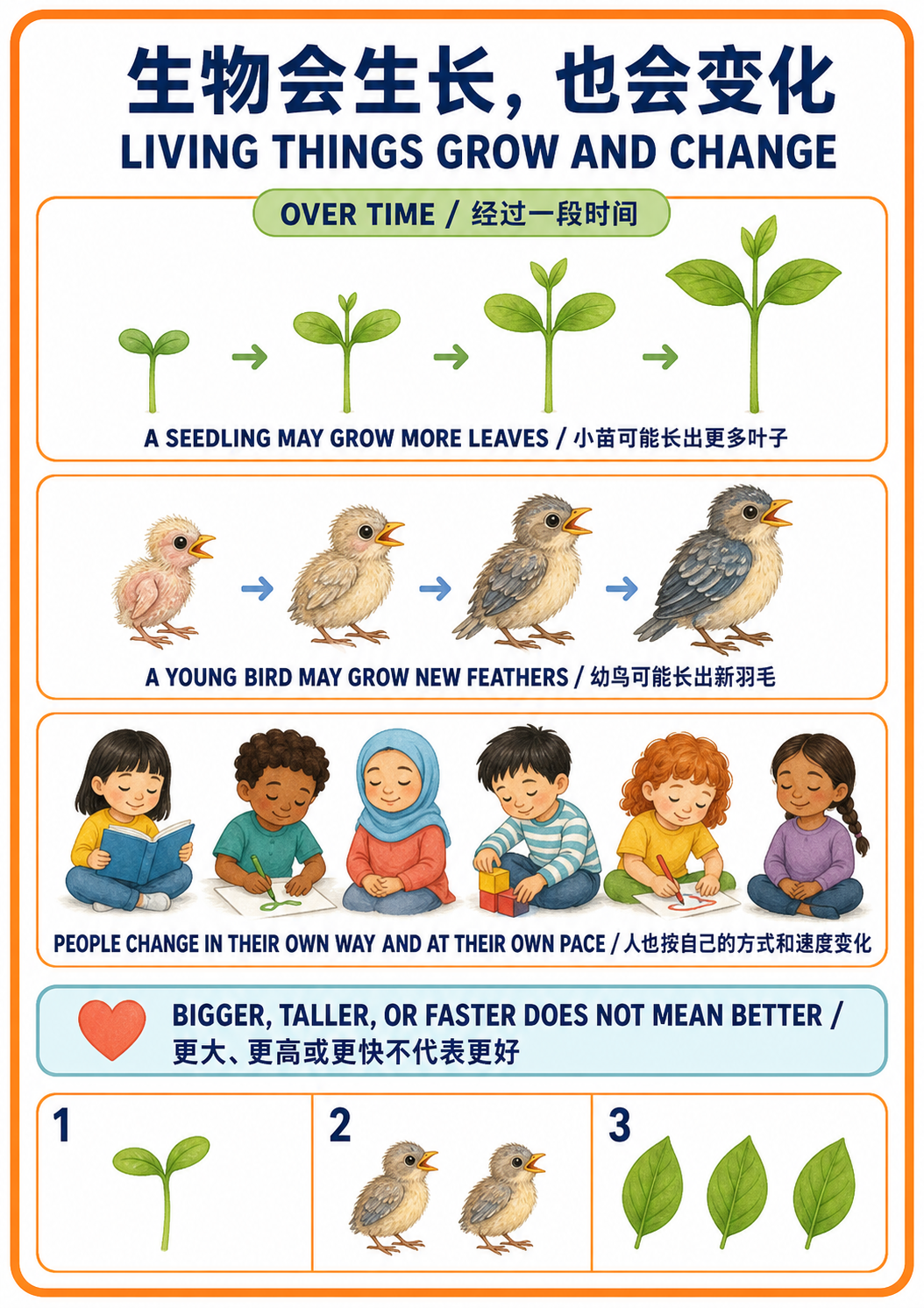
Today one A4 poster introduces change over time. Plants, animals, and people have their own patterns and pace of growth; children's height, size, speed, and ability are not compared.
Today's Approach
Amara is about 2 years and 8 months old. Keep each activity to 3–8 minutes. Looking, pointing, one word, quiet, pausing, or declining are valid. Do not quiz, correct, score, rank, reward, force repetition or performance, or require eye contact or touch.
A4 Teaching Picture
Open the original picture to download or print
Goals
- Chinese: meet “生长、变化、慢慢、不同、自己的速度.”
- English: meet
grow,change,over time,different ways, andown pace. - Science: understand that living things change over time, with different patterns and speeds.
- Body respect: bigger, taller, faster, or earlier is not treated as better.
Materials
- Only the A4 poster above, printed or displayed full-screen.
- The English audio below.
- No seed, plant, animal, or measuring tool. Do not measure height or weight or compare photographs or children's bodies.
1. Chinese Picture Talk
Time: 3–8 minutes.
At the plant panel, say, “小苗过一段时间可能长出更多叶子。” At the bird panel, say, “小鸟会慢慢长出不同的羽毛。” Then add, “每一种生物变化的样子和速度不一样。”
Amara may stay with any stage. Do not require sequencing or ask which one grew “best.”
2. English Time
Time: 3–5 minutes.
Download the 26 December English audio
Transcript:
English time. Listen, look, or point. Living things grow and change over time. A seedling may grow more leaves. A young bird may grow new feathers. People also grow and change, each in their own way and at their own pace. Bigger, taller, or faster does not mean better. One seedling. Two young birds. Three leaves.
| English | 中文 | Possible response |
|---|---|---|
grow | 生长 | Watch the seedling or stay quiet |
change | 变化 | Look between two stages |
over time | 经过一段时间 | Watch a time arrow |
different ways | 不同方式 | Point to any kind of change |
own pace | 自己的速度 | Stay, pause, or leave |
Do not ask Amara to report her age, height, or abilities.
3. Early Math: 1, 2, 3
Time: 3–5 minutes.
Count only the separate bottom strip: 1 seedling, 2 young birds, and 3 leaves. Do not count living things or leaves in the stage diagrams above.
4. Change Does Not Happen at One Speed
Time: 3–5 minutes.
Point to two timelines with different spacing and say, “有的变化容易看见,有的要很久才看见。”“同一类生物也会有差异。”
Do not present the pictured stages as a strict timetable or imply that slower means behind.
5. Growth and Developmental Boundary
Time: 3–5 minutes.
Early development includes wide individual variation and is affected by health, experience, environment, and support. The poster only builds a first idea of time and change; it cannot assess a child.
Do Not Compare Children's Bodies or Abilities
Do not measure or compare height, build, eating, speech, toileting, running, or sleep speed, and do not say, “You should be like the picture.” If a caregiver has a real developmental or health concern, record specific observations and consult a qualified professional instead of testing the child.
Bedtime Recall
- “你想看小苗,还是小鸟?”
- Say
Living things change in different ways.once.