
Weather Pictures Give Us Clues
Weather Pictures Give Us Clues
Today one A4 poster introduces weather clues. Clouds, sunshine, and raindrops can support observation, but a picture cannot promise rain or warmth.
Today's Approach
Amara is about 2 years and 8 months old. Keep each activity to 3–8 minutes. Looking, pointing, one word, quiet, pausing, or declining are valid. Do not quiz, correct, score, rank, reward, force repetition or performance, or require eye contact or touch.
A4 Teaching Picture
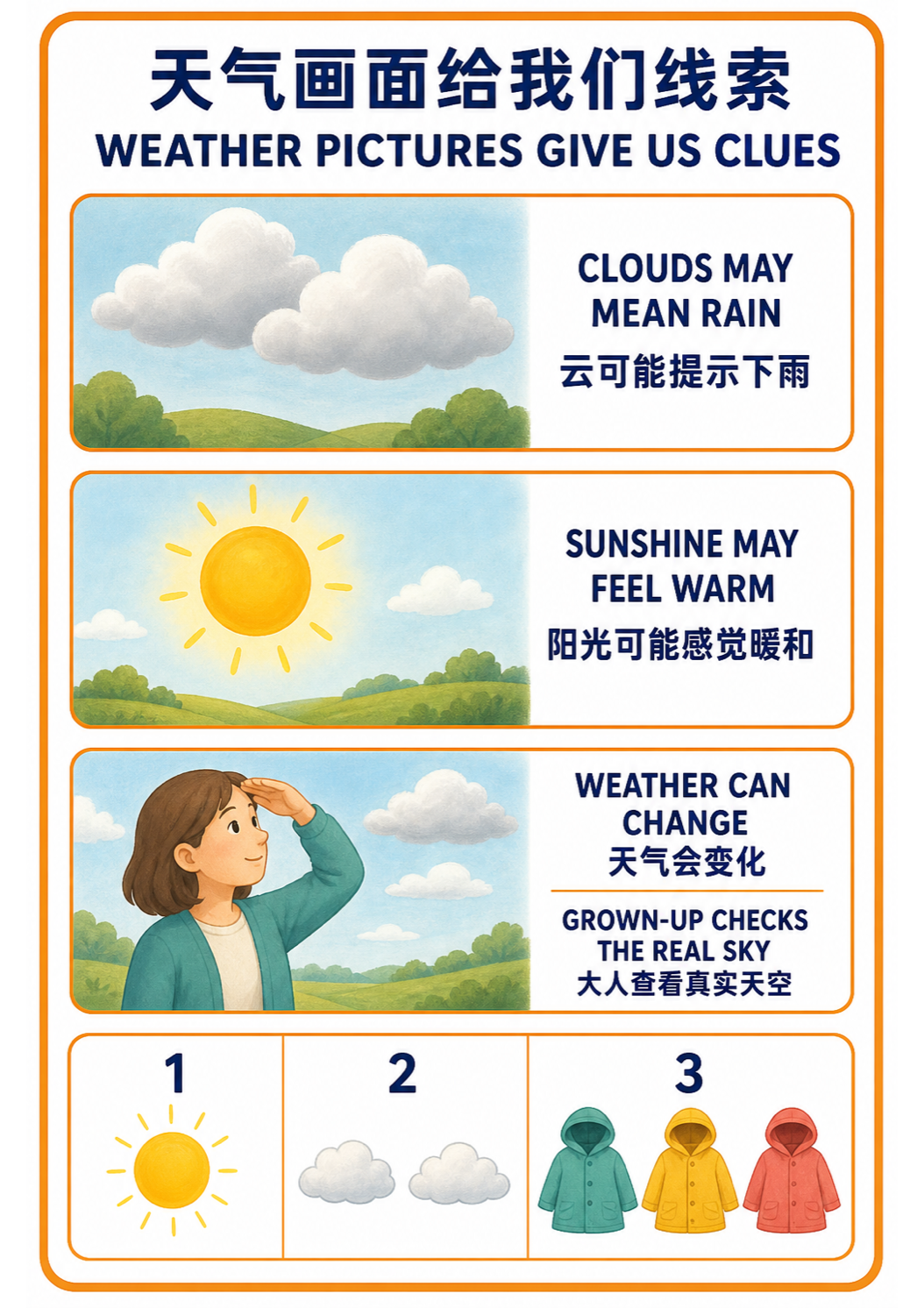
Open the original picture to download or print
Goals
- Chinese: meet “线索、可能、变化、实际看看.”
- English: meet
weather clue,cloud,sunshine,change, andgrown-up checks. - Science: understand that pictures and signs in the sky offer clues, not guarantees.
- Care: an adult checks real conditions before deciding clothing, outings, and weather protection.
Materials
- Only the A4 poster above, printed or displayed full-screen.
- The English audio below at a comfortable volume.
- No clothing, umbrella, thermometer, or outdoor observation, and no real-weather judgement practice.
1. Chinese Picture Talk
Time: 3–8 minutes.
Follow Amara's gaze and describe: “图里有云,这是一个线索。”“太阳出来了,也要看看实际冷不冷。”“天气会变化,大人会查看再决定。”
Looking away, pointing to one kind of weather, or listening quietly all count. Do not ask what clouds will certainly bring or require her to choose clothing.
2. English Time
Time: 3–5 minutes.
Download the 21 December English audio
Transcript:
English time. Listen, look, or point. A weather picture gives us a clue, not a promise. Clouds may mean rain, and sunshine may feel warm, but weather can change. A grown-up checks the real sky and decides what to wear and whether to go out. One sun. Two clouds. Three coats.
| English | 中文 | Possible response |
|---|---|---|
weather clue | 天气线索 | Look, point to one panel, or stay quiet |
cloud | 云 | Point to or watch a cloud |
sunshine | 阳光 | Point to the sun or blink |
change | 变化 | Look between two scenes |
grown-up checks | 大人查看 | Look toward the adult or not respond |
One play-through is enough. Stop immediately if Amara signals stop, looks away, or leaves.
3. Early Math: 1, 2, 3
Time: 3–5 minutes.
Count only the separate bottom strip: 1 sun, 2 clouds, and 3 coats. Do not count objects in the weather scenes above.
4. A Clue Is Not a Promise
Time: 3–5 minutes.
Connect two scenes with statements: “看到云,我们可以想到也许会下雨;也可能过一会儿云散开。”“图片帮助我们想一想,真实天气还要现在去看。”
Do not ask Amara to predict an outcome or treat one point as independent weather judgement.
5. Weather and Developmental Boundary
Time: 3–5 minutes.
A two-year-old can notice bold pictures and words but cannot reliably judge temperature, rain, air quality, or outing risk from icons, clouds, or sunshine. The poster supports language and early causality; it does not transfer adult responsibility.
Adults Make Outing Decisions
Adults use current conditions, how it feels, forecasts, and local advice to decide clothing, hydration, shade, and whether to go out. Amara never has to remember the poster to stay safe. Respond immediately to real discomfort, heat, cold, or refusal.
Bedtime Recall
- “你想看云,还是太阳?”
- Say
Weather can change.once. Quiet participation counts.