
A Tiny Story: Who, What, and Where
A Tiny Story: Who, What, and Where
Today uses two posters for a very small story. The first joins who, what happens, and where into one sentence. The second adds a change across two pictures. The adult narrates; Amara does not answer three questions.
Today's Approach
Amara is about 2 years and 8 months old. Keep each activity to 3–8 minutes. Looking, pointing, saying one word, staying quiet, pausing, or declining all count. Use only the two posters and audio; do not ask for repetition, performance, eye contact, or touch.
A4 Teaching Pictures
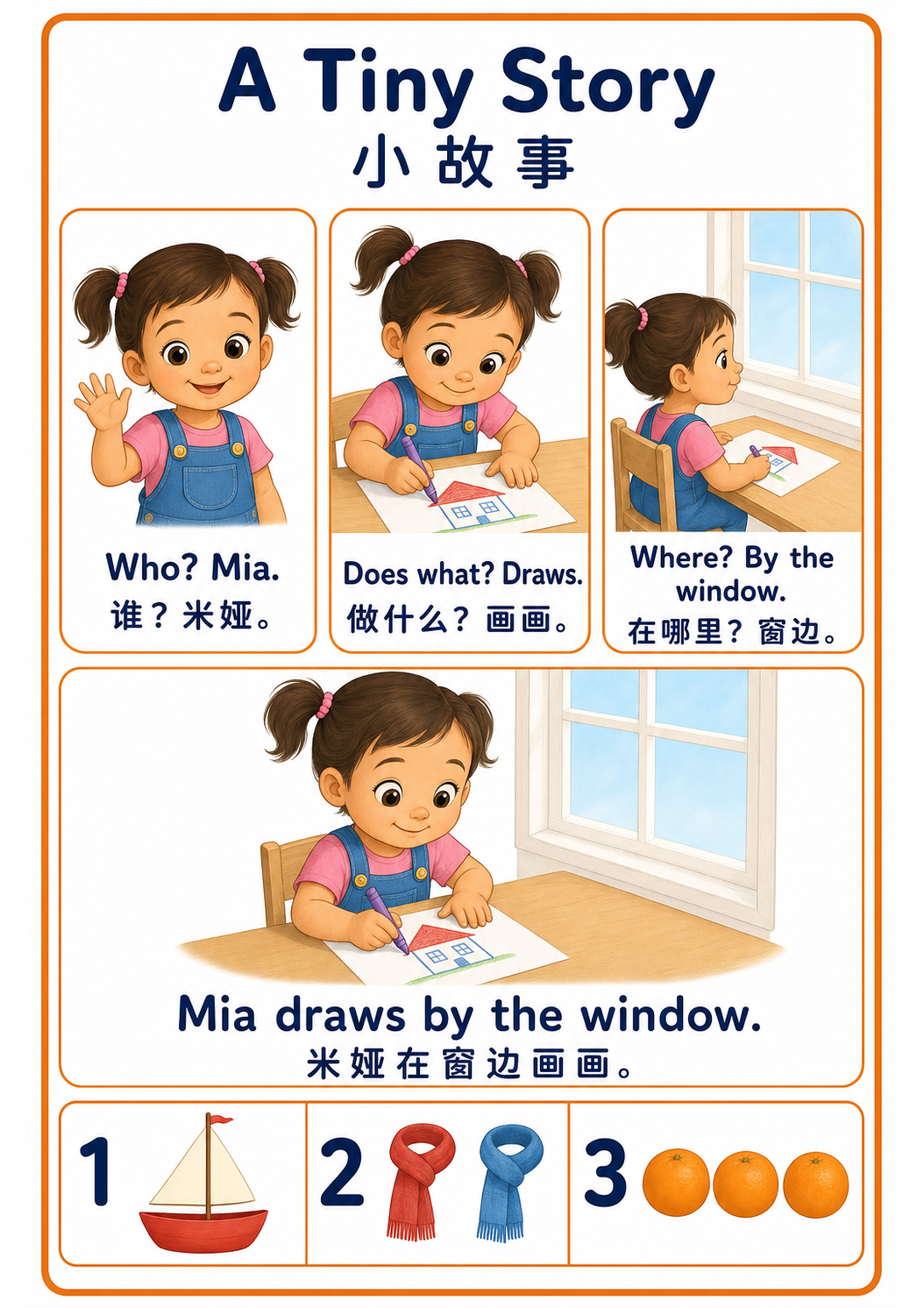
Open teaching poster 1 to download or print
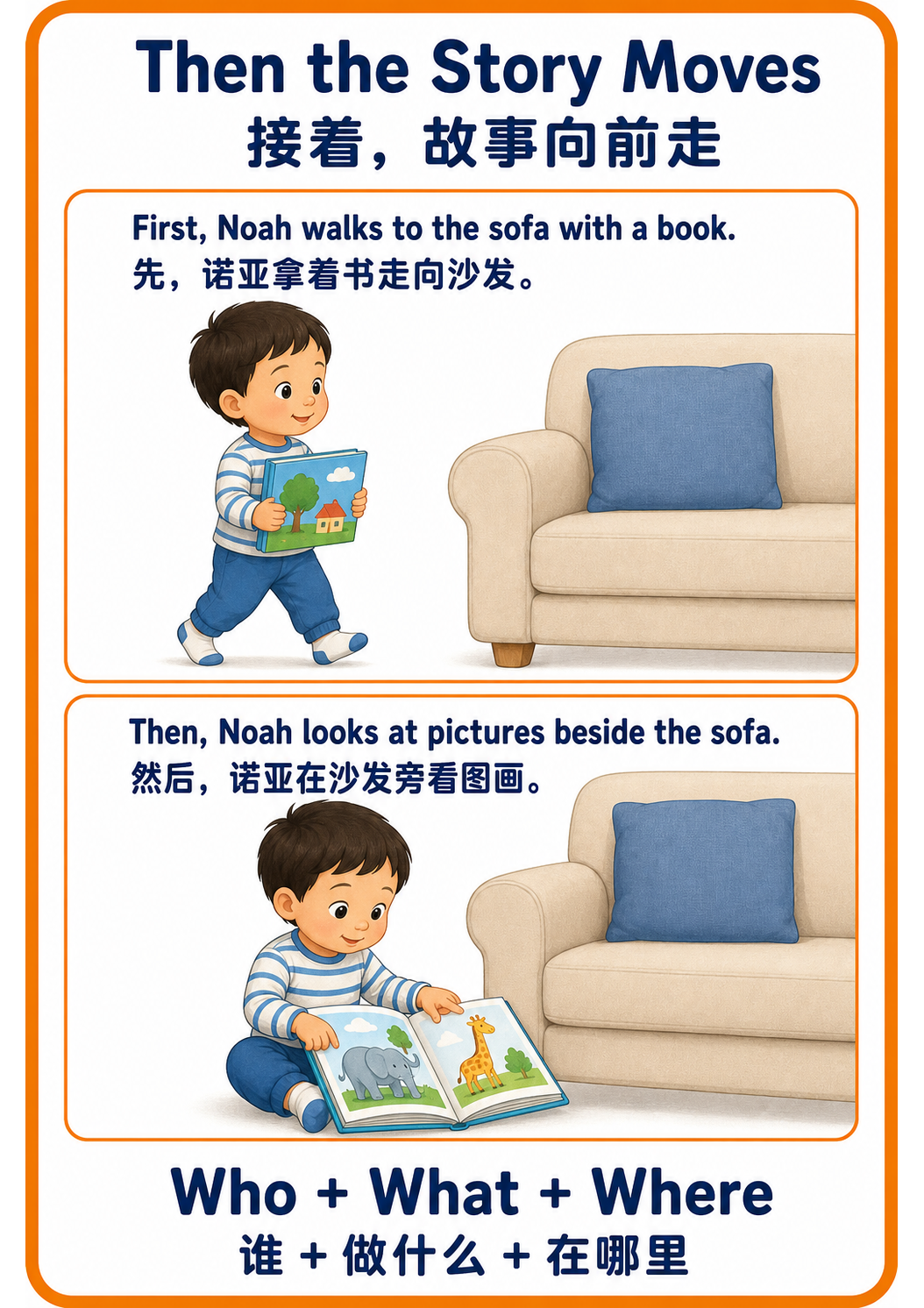
Open teaching poster 2 to download or print
Goals
- Chinese: hear an adult combine a person, action, and place into a tiny narrative.
- English: understand
Mia draws by the window. - Early maths: count one boat, two scarves, and three oranges only in the main poster's bottom strip.
- Narrative understanding: know that a small story can tell who, what happens, and where.
Materials
- Only the two A4 teaching pictures above, printed or displayed full-screen.
- The English audio below.
- No paintbrush, book, sofa, story cards, or other objects are needed.
1. Poster One: Build One Tiny Story Sentence
Time: 5–8 minutes.
Do not quiz. State what the poster shows: “谁?画面里是米娅。做什么?她在画画。在哪里?她在窗边。连起来就是:米娅在窗边画画。” The question marks help the adult organise language; they do not require Amara to answer.
She may notice the person, paintbrush, window, or whole sentence; point; say one word; stay quiet; pause; or decline. Do not lead her through a who–what–where question routine.
2. English Time
Time: 3–5 minutes.
Download today's English audio
Transcript: English time. Listen, look, or point. Who? Mia. What is she doing? Drawing. Where? By the window. Mia draws by the window. A short story can tell who, what happens, and where. One boat. Two scarves. Three oranges. All done.
Play it once. The audio immediately answers its own questions. Do not pause for Amara to answer.
| English | Chinese | Possible response |
|---|---|---|
Who? Mia. | 谁?米娅。 | Look at or point to the person, or stay quiet |
Drawing. | 在画画。 | Notice the action or say 画 |
By the window. | 在窗边。 | Look at the window, pause, or decline |
3. Poster Two: Let the Story Move
Time: 5–8 minutes.
Narrate from top to bottom: “先,诺亚拿着书走向沙发。然后,诺亚在沙发旁看图画。” The second picture still carries who, what, and where, while the story now has a small before-and-after change.
It is fine if Amara watches only one panel. Do not ask her to order, retell, or predict, and do not make attention to the second poster a condition of finishing.
4. Early Maths: 1, 2, 3
Time: 3–5 minutes.
Count only the separate bottom strip of main poster 1: one boat, two scarves, and three oranges. Point once to each complete object; ignore boat windows, scarf stripes, and orange leaves. Poster 2 has no counting task.
Language Note
Who, what, and where are supports for the adult's narration, not a required child-answer format. Real stories may also include time, cause, and feelings. Today focuses only on three elements that are easy to see in the pictures.
Bedtime Recall
- “Mia draws by the window.”
- “Noah carries a book towards the sofa and then looks at pictures beside it.”
- Say
A short story can tell who, what happens, and where.once, then finish.