
Comfort Can Look Different
Comfort Can Look Different
Today one A4 poster shows different forms of comfort: a wanted hug, sitting nearby, reducing sound or light, quiet company, or safe space. The goal is co-regulation, not making a child “stop crying now.”
Today's Approach
Amara is about 2 years and 8 months old. Keep each activity to 3–8 minutes. Looking, pointing, one word, quiet, pausing, or declining are valid. Do not quiz, correct, score, rank, reward, force repetition or performance, or require eye contact, a hug, or touch.
A4 Teaching Picture
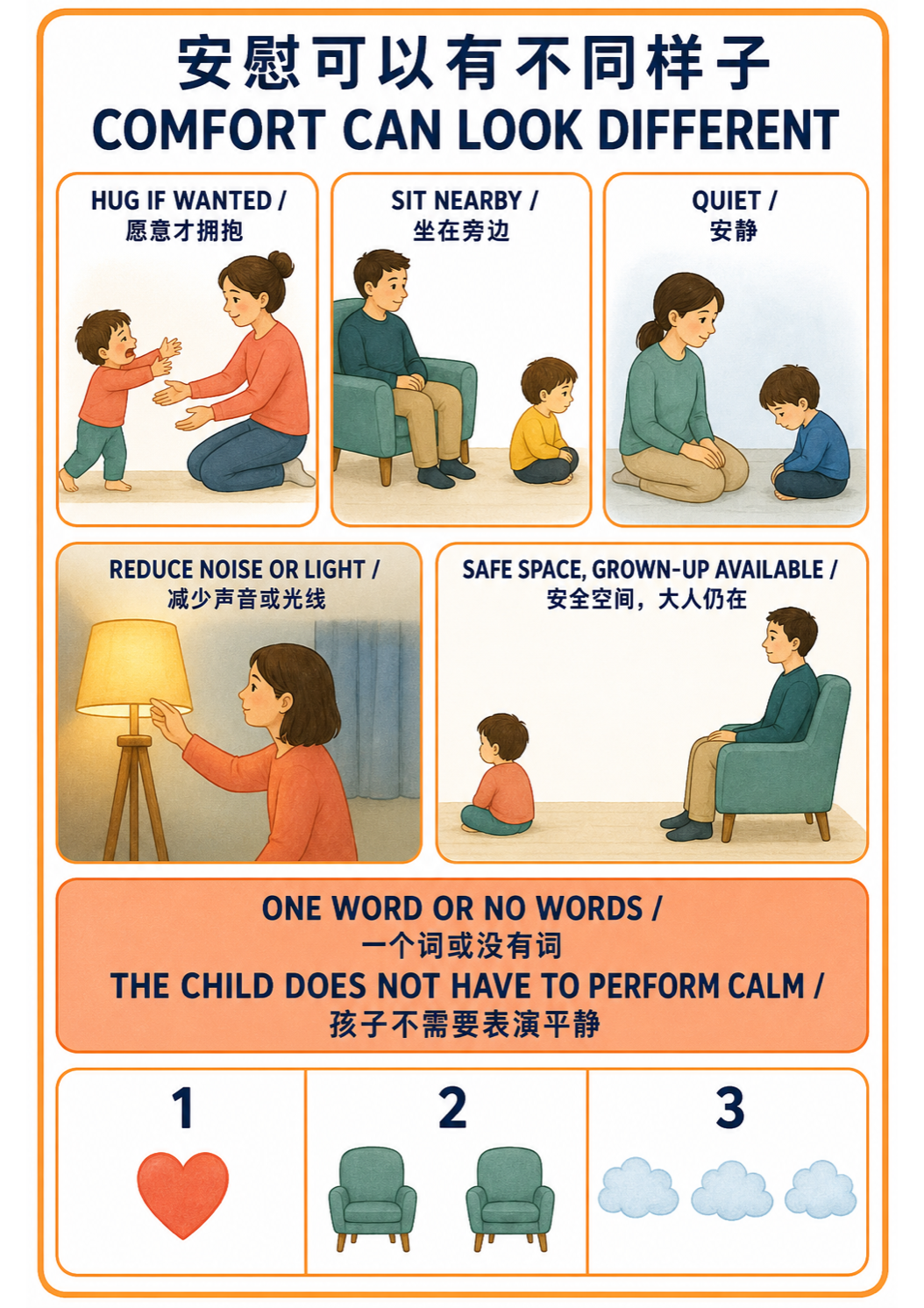
Open the original picture to download or print
Goals
- Chinese: meet “安慰、旁边、安静、少一点、空间.”
- English: meet
comfort,hug if wanted,sit nearby,reduce noise, andsafe space. - Emotion: understand that crying, turning away, becoming still, one word, or no words deserves a calm response.
- Relationship: adults help regulate the environment and body state; stopping tears is not a performance task.
Materials
- Only the A4 poster above, printed or displayed full-screen.
- The English audio below at a comfortable volume.
- No comfort toy, snack, or reward item. Do not create an emotional scenario or require hug practice.
1. Chinese Picture Talk
Time: 3–8 minutes.
Follow Amara's gaze and say, “想抱时可以抱;不想抱也可以。”“大人可以坐旁边、安静一点、减少声音和光线,或者给安全空间。”
Do not ask which method she “should” use when crying. She may watch one panel or choose none.
2. English Time
Time: 3–5 minutes.
Download the 29 December English audio
Transcript:
English time. Listen, look, or point. Comfort can look different. A hug is only for when the child wants it. A grown-up may sit nearby, stay quiet, reduce noise or light, or give safe space while remaining available. Crying, turning away, becoming still, one word, or no words all deserve a calm response. The grown-up helps the child's body settle. The child does not have to perform calm. One heart. Two quiet chairs. Three soft clouds.
| English | 中文 | Possible response |
|---|---|---|
comfort | 安慰 | Watch any panel or stay quiet |
hug if wanted | 愿意才拥抱 | Approach, move back, or not respond |
sit nearby | 坐在旁边 | Point to adjacent seats |
reduce noise | 减少声音 | Cover ears, turn, or stop audio |
safe space | 安全空间 | Watch the open circle or leave |
Any sign of discomfort takes priority over the audio. The adult reduces stimulation immediately.
3. Early Math: 1, 2, 3
Time: 3–5 minutes.
Count only the separate bottom strip: 1 heart, 2 quiet chairs, and 3 soft cloud shapes. Do not count people, chairs, or symbols above.
4. What the Adult Can Adjust
Time: 3–5 minutes.
Point to environmental actions and say, “声音少一点。”“灯光柔和一点。”“语言少一点。”“我在旁边,等你。” Describe one at a time without requiring breathing, counting, or emotion words.
A hug requires willingness. Moving back, stiffening, turning the head, or saying no means not to continue.
5. Co-Regulation and Developmental Boundary
Time: 3–5 minutes.
A two-year-old still depends on adult co-regulation. Crying or intensity is not manipulation or learning failure. Adults first check pain, hunger, thirst, fatigue, toileting, temperature, and sensory load, then offer steady presence.
Calm Is Not a Performance Goal
Do not say “stop crying to get a hug” or offer a reward for quiet. Do not force deep breathing, smiling, apologising, or immediate return to activity. For persistent distress, breathing difficulty, injury, altered awareness, or a health concern, stop learning and seek qualified medical help promptly.
Bedtime Recall
- “你想看旁边坐着,还是安静空间?”
- Say
I can stay nearby.once without requiring a response.