
Please Help, More, and All Done
Please Help, More, and All Done
Today introduces three short phrases that directly support everyday communication: please help, more, and all done. Speech is not the only route. Pointing, gestures, quiet, turning away, or leaving may also communicate a need; the adult watches and respects stopping signals.
Today's Approach
Amara is about 2 years and 8 months old. Keep each activity to 3–8 minutes. Looking, pointing, saying one word, staying quiet, pausing, or declining all count. Use only the poster and audio; do not ask for repetition, performance, eye contact, or touch.
A4 Teaching Picture
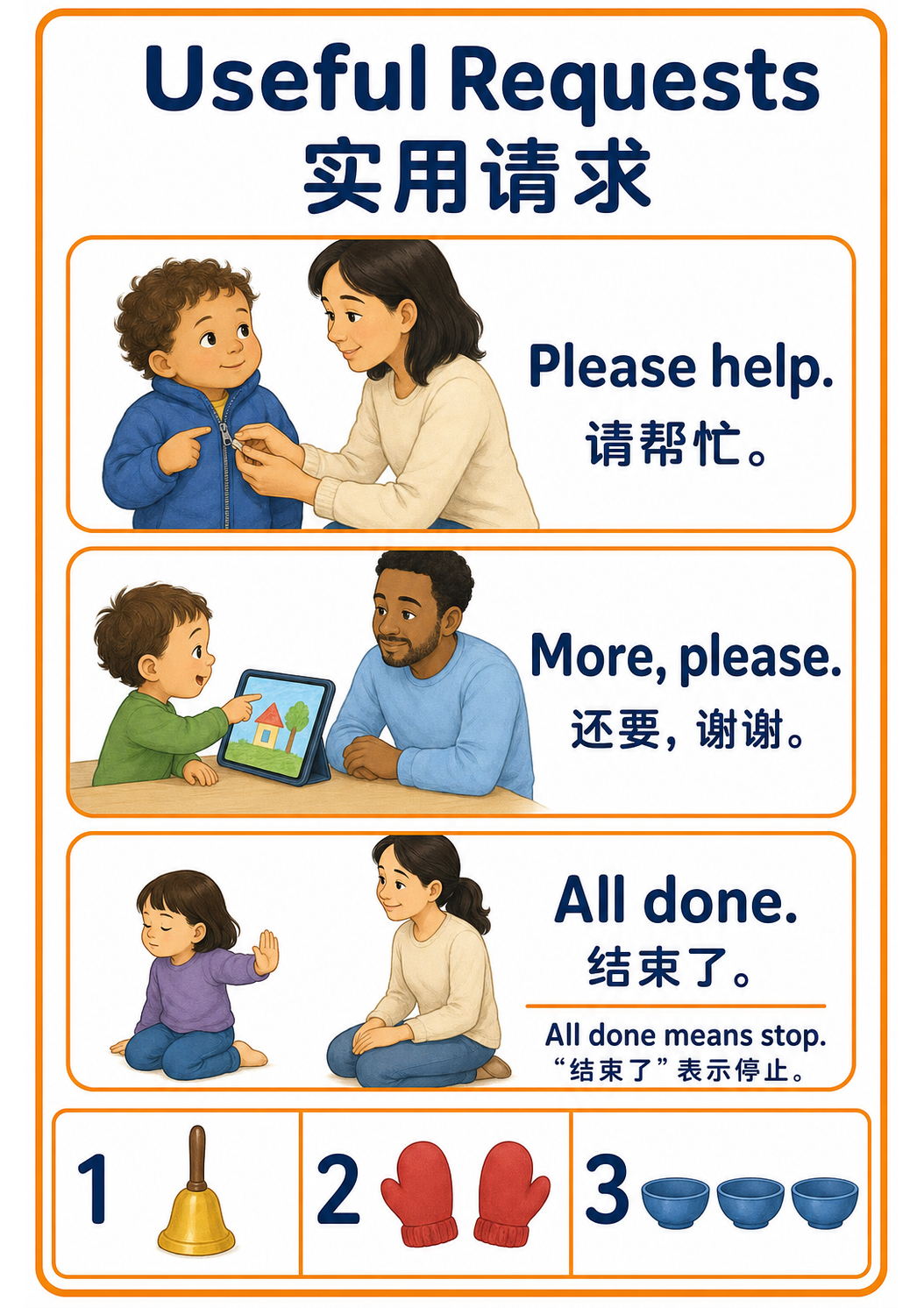
Open the teaching poster to download or print
Goals
- Chinese: understand “请帮忙、还要、结束了” in clear contexts.
- English: notice
Please help.,More, please., andAll done. - Early maths: count one bell, two mittens, and three bowls with one-to-one pointing.
- Autonomous communication: the adult recognises and respects verbal and nonverbal stopping signals.
Materials
- Only the A4 teaching picture above, printed or displayed full-screen.
- The English audio below.
- No food, toy, request card, bell, or other object is needed.
1. Chinese Picture Talk
Time: 5–8 minutes.
Describe the three contexts: “需要支持时,可以说‘请帮忙’。”“想继续时,可以说‘还要’。”“想停止时,可以说‘结束了’。” Then add, “不说话、转开或离开,也可能是在告诉我想停。”
Amara may look, point to a picture, say “帮,” “还要,” or “停,” stay quiet, turn away, or decline. Do not create a difficulty to force a request. Never make spoken words a condition for receiving care.
2. English Time
Time: 3–5 minutes.
Download today's English audio
Transcript: English time. Listen, look, or point. Please help. More, please. All done. Words or gestures can make a request. Quiet or moving away may signal stopping. When a child says or shows all done, the adult respects it and stops. One bell. Two mittens. Three bowls. English time is all done.
Play it once. The adult may point to each matching picture. Amara does not need to perform a request with these phrases.
| English | Chinese | Possible response |
|---|---|---|
Please help. | 请帮忙。 | Look, point, say 帮, or stay quiet |
More, please. | 还要,谢谢。 | Look, use one word or a gesture, or pause |
All done. | 结束了。 | Say 停, turn away, leave, or decline |
3. Early Maths: 1, 2, 3
Time: 3–5 minutes.
Count only the separate bottom strip: one bell, two mittens, and three bowls. Point to each complete object once; ignore the bell opening, mitten fingers, and bowl rims.
4. Requests, Care, and Boundaries
Time: 3–5 minutes.
The adult may model, “I see you turning away, so I will stop,” or, “You are pointing to the continue picture; I could say 还要.” Use “may” and “I see” to preserve uncertainty. If a signal is unclear, confirm gently without continuing to pressure.
Autonomy and Safety
“All done” and clear pushing away, avoiding, or leaving should be respected. The adult remains responsible in care or urgent-safety situations and explains briefly. Everyday learning must never withhold help, food, rest, or comfort because a child did not say a target phrase.
Bedtime Recall
- “Please help asks for support.”
- “More means continue; all done means stop.”
- Say
All done means we stop.once, and then genuinely stop.